
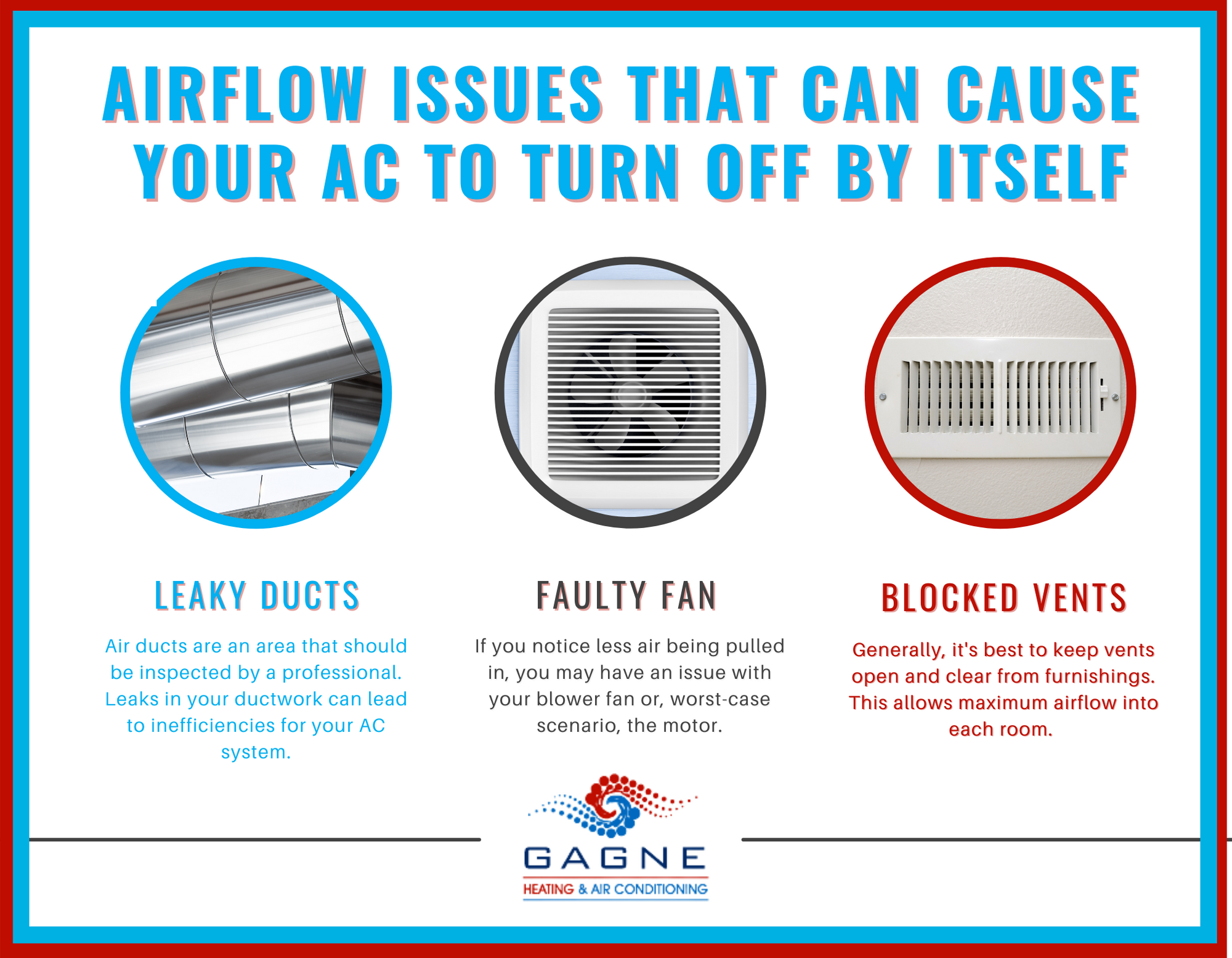
Image Source: gagneac.com
Why Does My Air Conditioner Turn Off By Itself? Solved!
Is your air conditioner playing hide-and-seek, turning on only to shut off again shortly after? This frustrating issue, where your ac keeps turning off after a few minutes or engages in what’s known as air conditioner short cycling, happens for several reasons. Often, it’s because a part of the system is struggling or a built-in HVAC system safety switch has activated to prevent damage. Problems can range from a simple dirty AC air filter or a clogged AC drain line to more complex issues like low refrigerant AC, an AC capacitor failure, a tripped circuit breaker ac, or even the thermostat shutting off ac due to a sensor problem or improper settings. Sometimes, it’s a sign your ac unit freezing up. Fixing it usually involves finding the root cause and addressing it directly, sometimes requiring a professional HVAC technician.
Fathoming the Problem: Why ACs Stop Unexpectedly
An air conditioner’s job is to cool your home and often remove moisture. It has many parts that must work together correctly. When one part fails or faces a problem, the system might stop working to protect itself from harm. Think of it like your body; if something isn’t right, it gives you a signal (like pain) or might just stop doing something strenuous to prevent injury. Your AC has similar built-in protections. These protections often cause the unit to turn off by itself.
Several common issues can trigger this behavior. Sometimes, it’s something easy to fix yourself. Other times, it needs a trained expert. Let’s look at the main reasons your AC might be quitting on you too soon.
Reasons Your AC Might Shut Off
There are many potential culprits when your air conditioner keeps turning off. Pinpointing the exact cause can take some detective work. Here are the most common reasons:
Thermostat Issues: The Control Center’s Troubles
Your thermostat is the brain of your cooling system. It tells the AC when to turn on and off based on the temperature. If the thermostat isn’t working right, it can send wrong signals, causing the AC to shut off unexpectedly.
- Wrong Settings: Maybe the thermostat is set to “FAN AUTO” instead of “COOL,” or the temperature setting is too close to the current room temperature. Check your settings first. Make sure it’s set to cool and the temperature is set lower than the current room temperature.
- Dead Batteries: Some thermostats use batteries. If they are low or dead, the thermostat might not communicate correctly with the AC unit, leading to sudden shutdowns. Change the batteries if yours uses them.
- Poor Location: If the thermostat is in direct sunlight or near a heat source (like a lamp or vent), it might think the room is warmer than it is. This could cause it to cool the area too quickly and satisfy the temperature setting too soon, leading to
air conditioner short cycling. The AC turns on, runs briefly, cools the air around the thermostat, shuts off, and then repeats this cycle. - Faulty Sensor or Wiring: The internal sensor that reads the room temperature might be broken. Or the wires connecting the thermostat to the AC system might be loose or damaged. A faulty sensor might think the room is cool enough when it’s not, causing the
thermostat shutting off aceven when you want it to run. This often requires a technician to fix.
Blocked Airflow: The System Can’t Breathe
Proper airflow is vital for your AC to work correctly. If air can’t move freely through the system, it causes problems that can make the unit turn off.
-
Dirty Air Filter (
dirty AC air filter): This is one of the most common reasons for AC problems. The air filter catches dust and dirt before air enters your system. If the filter is clogged, it blocks airflow over the evaporator coil (the part that gets cold). Reduced airflow means less warm air passes over the coil, and the cold air produced can’t move away efficiently.- How it causes shutoff: Blocked airflow makes the evaporator coil get too cold. This can cause moisture in the air to freeze onto the coil, leading to an
ac unit freezing up. A frozen coil blocks airflow even more. Many systems have a safety switch (HVAC system safety switch) that detects when the coil is too cold or when airflow is blocked, shutting the unit off to prevent damage. Also, reduced airflow can cause the outdoor unit to overheat because it’s working harder with less air moving through the system. Overheating can trigger a thermal overload safety switch in the compressor. - What to do: Check your air filter every month, especially during heavy use. Replace it if it looks dirty. This is a simple fix that prevents many issues.
- How it causes shutoff: Blocked airflow makes the evaporator coil get too cold. This can cause moisture in the air to freeze onto the coil, leading to an
-
Blocked Vents or Return Grilles: Furniture, curtains, or rugs blocking supply vents (where cool air comes out) or return grilles (where warm air is pulled in) restrict airflow in your home.
- How it causes shutoff: Similar to a dirty filter, blocked vents reduce the amount of air circulating through the system. This can lead to the coil freezing or the system overheating and triggering safety shutdowns.
- What to do: Make sure all supply and return vents are open and not blocked. Don’t close too many vents in unused rooms, as this can also disrupt airflow balance.
-
Dirty Evaporator Coil: Even with clean filters, the evaporator coil can get dirty over time. Dust and grime build up on its surface, reducing its ability to absorb heat from the air and restricting airflow.
- How it causes shutoff: A dirty coil is less efficient and contributes to freezing issues, leading to
ac unit freezing upand triggering safety switches. - What to do: Cleaning the evaporator coil is usually a job for a professional technician, though there are DIY coil cleaning sprays available. It’s often part of routine maintenance.
- How it causes shutoff: A dirty coil is less efficient and contributes to freezing issues, leading to
Drainage Problems: Water, Water Everywhere (Where It Shouldn’t Be)
As your AC cools the air, it also removes moisture. This water (condensate) collects on the evaporator coil and drips into a drain pan, then flows out through a drain line. If this drain line gets blocked, the water has nowhere to go.
- Clogged Drain Line (
clogged AC drain line): Algae, mold, sludge, and dirt can build up in the condensate drain line over time, creating a blockage.- How it causes shutoff: When the drain line is blocked, the drain pan fills up. Many modern HVAC systems have a float switch (
HVAC system safety switch) installed in the drain pan or line. When the water level rises too high, this switch activates and shuts off the entire AC system (or sometimes just the cooling cycle) to prevent water damage to your home. This is a common reason for theac keeps turning off after a few minutesor cycling on and off. - What to do: Check the drain pan for standing water. If it’s full, the drain line is likely clogged. You might be able to clear a minor clog with a wet/dry vacuum on the outdoor end of the drain line or by carefully pouring a small amount of vinegar or bleach (check your system’s manual first) into the drain opening near the indoor unit (often a T-shaped vent pipe with a cap). However, stubborn clogs might need professional help. Regular maintenance often includes cleaning the drain line to prevent this.
- How it causes shutoff: When the drain line is blocked, the drain pan fills up. Many modern HVAC systems have a float switch (
Refrigerant Issues: The Lifeblood of Cooling
Refrigerant (like Freon) is the chemical that absorbs heat from your indoor air and releases it outside. Your AC system has a specific amount of refrigerant; it operates in a closed loop, meaning the refrigerant isn’t used up like fuel. If the level is low, it’s because there’s a leak.
- Low Refrigerant (
low refrigerant AC): This is a serious problem. Low refrigerant doesn’t cool the air effectively.- How it causes shutoff: Low refrigerant pressure makes the evaporator coil get too cold because there isn’t enough refrigerant flowing through it to absorb heat properly. This almost always causes the
ac unit freezing up. A frozen coil triggers safety switches and leads to shutoff orair conditioner short cycling. Low refrigerant also makes the compressor work harder, potentially leading to overheating and triggering its safety switch. Furthermore, AC systems have low-pressure and high-pressure safety switches that shut off the unit if refrigerant levels fall too low or pressures become unsafe. - What to do: You cannot simply “top off” refrigerant. If it’s low, there is a leak. A technician must find and repair the leak before adding the correct amount of refrigerant. This requires special tools and handling due to environmental regulations. Never try to add refrigerant yourself. This is a job for a licensed professional.
- How it causes shutoff: Low refrigerant pressure makes the evaporator coil get too cold because there isn’t enough refrigerant flowing through it to absorb heat properly. This almost always causes the
Electrical Problems: The Power Struggle
Your AC system relies on electricity. Issues with power supply, wiring, or electrical components can cause it to shut down.
-
Tripped Circuit Breaker (
tripped circuit breaker ac): An AC unit, especially the outdoor compressor, draws a lot of power. If there’s an electrical surge, an overload, or a problem within the unit, the circuit breaker protecting that circuit will trip to prevent fires or damage.- How it causes shutoff: A tripped breaker cuts power to the unit, causing it to turn off completely and not come back on until the breaker is reset. If the breaker trips repeatedly, it’s a sign of a more serious electrical problem or an issue within the AC unit itself (like a failing motor or compressor drawing too much power).
- What to do: Check your electrical panel for a tripped breaker (it will be in the OFF position or somewhere in between ON and OFF). You can try resetting it by flipping it firmly to the OFF position and then back to ON. However, if it trips again immediately or frequently, DO NOT keep resetting it. This indicates a problem that needs professional diagnosis. Call an HVAC technician or electrician.
-
AC Capacitor Failure (
AC capacitor failure): Capacitors are electrical components that provide the necessary jolt of power to start motors (like the fan motor or compressor motor). There’s usually a start capacitor and a run capacitor.- How it causes shutoff: If a capacitor is weak or failing, the motor it serves might struggle to start, hum loudly without running, or start and then quickly stop. The compressor, in particular, requires a strong capacitor to get going. If it can’t start properly, the unit won’t cool, and safety features might prevent it from continuing to try, leading to shutoff or
air conditioner short cycling. - What to do: Faulty capacitors can be diagnosed and replaced by an HVAC technician. They are relatively inexpensive parts, but they store a high electrical charge and can be dangerous to handle without knowing what you’re doing.
- How it causes shutoff: If a capacitor is weak or failing, the motor it serves might struggle to start, hum loudly without running, or start and then quickly stop. The compressor, in particular, requires a strong capacitor to get going. If it can’t start properly, the unit won’t cool, and safety features might prevent it from continuing to try, leading to shutoff or
-
Loose or Damaged Wiring: Connections can loosen over time due to vibration or corrosion. Wiring can also be chewed by pests or damaged during other work.
- How it causes shutoff: Loose or damaged wires can interrupt power flow or cause short circuits, leading to erratic behavior, system failure, or tripping breakers. This can cause the unit to stop suddenly.
- What to do: Checking and fixing AC wiring is best left to a qualified technician due to the high voltage involved.
-
Motor Issues (Fan or Compressor): If the motor for the indoor fan, outdoor fan, or compressor is failing, it might overheat, draw too much power, or simply stop working.
- How it causes shutoff: Motors have thermal overload protection. If a motor overheats, its internal safety switch will shut it off. This can cause the entire unit to stop or cause other components to fail and trigger system-level safety shutdowns. A failing compressor, the heart of the system, will definitely cause the cooling to stop, and often the whole unit will shut down.
- What to do: Motor problems usually require diagnosis and replacement by an HVAC professional.
Safety Switches: The System’s Self-Preservation Mode
Modern AC systems have multiple safety switches (HVAC system safety switch) designed to protect expensive components from damage. When a problem occurs that could harm the system, a safety switch activates and shuts off the unit.
- Condensate Overflow Switch (Float Switch): As mentioned earlier, this switch detects rising water in the drain pan due to a
clogged AC drain line. It prevents water damage by shutting off the unit. - High/Low Pressure Switches: These switches monitor the refrigerant pressure in the system. If the pressure is too low (often due to
low refrigerant ACfrom a leak) or too high (due to blockages, overcharging, or extreme heat), the switch trips to protect the compressor and other parts. - Freeze Stat: This sensor detects if the evaporator coil temperature drops too low, indicating freezing (
ac unit freezing up) due to poor airflow or low refrigerant. It shuts off the compressor (though sometimes the fan might continue running) to allow the ice to melt, preventing damage. - Thermal Overload Switches: Motors and the compressor have internal thermal switches that shut them off if they overheat. This protects the motor windings from being burned out.
-
Time Delay Relays: Some systems have timers that prevent the compressor from restarting too quickly after shutting off (usually a 3-5 minute delay). Rapid cycling (short cycling) can damage the compressor. While not strictly a “shutoff” switch, it manages how the system turns back on after stopping, sometimes making it seem like it’s delayed in restarting.
-
How they cause shutoff: These switches detect specific dangerous conditions (like flooding, extreme pressure, freezing, or overheating) and interrupt power to relevant components or the entire system, causing it to turn off unexpectedly. This is often why the unit might run for a bit and then just stop.
- What to do: The presence of a tripped safety switch indicates an underlying problem. Resetting the switch might get the unit running temporarily, but the switch will likely trip again until the root cause (clogged drain, low refrigerant, dirty filter, etc.) is fixed. A technician is needed to diagnose which switch tripped and, more importantly, why it tripped.
Oversized AC Unit: The Problem of Too Much Power
While it seems counterintuitive, an AC unit that is too big for your home can cause it to air conditioner short cycling and turn off frequently.
- How it causes shutoff: An oversized unit cools the air very quickly. It satisfies the thermostat’s temperature setting before it has run long enough to properly remove humidity from the air. The thermostat tells the AC to turn off. The air temperature rises again relatively fast (especially if it’s humid), and the cycle repeats. The unit runs for only a few minutes at a time (
ac keeps turning off after a few minutes). - What to do: If your AC has always short cycled since it was installed, it might be oversized. Unfortunately, this is a fundamental design issue that can’t be easily fixed other than potentially replacing the unit with a properly sized one or sometimes adjusting blower speeds (though this has limited effect). Short cycling wears out components faster than normal operation.
The Dreaded Short Cycling: AC Keeps Turning Off After a Few Minutes
Let’s look closer at air conditioner short cycling. This happens when your AC turns on, runs for a very short period (maybe just a few minutes), and then turns off, only to repeat this cycle frequently.
- What it is: Instead of running for longer, steady periods to cool the house, the AC cycles on and off rapidly.
- Why it’s bad:
- Inefficient: The system uses the most energy when it starts up. Frequent starts waste energy.
- Poor Dehumidification: ACs need to run for a while to remove humidity. Short cycles leave the air feeling cold but clammy.
- Component Wear: Starting puts stress on electrical components (like capacitors) and the compressor. Frequent starts cause these parts to wear out much faster, increasing the risk of
AC capacitor failureor compressor failure.
- Common Causes of Short Cycling:
- Oversized AC unit (as discussed above).
- Thermostat issues (faulty sensor, poor placement, low batteries).
- Dirty air filter (
dirty AC air filter) leading to airflow problems and potentially freezing. AC unit freezing up(caused by dirty filter, low refrigerant, or blocked vents).Low refrigerant AC(causes freezing and pressure switch trips).- Dirty outdoor condenser coil (prevents heat release, causes overheating and high-pressure switch trips).
- Electrical issues (
AC capacitor failure, loose wiring) making it hard for the unit to start or run properly. Clogged AC drain lineactivating the float switch (HVAC system safety switch).- Compressor issues: A failing compressor might struggle to start or run, triggering its thermal overload switch.
If your AC is short cycling, don’t ignore it. It’s a sign something is wrong and needs attention to prevent more significant problems down the road.
Deciphering the Signs: What to Look For
When your AC turns off by itself, pay attention to what you see and hear. These clues can help figure out the problem.
- Is the indoor unit running? Is the fan blowing air? Is the air cold?
- Is the outdoor unit running? Is the fan spinning? Is the compressor making noise?
- Do you see ice? Check the pipes coming out of the indoor unit and the evaporator coil itself. Is there ice buildup (
ac unit freezing up)? - Do you see water? Check the drain pan under the indoor unit. Is it full of water? Is water leaking anywhere (
clogged AC drain line)? - Did you hear a click? Sometimes you can hear the thermostat click off or the circuit breaker trip (
tripped circuit breaker ac). - How long does it run? Does it run for a few seconds, a few minutes (
ac keeps turning off after a few minutes), or longer before stopping? Short run times point towards specific issues like short cycling, freezing, or safety switch trips. - What’s the temperature like? Is the air coming out cool at all? Does the temperature in the house drop? (
low refrigerant ACoften means little to no cooling). - When did this start? Did it happen suddenly, or has it gotten worse over time?
Taking Action: What You Can Check (And When to Call a Pro)
Before calling for service, there are a few simple things you can check safely.
Simple Checks You Can Do:
- Thermostat:
- Check the mode (should be COOL) and temperature setting (should be lower than room temperature).
- Make sure the fan is set to AUTO (or ON, but AUTO is typical for cooling cycles).
- Replace batteries if your thermostat uses them.
- Ensure nothing is blocking or directly heating the thermostat sensor.
- Air Filter:
- Locate your air filter (usually in the return vent or near the indoor air handler/furnace).
- Pull it out and check how dirty it is (
dirty AC air filter). Hold it up to the light; if you can’t see light through it, it’s time to replace it. - Replace a dirty filter with a clean one of the correct size and type.
- Circuit Breaker:
- Go to your electrical panel.
- Look for the breaker labeled for your AC unit (it might say “AC,” “Furnace,” or “Air Handler”).
- See if it’s in the tripped position. If it is, firmly push it to the OFF position, then push it back to the ON position.
- IMPORTANT: If the breaker trips again right away or frequently, stop resetting it and call a professional. This indicates an electrical problem or a fault within the unit.
- Airflow:
- Check that supply vents in rooms are open and not blocked by furniture or curtains.
- Check that return air grilles are not blocked.
- Drain Pan/Line:
- Locate the indoor unit. Find the drain pan under the evaporator coil.
- Look for standing water in the pan (
clogged AC drain line). - Look for the condensate drain line (usually a PVC pipe leaving the indoor unit, often with a T-shaped vent). If you see a safety switch (often looks like a small box or device on the pipe or in the pan), check if the pan is full enough to activate it.
- If you feel comfortable and have located the correct pipe, you might try to clear a minor blockage as mentioned earlier (wet/dry vac or small amount of vinegar/bleach carefully). If unsure, skip this step.
When to Call a Professional:
For most other issues, or if the simple checks don’t fix the problem, it’s time to call a qualified HVAC technician. You need a pro for:
- Diagnosing and fixing
low refrigerant ACissues (finding and repairing leaks, adding refrigerant). - Diagnosing
AC capacitor failureand replacing the capacitor. - Diagnosing and fixing electrical problems beyond a simple tripped breaker (bad wiring, motor issues).
- Dealing with a significantly
clogged AC drain linethat won’t clear easily. - Diagnosing why your
ac unit freezing up(could be airflow, refrigerant, or other issues). - Troubleshooting
thermostat shutting off acif battery replacement doesn’t help or you suspect wiring/sensor issues. - If your
air conditioner short cyclingpersists after checking basic airflow/filter issues. - Any time you feel uncomfortable or unsafe working on the unit. AC systems have high voltage and complex components.
Trying to fix complex issues yourself can be dangerous and might cause more expensive damage. Professionals have the tools, knowledge, and safety training to diagnose and repair these problems correctly.
Preventive Care: Avoiding Future Shutdowns
Regular maintenance is key to preventing your AC from turning off unexpectedly.
- Replace Filters Regularly: This is the easiest and most effective step you can take. Change them every 1-3 months depending on the filter type and how much you use your system.
- Clean Around the Outdoor Unit: Keep the area around the condenser unit free of grass clippings, leaves, dirt, and debris. This ensures proper airflow around the coil, helping it release heat efficiently and preventing overheating.
- Pour Vinegar Down the Drain Line: Periodically pouring a small amount (like 1/4 cup) of undiluted white vinegar into the condensate drain line (through the accessible vent, often a T-shaped pipe) can help prevent biological growth that causes clogs (
clogged AC drain line). - Schedule Professional Maintenance: Have an HVAC technician perform a tune-up once a year (ideally in the spring before the cooling season). They will clean coils, check refrigerant levels (
low refrigerant AC), inspect electrical components (AC capacitor failure), check the drain line, verify thermostat operation (thermostat shutting off ac), and look for any potential issues before they cause a breakdown or trigger aHVAC system safety switch. This also helps keep the system running efficiently and extends its lifespan.
Summary of Common Issues and Fixes
Here is a quick overview of the typical problems causing AC shutoff and the necessary action:
| Problem | Common Symptoms | Potential Cause | DIY Check/Simple Fix | When to Call a Pro |
|---|---|---|---|---|
| Thermostat Issue | AC doesn’t turn on when expected, short cycling. |
Wrong settings, dead batteries, poor location, faulty sensor | Check settings, replace batteries, relocate/shield stat. | If settings/batteries don’t fix it, suspected sensor/wiring |
| Dirty Air Filter | Poor cooling, reduced airflow, ac unit freezing up. |
Filter clogged with dust/dirt (dirty AC air filter). |
Check and replace the filter. | If freezing persists after filter change. |
| Clogged Drain Line | Water leak near indoor unit, full drain pan, shuts off. | Buildup in condensate drain line (clogged AC drain line). |
Check pan for water. Try wet/dry vac or vinegar (carefully). | If clog won’t clear or unsure how to access/clean. |
| Frozen Evaporator Coil | AC blows warm air, ice on indoor unit pipes (ac unit freezing up). |
Restricted airflow (filter, vents), low refrigerant AC. |
Check/change filter, open vents. Turn AC off to melt ice. | To diagnose underlying cause (airflow issue, low refrigerant). |
| Low Refrigerant | Poor cooling, ac unit freezing up, unit short cycles. |
Refrigerant leak (low refrigerant AC). |
None (cannot check level or add yourself). | Always requires a professional to find leak and recharge. |
| Tripped Circuit Breaker | Unit completely off, no power. | Electrical overload, short circuit, component failure. | Check electrical panel. Reset breaker once. | If breaker trips repeatedly. |
| Faulty Capacitor | Unit hums but doesn’t start, outdoor fan/compressor doesn’t run, short cycling. |
Failed start or run capacitor (AC capacitor failure). |
None (requires electrical testing). | Always requires a professional to test and replace. |
| Safety Switch Trip | Unit suddenly shuts off, often after running a bit. | Triggered by clogged AC drain line (float), low pressure, high pressure, freezing (HVAC system safety switch). |
Check for obvious triggers (full drain pan, ice). | To diagnose why the switch tripped and fix the root cause. |
| Short Cycling | AC runs for only a few minutes (air conditioner short cycling, ac keeps turning off after a few minutes). |
Oversized unit, dirty filter, low refrigerant, electrical issue, safety trip. | Check filter, vents, thermostat. See if pan is full or ice present. | If basic checks don’t solve it, or suspect unit size/complex issue. |
FAQ Section
Q: Is it bad if my AC keeps turning off every few minutes?
A: Yes, air conditioner short cycling or the ac keeps turning off after a few minutes is bad. It wastes energy, doesn’t cool or dehumidify your home properly, and puts extra stress on components, making them wear out faster.
Q: Why would a brand new AC unit short cycle?
A: A brand new unit might short cycle if it is oversized for your home. It could also have installation issues like incorrect wiring, improper refrigerant charge, or a miscalibrated thermostat. Check basics like the filter and thermostat settings first, but often a new unit problem needs the installer to fix it.
Q: Can a dirty AC air filter really cause the AC to turn off?
A: Absolutely. A dirty filter severely restricts airflow. This can cause the evaporator coil to freeze (ac unit freezing up). Ice buildup acts like an even bigger blockage. This triggers a HVAC system safety switch called a freeze stat, which shuts off the compressor to prevent damage. Restricted airflow can also cause the outdoor unit to overheat.
Q: How often should I replace my air filter to prevent problems?
A: Most standard filters should be checked monthly and replaced every 1 to 3 months. Thicker pleated filters (4 inches or more) can last longer, perhaps 6-12 months, but check the manufacturer’s recommendation. High usage or dusty conditions mean you should change it more often.
Q: My AC drain pan is full of water. Can I just empty it?
A: You can empty the water, but the pan filled up because the drain line is clogged AC drain line. Simply emptying the pan doesn’t fix the blockage, and it will fill up again. The AC likely turned off because a HVAC system safety switch was activated by the high water level. You need to clear the clog in the drain line itself.
Q: I think my AC is low refrigerant AC. Can I buy a can and add it myself?
A: No, absolutely not. Adding refrigerant requires specific knowledge, tools, and proper licensing due to environmental regulations. More importantly, if your refrigerant is low, it means there is a leak somewhere in the system. Simply adding more without fixing the leak is a temporary fix that is illegal, harmful to the environment, and will not solve the underlying problem. A professional must find and repair the leak and then add the correct amount of refrigerant.
Q: My circuit breaker for the AC tripped (tripped circuit breaker ac). Is it safe to just keep resetting it?
A: It’s safe to reset it once. However, if it trips again quickly or frequently, it means there is a problem causing an overload or short circuit. Continuously resetting it can damage the breaker, the wiring, or the AC unit itself, and poses a fire hazard. Call a technician immediately if the breaker keeps tripping.
Q: What does an AC capacitor failure sound like?
A: If the outdoor unit’s capacitor is failing, you might hear a humming or clicking sound from the unit, but the fan or compressor doesn’t start running. The unit might try to start multiple times and then shut off.
Q: What is an HVAC system safety switch?
A: It’s a device built into your AC system that monitors conditions like water levels, pressure, or temperature. If a condition becomes dangerous for the system or your home (like a clogged AC drain line causing water backup, or low refrigerant AC causing dangerous pressure), the switch automatically shuts off the system or a component to prevent damage. They are important protective features.
Q: Why does my AC run fine sometimes but ac keeps turning off after a few minutes at other times?
A: This can happen if the problem is intermittent or related to specific operating conditions. For example, a partial clogged AC drain line might only cause the pan to fill and trip the switch during long run cycles on humid days. A mild low refrigerant AC leak might only cause ac unit freezing up when the unit runs for extended periods. Electrical issues can also be intermittent.
Conclusion: Get to the Root of the Problem
An air conditioner that turns off by itself is more than just annoying; it’s a sign that something isn’t working right. Ignoring the issue, especially if it involves air conditioner short cycling, ac unit freezing up, or repeated tripped circuit breaker ac, can lead to more serious damage and expensive repairs down the road.
Start by checking the simple things you can access safely, like the thermostat settings, dirty AC air filter, and the circuit breaker. If those don’t solve the problem, or if you suspect issues like clogged AC drain line, low refrigerant AC, AC capacitor failure, or a tripped HVAC system safety switch, it’s always best to call a qualified HVAC technician. They have the expertise to correctly diagnose why your AC is shutting off and fix the underlying cause, restoring cool comfort to your home safely and effectively. Regular maintenance is your best defense against these unexpected shutdowns.