
Can you mount a TV in an RV if you can’t find studs? Yes, you absolutely can! RV walls are different from house walls. They are often thin and do not have strong wood studs everywhere like a home. This means you need special ways to put up a TV mount so it stays safe and secure while you are driving. This guide will show you how to put up your TV without using studs.
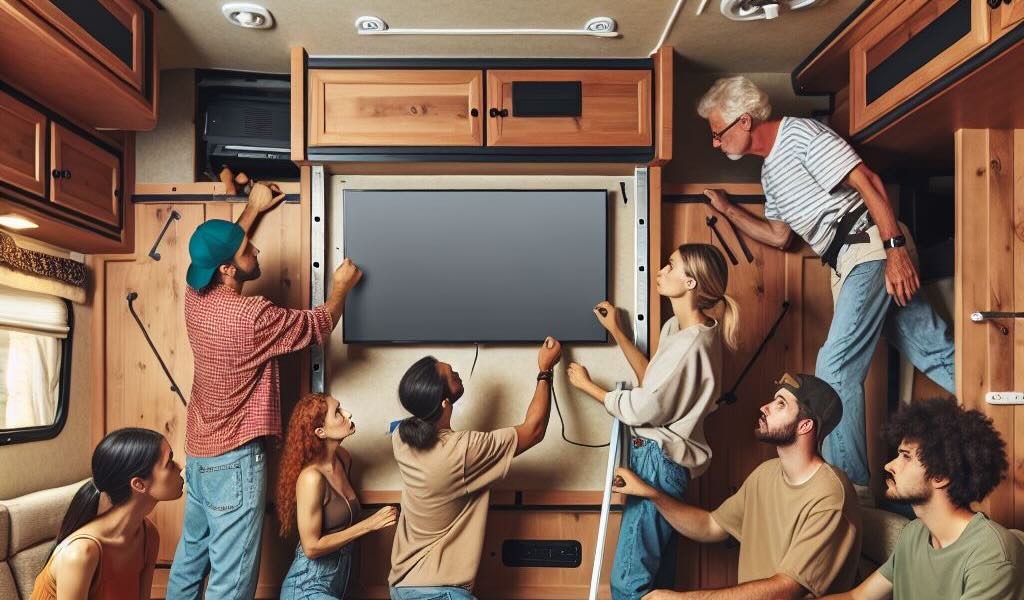
Image Source: custom-way.com
The Challenge Of RV Walls
RV walls are not built like walls in a home. They are much thinner. They use different stuff like thin wood panels, plastic, or fiberglass. Under the thin layer, there might be foam or just empty space. There are often no thick wood studs placed close together. This makes it hard to use the same tools you would use in a house. You need different tools and methods to make sure your TV stays on the wall, even when the RV is moving.
Grasping Why Studs Are Often Missing
In a house, studs are big pieces of wood inside the wall. They hold the walls up. You screw things into these studs to make sure they are strong. RVs are made to be light so they can be moved easily. Using less wood makes them lighter. So, RV walls have less wood or sometimes no wood studs where you want to put a TV. This means you cannot just drill anywhere and find a strong place to put screws. You need to find other ways to make a strong spot for your TV mount.
Finding The Right Spot For Your TV
Before you do anything, pick the best spot for your TV.
Think about these things:
- Can you see it well? Sit in your favorite chair. Where should the TV go?
- Is there space for the TV? Make sure the TV fits and does not block a door or window.
- Are there wires nearby? You need power for the TV. Is there an outlet close?
- How strong is the wall there? Tap on the wall. Does it feel very thin? Look on the other side if you can. What is there?
Some RVs have a place already marked for a TV. It might say “TV Backer.” This means there is a stronger piece of wood or metal inside the wall in that spot. If you have one, use it! This is the best place to use a secure TV mount without studs RV worries because the backer acts like a stud.
But what if there is no marked spot? Then you need to find a way to make any spot strong enough.
Methods For Mounting Without Studs
Since studs are often not there, you need special tools called anchors. Anchors go into the wall and spread out behind it. This makes a strong hold. Think of it like making a knot behind the wall.
There are many kinds of anchors. The best ones for RV walls are ones that can hold a lot of weight in thin material.
Using Heavy-Duty Wall Anchors
These anchors are made to hold heavy things on walls that are not strong. They are much better than simple plastic anchors you might use for a small picture.
Some types of heavy-duty RV wall anchors are:
- Toggle Bolts: These have a metal piece that folds up. You push the bolt with the metal piece through a hole in the wall. Once it is through, the metal piece springs open behind the wall. Then you tighten the bolt. The open metal piece presses against the back of the wall, making a very strong hold.
- Molly Bolts (or Sleeve Anchors): These are metal anchors that look like a screw with a metal sleeve around it. You put them in a hole. As you tighten the screw, the metal sleeve behind the wall squishes and expands. This makes it grip the wall tight from the back.
- Special RV Anchors: Some stores sell anchors made just for RV walls. These are often designed to work well in thin materials like the ones used in RVs. Looking for these can help you find the best anchors for RV walls.
Using these anchors is key for installing TV mount on hollow RV wall or thin paneling.
Mounting TV On Thin RV Paneling
RV walls are often made of thin wood paneling or a similar thin material. You cannot just screw a mount into this directly. It will pull right out, especially when the RV is driving.
To mount a TV on mounting TV on thin RV paneling, you must use anchors. Toggle bolts are often a very good choice for thin paneling because they spread the weight over a bigger area behind the wall.
Another way to help with thin walls is to add something to make the wall stronger where the mount goes.
Adding A Backing Plate
This is a very good way to make a weak spot strong. You can use a piece of plywood or a strong plastic board. Make it a little bigger than your TV mount.
How it works:
- Find the spot for the TV mount.
- Cut a piece of plywood or strong board.
- Put this board on the wall where the TV mount will go.
- Attach the board to the wall using many screws or strong anchors around the edges of the board. Use anchors that work with your wall type. This spreads the pull from the board over a bigger area.
- Now, attach your TV mount to the plywood board. You can usually just screw the mount right into the plywood. The plywood is strong, and it is held to the wall with many anchors.
This method is excellent for mounting TV on thin RV paneling. It gives the TV mount a strong, flat surface to grab onto, instead of just the thin wall. It makes the RV TV wall mount no studs problem much easier to solve.
Mounting TV On RV Fiberglass Wall
Some RV walls are made of fiberglass, especially outside walls or bathroom walls. Fiberglass can be strong, but it can also be thin.
If the fiberglass wall is thick and feels solid, you might be able to use special anchors made for fiberglass or boat hulls. These often look like large screws with wide threads or anchors that expand a lot.
If the fiberglass is thin, you will likely need to use toggle bolts or the backing plate method. The backing plate method works very well for mounting TV on RV fiberglass wall because it does not rely just on the fiberglass itself for strength.
Be careful when drilling into fiberglass. Use the right drill bits and go slow so you do not crack it.
Using Toggle Bolts For Mounting TV In RV
Toggle bolts are one of the most popular choices for mounting heavy things in RVs without studs. They are strong and work well in thin walls.
Here are the basic steps for using toggle bolts (we will cover full steps later):
- Drill a hole in the wall. The hole size depends on the toggle bolt you are using.
- Fold the metal toggle part flat against the bolt.
- Push the metal toggle part and the bolt through the hole.
- Once the metal toggle part is all the way through, it will spring open behind the wall.
- Pull back slightly on the bolt to make sure the metal toggle part is pressing against the inside of the wall.
- Now, you can attach your TV mount using the bolt. As you tighten the bolt, it pulls the mount tight against the wall, with the open toggle behind the wall holding it securely.
Toggle bolts are a great tool for a secure TV mount without studs RV.
Alternative RV TV Mounting Methods
Sometimes mounting on the wall, even with anchors, is not the best idea or is too hard. There are other ways to put a TV in your RV. These are called alternative RV TV mounting methods.
- Ceiling Mounts: You can hang a TV from the ceiling. RV ceilings often have more structure than the walls, or you can add a strong backing plate to the ceiling structure. Some ceiling mounts let you flip the TV up and out of the way when you are not watching it. You must make sure the ceiling spot is strong enough to hold the TV weight plus the stress of driving.
- Cabinet Mounts: Some mounts attach to the inside of a cabinet. The TV can pull out or swing out when you want to watch it and then be tucked back in. Cabinets often have stronger frames than the main walls.
- Countertop Stands: You can just place the TV on a stand on a counter or table. This is the easiest method, but the TV can fall when driving. You would need to put it away or secure it very well before moving.
- Portable Stands: Some stands sit on the floor. These can be moved around. Again, you need a plan for driving days.
- Adhesive TV Mount for RV: There are mounts that say they use strong sticky pads (adhesive) to hold to the wall. For a very small, lightweight TV (like a small kitchen TV), this might work if the wall surface is perfect and clean. However, for most TVs, especially bigger ones or TVs used while driving, an adhesive mount is NOT secure enough. The bumps and shakes of the road will likely make it fall. It is not a reliable way to get a secure TV mount without studs RV for your main viewing TV. Stick to anchors or backing plates for real security.
Choosing the right alternative RV TV mounting methods depends on your RV layout and how much work you want to do.
Selecting The Right TV Mount
Not all TV mounts are the same. For an RV, you need a mount that is not just strong but also keeps the TV tight against the wall when driving.
Types of mounts:
- Fixed Mount: The TV sits flat against the wall. It does not move. This is the most simple and often the most secure type for an RV because the TV is held tight and cannot swing around.
- Tilt Mount: Lets you tilt the TV up or down. Good if the mounting spot is high or low.
- Swivel/Articulating Mount: This mount has an arm that lets you pull the TV out from the wall and turn it side to side. These are great for watching TV from different spots. BUT in an RV, these mounts need to be very strong and have a way to lock the arm tightly in place for driving. If the arm is not locked, the TV will swing and bounce, which can damage the wall mount point or the TV. Look for RV-specific mounts with a strong locking pin or strap.
When choosing a mount, check:
- Weight Limit: Does the mount hold more weight than your TV?
- TV Size: Is the mount made for your TV’s screen size?
- VESA Pattern: The holes on the back of your TV match the holes on the mount. This is called the VESA pattern (like 100mm x 100mm). Check your TV manual.
- Locking Mechanism (for swivel mounts): How does it stay locked for travel?
For a secure TV mount without studs RV, a fixed or tilt mount is often the simplest and safest choice, as there is less movement possible. If you want a swivel mount, make sure it is a good quality one with a strong travel lock.
Getting Ready: Planning And Tools
Good planning makes the job easier and safer.
Measuring And Marking
- Hold the TV mount up to the wall where you want it to go.
- Use a pencil to mark where the screw or bolt holes are. Make sure the mount is level using a small level.
- Mark the center points of the holes clearly.
- Double-check the height and position. Can you reach the back of the TV? Is it in the right place to see?
Checking For Wires And Pipes
Before you drill, you MUST know what is behind the wall.
- Look on the other side of the wall if possible. Is there a bathroom, a cabinet, or the outside of the RV?
- Are there electrical outlets near? There might be wires in the wall.
- Are there water hookups nearby? There might be pipes.
- You can sometimes tap on the wall to listen for hollow spots or solid spots (like a backer if you have one).
- Use a stud finder if you have one, but know they do not always work well on thin RV walls. A wire/pipe finder tool might be more helpful.
- Drill a small test hole first if you are unsure. Drill only through the first layer of the wall. Use a flashlight to look inside before drilling a big hole.
Drilling into a wire can cause a fire or shock. Drilling into a pipe can cause a water leak. Take your time with this step.
Gathering Your Tools
You will need some tools:
- The TV mount and all its parts.
- Your TV.
- The right anchors (like toggle bolts, molly bolts, or RV-specific anchors). Make sure they are rated for the weight of your TV and mount.
- A drill and drill bits (check the anchor instructions for the right size bit).
- A level.
- A pencil.
- A screwdriver or a drill bit for driving screws/bolts.
- Maybe a stud finder or wire/pipe finder.
- Safety glasses.
- Maybe a second person to help hold things.
- If using a backing plate: plywood or strong board, screws/anchors to attach the board, saw to cut the board (or have it cut).
Step-By-Step: Installing With Toggle Bolts
This is a common way to get a secure TV mount without studs RV.
h4 Step 1: Mark The Mount Position
- Hold the TV mount on the wall where you want it. Use your level to make sure it is straight.
- Use a pencil to mark the center of each screw hole on the wall.
h4 Step 2: Drill Holes For The Toggles
- Check the instructions that came with your toggle bolts. They will tell you what size drill bit to use. It needs to be big enough for the metal toggle part to go through.
- Put on your safety glasses.
- Carefully drill a hole at each pencil mark. Drill straight into the wall. Clean away any dust.
h4 Step 3: Push Toggles Through The Wall
- For each hole, take a toggle bolt. Screw the bolt into the metal toggle part a little bit.
- Fold the metal toggle part flat against the bolt.
- Push the metal toggle part through the hole in the wall. You might hear it spring open on the other side.
- Pull back gently on the bolt. You should feel the metal toggle part pull against the back of the wall.
h4 Step 4: Position The Mount
- Line up the holes in your TV mount with the bolts sticking out of the wall.
- Slide the mount over the bolts.
h4 Step 5: Tighten The Bolts
- Add any washers that came with the mount or bolts, if needed.
- Begin tightening the bolts. As you tighten, the metal toggle part behind the wall will pull tight against the wall, making a strong grip.
- Tighten all the bolts evenly. Do not overtighten, as you could damage the wall, but make sure the mount is pulled tight against the wall and feels very solid. Use your level again to check it is still straight before fully tightening the last bits.
h4 Step 6: Attach The TV
- Now that the mount is strongly on the wall using the toggle bolts for mounting TV in RV, you can attach the pieces that go on the back of your TV.
- Attach these pieces to the back of your TV using the screws that came with the mount. Make sure they are tight.
- Carefully lift the TV and hook it onto the mount on the wall. Most mounts have a way to hook on and then maybe put a safety screw or clip to hold the TV on the mount.
Step-By-Step: Installing With A Backing Plate
This method adds strength and is great for mounting TV on thin RV paneling.
h4 Step 1: Choose And Prepare The Plate
- Get a piece of strong plywood or a similar board. Make it bigger than your TV mount base. Maybe 12×12 inches or larger, depending on your mount.
- Paint or cover the board so it looks nice on your wall. Let it dry fully.
h4 Step 2: Mark Plate Position On Wall
- Hold the board on the wall where you want the TV mount to go. Use a level to make sure it is straight.
- Lightly trace the edges of the board on the wall with a pencil.
h4 Step 3: Mark Anchor Points For The Plate
- Decide how you will attach the board to the wall. You will use screws with anchors around the edges of the board. Plan to use several anchors, maybe 6 to 10, depending on the board size, to spread the weight.
- Mark the spots for these anchors inside the area you traced for the board. Do not place them too close to the edge of the board.
h4 Step 4: Drill Holes For Plate Anchors
- Check the instructions for the anchors you are using (like toggle bolts, molly bolts, etc.). Use the correct drill bit size.
- Put on safety glasses.
- Carefully drill the holes at the marks you made for the anchors.
h4 Step 5: Attach The Backing Plate
- Place the backing plate over the holes you drilled.
- If using toggle bolts or similar anchors, push them through the plate first, then through the wall holes.
- Secure the backing plate to the wall using all your anchors. Tighten them until the plate is pulled tight and flat against the wall. This plate is now strongly attached to the thin wall by spreading the pull over many points.
h4 Step 6: Mark Mount Position On Plate
- Now that the board is firmly on the wall, hold your TV mount onto the board.
- Use a level to make sure the mount is straight on the board.
- Mark the screw holes of the TV mount onto the board with a pencil.
h4 Step 7: Attach The TV Mount To The Plate
- For most plywood or strong boards, you can screw the TV mount directly into the board using strong wood screws. You do not need anchors for this step because the board is your “stud.”
- Drill small pilot holes first (smaller than the screws) to make screwing easier and stop the wood from splitting.
- Screw the TV mount firmly onto the backing plate using the screws that came with the mount or strong wood screws of the right size.
h4 Step 8: Attach The TV
- Attach the pieces that go on the back of your TV using the screws that came with the mount.
- Carefully lift the TV and hook it onto the mount on the backing plate. Secure it with any safety screws or clips.
This method makes a very secure TV mount without studs RV and is good for mounting TV on thin RV paneling or mounting TV on RV fiberglass wall that feels weak.
Testing And Safety
Once the mount is up but before the TV is on it, give it a test.
- Gently but firmly pull on the mount. Does it feel solid? Does it move at all?
- If it feels loose, re-check your anchors. Did they open right? Are they tight?
- Once the TV is on, make sure any locking pins or straps on the mount are secured, especially if you have a swivel mount.
- Before driving, always check that the TV is locked in place. The bumps and turns on the road are the biggest test of your mount.
Other Places To Put Your TV
If putting the TV on a main wall feels too risky or hard, remember the alternative RV TV mounting methods:
- Inside a cabinet.
- From the ceiling.
- On a stand that you put away when driving.
These can be easier than trying to get a secure TV mount without studs RV on a weak wall.
Looking After Your Mount
Check your TV mount every few months.
- Look at the screws and bolts. Are they still tight?
- Does the mount still feel solid on the wall?
- If you have a swivel mount, does the lock still work well?
RV travel causes a lot of shaking. Checking your mount keeps your TV safe and stops damage to your wall.
Choosing The Best Anchors For RV Walls
When you need to mount something heavy like a TV on thin RV walls without studs, picking the right anchor is very important. Simple plastic anchors are not strong enough. You need anchors made for hollow or thin walls that can hold weight.
Here are some good choices often considered the best anchors for RV walls for a TV:
| Anchor Type | How It Works | Best For | Pros | Cons |
|---|---|---|---|---|
| Toggle Bolt | Metal bar flips open behind wall, pulls tight. | Thin walls, hollow walls | Very strong, spreads weight. | Needs a bigger hole, hard to remove cleanly. |
| Molly Bolt | Metal sleeve expands behind wall as screw tightens. | Thin to medium thick walls | Strong once set. | Can be tricky to set right, can spin. |
| Special RV Anchor | Designed for thin RV materials. | Specific RV panels | Can be easier to install in RVs. | Strength varies by type, might be less common. |
| Heavy-Duty Drywall Anchor | Strong plastic or metal anchors for drywall. | If RV wall is thicker than usual paneling | Stronger than simple plastic anchors. | May not hold enough weight on very thin walls. |
For most RV walls where there are no studs, toggle bolts are usually a top recommendation for a heavy-duty RV wall anchors for a TV. They provide excellent grip on the back of the thin wall.
Remember to always check the weight rating on the anchor package. Make sure the total weight your anchors can hold is much more than the weight of your TV and mount together. Using more anchors than the mount needs can also help spread the load and make it stronger.
Factors Affecting Security
Several things make your TV mount more or less secure when you have no studs:
- Weight of the TV: A heavier TV puts more stress on the mount and the wall. Pick methods that can hold the weight.
- Type of Mount: Fixed mounts are generally more secure for travel than swivel mounts that can swing. If you use a swivel mount, the travel lock is key.
- Wall Material: Thin paneling, fiberglass, or hollow walls all need different ways to secure the mount.
- Quality of Anchors: Using strong, reliable heavy-duty RV wall anchors made for hollow or thin walls is a must. Cheap anchors will fail.
- Right Installation: Drilling the right size holes, setting the anchors correctly, and tightening everything properly makes a big difference.
- Driving Conditions: Rough roads, sudden stops, and sharp turns put extra force on the mount. What works when parked might not hold up when driving. This is why making it very strong is so important for a secure TV mount without studs RV.
Summarizing Mounting Techniques
To review the main ways to handle RV TV wall mount no studs:
- Use Heavy-Duty Anchors: Especially toggle bolts or molly bolts that grip the back of the thin wall. Good for installing TV mount on hollow RV wall.
- Add a Backing Plate: Attach a strong board to the wall using many anchors, then screw the mount into the board. Great for mounting TV on thin RV paneling or mounting TV on RV fiberglass wall.
- Find a “TV Backer”: If your RV has a spot marked for a TV, use it! It has a strong piece behind the wall like a stud.
- Consider Alternatives: If wall mounting is too hard or risky, use ceiling mounts, cabinet mounts, or portable stands. Avoid adhesive TV mount for RV for anything other than maybe a very small, lightweight item.
No matter which method you choose, always:
- Check behind the wall before drilling.
- Use the right tools.
- Use anchors rated for enough weight.
- Test the mount before putting the TV on it.
- Secure the TV for travel.
By taking the time to plan and use the right tools and methods, you can safely install a TV in your RV even without finding traditional studs. Enjoy watching your favorite shows in your home on wheels!
FAQ – Answers To Common Questions
h4 Can I use regular drywall anchors in my RV wall?
Regular drywall anchors are usually made for thicker drywall found in houses. RV walls are much thinner. Regular anchors will likely not grip correctly and will not hold enough weight for a TV. You need anchors made for thin or hollow walls, like toggle bolts, or special RV anchors.
h4 How do I know what size toggle bolt to use?
The size of the toggle bolt needed depends on the weight of your TV and mount. Check the weight rating on the toggle bolt package. Make sure the total weight held by all your toggle bolts is much more than the weight of your TV and mount. The package will also tell you what size drill bit you need for the metal part of the toggle bolt to pass through the wall.
h4 What if I accidentally drill into a wire or pipe?
Stop drilling immediately. If it is an electrical wire, turn off the power to that part of the RV right away from the breaker box. Do not touch the wire. Call a qualified RV repair person or electrician. If it is a water pipe, turn off the water pump or main water supply. Call an RV repair person or plumber. This shows why checking behind the wall first is very important.
h4 Is an adhesive TV mount strong enough for an RV?
Generally, no. While adhesive can be strong for light items on a smooth, clean surface, the constant shaking, bumps, and temperature changes in an RV while driving will likely cause an adhesive mount to fail, leading to your TV falling. For a secure TV mount, you need mechanical fasteners like anchors or screws into a strong backing plate.
h4 Can I add a stud to my RV wall?
Adding a full wood stud inside an RV wall is usually a big job. It means taking the wall apart. A much easier and often better way is to add a strong backing plate to the surface of the wall where the mount will go. This plate acts like a strong, large stud on the outside, giving the mount a solid place to attach.
h4 How much weight can RV walls hold?
It depends a lot on how the wall is made and where you try to put weight. Thin paneling with nothing behind it cannot hold much weight at all by itself. But if you use the right anchors or add a strong backing plate, you can make a spot that holds enough weight for a TV. Always use mounting methods and anchors rated for more weight than your TV.
h4 How do I find a TV backer in my RV?
Some RV makers mark the spot where they put a stronger piece of wood or metal in the wall for a TV. Look for a sticker that says “TV Backer” or “Mounting Location.” If you can’t find a sticker, try tapping the wall. A backer board will sound and feel more solid than the empty space around it. You can also use a stud finder, but they are not always accurate on all RV wall types. Check your RV’s manual or call the RV maker if you can’t find information.
h4 Can I mount a TV outside my RV without studs?
Mounting a TV outside the RV adds even more challenges with weather and security. Some RVs have an outside TV mount location built-in, often with a strong backer. If not, you would need to add a very strong backing plate to the outside wall using methods similar to inside, making sure it is sealed perfectly against water. Many people use portable outside TV stands instead.
h4 What if my TV mount screws are too long for the RV wall?
If you are screwing into a backing plate, use screws that go almost all the way through the plate but do not hit anything behind it. If you are using anchors like toggle bolts, the bolt length is part of the anchor system. Do not use screws that are too long and might hit wires or go through the outer skin of your RV. Always check screw lengths and know what is behind the wall.
h4 Should I use nuts and bolts instead of anchors?
If you can reach behind the wall (for example, if the wall is part of a cabinet or closet), using nuts and bolts with large washers is a very strong method. The large washers spread the pressure on both sides of the wall. This is often stronger than anchors. However, you can only do this if you have access to the back of the wall. For most wall areas, you cannot reach behind, so anchors are needed.