
An RV fridge uses about 0.5 to 1.5 pounds of propane per day. This is a common range for most RV absorption refrigerators when running on propane. The exact amount changes based on many things.
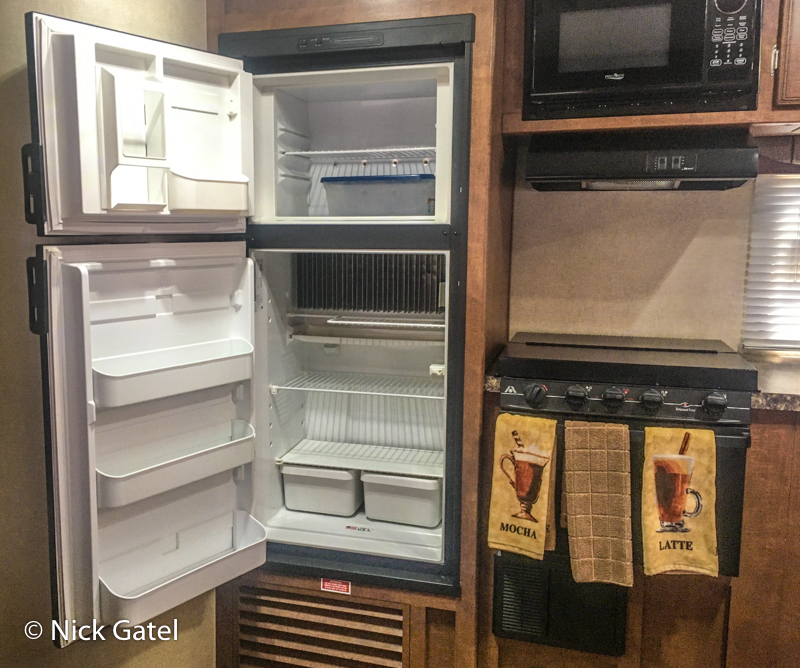
Image Source: popupbackpacker.com
Fathoming How Your RV Fridge Works
Most RV fridges are not like the one in your home. They are called absorption fridges. These fridges do not use a motor or a compressor like home fridges.
Instead, they use heat. This heat starts a cooling process. This process uses a mix of chemicals. The heat can come from two places. It can come from electricity. Or it can come from propane gas.
When you use propane, a small flame burns. This flame makes heat. This heat makes the cooling work. This is why these fridges use gas.
RV Absorption Fridge Power Source (Propane/Electric)
Your RV absorption fridge can run on two power types. It can use propane. It can also use electricity.
Most RVs let you choose the power source. Or the fridge picks one on its own. This is often called auto mode.
When you are plugged into shore power, it uses electricity. Shore power is like plugging into your house wall. This is often a 120-volt AC power source.
When you are not plugged in, it can use propane. It can also use 12-volt DC power. But the 12-volt power usually only runs the control board. It does not make the main cooling heat. The main cooling heat on 12-volt is less common. Some RV fridges have this option. But it uses a lot of 12-volt power. Most people use propane when not plugged in.
Using propane is good when you are not at a campground with power. It lets you camp off the grid. This is called boondocking.
RV Refrigerator Propane Consumption Rate: What to Expect
How much gas does an RV fridge use? This is the RV refrigerator propane consumption rate. It is not a single fixed number. It is more of a range.
A small RV fridge might use about 0.5 pounds of propane each day. A medium or large fridge might use 1 pound per day. Very large or old fridges might use 1.5 pounds or more per day.
A pound of propane is about 0.24 gallons.
So, a fridge using 1 pound a day uses about a quarter gallon a day.
This rate tells you how fast your gas tank will empty. Knowing this rate helps you plan your trips. It helps you know when you need more gas.
Propane Usage RV Refrigerator Per Day: Average Numbers
Let’s talk about the daily amount. How much gas does the fridge use in one day? This is the propane usage RV refrigerator per day.
For a typical medium-sized RV fridge (around 6-8 cubic feet):
– It might use about 0.8 to 1.2 pounds of propane per 24 hours.
Again, this is an average. Your fridge might use more or less.
Let’s use gallons too.
– 0.8 pounds is about 0.19 gallons.
– 1.2 pounds is about 0.29 gallons.
So, expect to use roughly a quarter gallon of propane each day. This is just for the fridge. Your RV uses propane for other things too. It heats water. It heats the inside air. It runs the stove or oven.
The fridge uses propane all the time it is running on gas. The heater and water heater turn on and off. This means the fridge uses propane more constantly than other things.
How Long Does RV Fridge Run on Propane?
People often ask, “How long does RV fridge run on propane?” This depends on your tank size. It also depends on how much gas your fridge uses daily.
RV propane tanks come in different sizes. Common sizes are:
– 20-pound tanks (like on a gas grill)
– 30-pound tanks
– Built-in tanks measured in gallons (like 20 gallons, 30 gallons, etc.)
A 20-pound tank holds about 4.7 gallons of propane.
A 30-pound tank holds about 7 gallons of propane.
A 20-gallon built-in tank holds about 80 pounds of propane (since 1 gallon is about 4.24 pounds).
Let’s do some math with common tanks. We will guess the fridge uses 1 pound of propane per day.
-
With a 20-pound tank:
- The tank has 20 pounds.
- The fridge uses 1 pound per day.
- 20 pounds / 1 pound/day = 20 days.
- A 20-pound tank might last about 20 days.
-
With a 30-pound tank:
- The tank has 30 pounds.
- The fridge uses 1 pound per day.
- 30 pounds / 1 pound/day = 30 days.
- A 30-pound tank might last about 30 days.
-
With a 20-gallon built-in tank (about 80 pounds):
- The tank has 80 pounds.
- The fridge uses 1 pound per day.
- 80 pounds / 1 pound/day = 80 days.
- An 80-pound tank might last about 80 days.
This table shows rough ideas:
| Tank Size (Pounds) | Gallons (Approx) | Fridge Use (Lbs/Day) | Days Tank Might Last |
|---|---|---|---|
| 20 | 4.7 | 0.8 | 25 |
| 20 | 4.7 | 1.0 | 20 |
| 20 | 4.7 | 1.2 | 16 |
| 30 | 7.0 | 0.8 | 37 |
| 30 | 7.0 | 1.0 | 30 |
| 30 | 7.0 | 1.2 | 25 |
| 80 (20 gal) | 18.8 | 0.8 | 100 |
| 80 (20 gal) | 18.8 | 1.0 | 80 |
| 80 (20 gal) | 18.8 | 1.2 | 66 |
This table assumes only the fridge is using gas. In reality, you use gas for other things too. So the tank will not last this long if you also use the heater or hot water often.
This shows the Propane tank life RV fridge in an ideal case.
Factors Affecting RV Fridge Propane Use
Many things can make your RV fridge use more or less propane. Knowing these helps you save gas. These are the factors affecting RV fridge propane use.
- Outside Temperature: This is a big one. If it is hot outside, the fridge works harder. It needs more heat to cool inside. More heat means more propane burned. In very hot weather, propane use can go up a lot.
- Inside Temperature Setting: How cold do you want your food? A colder setting makes the fridge work harder. It needs more heat. This uses more propane. Set it to a safe temp, but not colder than needed.
- How Often You Open the Door: Every time you open the fridge door, cool air escapes. Warm air gets in. The fridge must work harder to cool down again. Open the door quickly. Close it tight.
- How Full the Fridge Is: A full fridge stays cold longer. Food and drinks hold the cold. An empty fridge loses cold air faster. It has to run more often. Pack your fridge well, but do not block the vents inside.
- Fridge Venting: The fridge needs good airflow outside. It gets rid of heat this way. If the outside vents are blocked, heat builds up. The fridge cannot cool well. It runs longer and uses more gas. Make sure nothing blocks the outside vents. Check for dirt or insect nests.
- Age and Condition of the Fridge: An older fridge might not be as efficient. Seals around the door might be bad. This lets cold air out. The cooling unit itself might be less efficient. A well-maintained fridge works better. Check door seals often. Clean the cooling fins inside the fridge.
- Leveling the RV: Absorption fridges need to be level to work right. If the RV is not level, the chemicals inside the cooling unit cannot flow properly. The fridge will not cool well. It will try harder and use more gas. Always level your RV when using the fridge on propane.
- Starting Temperature of Food: Putting warm food or many warm drinks into the fridge makes it work hard. It has to cool them down. This uses extra gas. Try to cool food before you put it in the RV fridge.
These points show why the Absorption fridge propane usage can change daily.
RV Fridge Gas Consumption Comparison: Propane vs. Electric
Your RV fridge can run on propane or electricity. How does gas use compare to electric use? This is an RV fridge gas consumption comparison.
When the fridge runs on propane, it uses propane. That’s simple.
When it runs on electricity, it uses electric power. This can be:
– 120-volt AC power (like from shore power or a generator)
– 12-volt DC power (like from your RV batteries – less common for cooling, mostly controls)
The electric heater element uses power. It uses about the same amount of heat as the propane flame.
Using 120V AC power:
– A medium fridge might use about 200-300 watts of power.
– This power comes from shore power or your generator.
– It uses no propane.
Using 12V DC power (if your fridge supports it for cooling):
– This uses a lot of battery power. It might use 10-15 amps or more.
– This will drain your batteries very quickly if you do not have a way to charge them (like solar or your engine running).
– It uses no propane.
So, if you are plugged into shore power, use electricity. It saves your propane. Propane is harder to find and costs money. Electricity at a campground is often included in the fee.
If you are boondocking (no hookups), use propane. It uses gas, but it does not use a lot of battery power. Your batteries are needed for lights, water pump, etc.
Using propane lets your batteries last longer for other things.
Comparing the ‘cost’ of use:
– On shore power: Costs are usually part of campground fee. Very cheap cooling.
– On propane: You buy tanks or fill built-in tanks. The cost depends on propane price. Usually affordable daily cost.
– On 12V DC (for cooling element): Drains batteries fast. Needs lots of charging power (generator running a lot, big solar system). Can be costly in fuel for generator or setup cost for solar.
For most RVers off-grid, propane is the usual and best choice for the fridge’s main power.
Deciphering RV Fridge Efficiency Propane
How well does your fridge use propane? This is RV fridge efficiency propane. An efficient fridge uses less gas to stay cold.
Newer fridges are often more efficient. They have better insulation. Their cooling units are designed better.
Things that hurt efficiency:
– Bad door seals
– Blocked vents outside
– RV not level
– Old cooling unit
You can help your fridge be more efficient.
– Check and clean outside vents often.
– Make sure the RV is level when using propane.
– Keep the door seals clean and check they close well.
– Do not set the temp colder than you need.
– Pre-cool food before putting it in.
– Fill the fridge well, but allow air flow inside.
Some people add small fans inside the fridge. These fans move the cold air around. This helps keep the temperature even. This can help the fridge run less often. This might save a little gas.
Some people add fans near the outside cooling fins. These fans push more air over the fins. This helps the fridge get rid of heat better. This can also help efficiency, especially in hot weather.
Making your fridge more efficient helps your propane tank last longer. It means fewer trips to get more gas. It saves you money over time.
Estimate RV Fridge Propane Usage for Your Trip
You can try to guess how much propane you will need for a trip. This is how to estimate RV fridge propane usage.
First, think about how long your trip is. Let’s say it is a 10-day trip.
Next, guess how many days you will use propane for the fridge.
– If you are plugged in every night, you use 0 days of propane.
– If you boondock for 5 nights and are plugged in for 5 nights, you use 5 days of propane.
– If you boondock the whole time, you use 10 days of propane.
Let’s say you will use propane for 7 days.
Now, guess your fridge’s daily propane use. Use the average numbers we talked about. Or watch your own fridge for a few days.
– Is it a small fridge? Maybe 0.6 pounds/day.
– Is it a medium fridge in hot weather? Maybe 1.2 pounds/day.
– Let’s guess 1.0 pounds/day for a typical trip.
Total propane needed = Days using propane × Daily use rate
Total propane needed = 7 days × 1.0 pounds/day
Total propane needed = 7 pounds
Now look at your tank size.
– A 20-pound tank has 20 pounds. You need 7 pounds. You are good.
– A 30-pound tank has 30 pounds. You need 7 pounds. You are good.
What if your trip is 25 days and you boondock the whole time?
Total propane needed = 25 days × 1.0 pounds/day = 25 pounds.
– A 20-pound tank is not enough (you need 25, tank has 20). You will need to refill or have a second tank.
– A 30-pound tank is just enough (you need 25, tank has 30). It will be close!
This is a simple way to estimate. Remember, other gas uses add up.
Propane Tank Life RV Fridge: Planning Your Gas Needs
Knowing your Propane tank life RV fridge is key for long trips. Especially when you are not near places to refill.
We saw that a 20-pound tank might last about 20 days just for the fridge. A 30-pound tank might last 30 days.
But you use gas for other things!
– Heater (Furnace): Uses a lot of propane! If it is cold, the heater can use 0.2 to 0.5 gallons (0.8 to 2 pounds) per hour it runs. Running the heater overnight can use several pounds of gas. This cuts into fridge time fast.
– Water Heater: Uses propane to heat water. It uses gas only when heating. It turns off when the water is hot. This uses less gas than the furnace, but still adds up. Maybe 0.1 to 0.3 gallons (0.4 to 1.2 pounds) for a few showers’ worth of hot water per day.
– Stove/Oven: Uses very little gas. Cooking a meal might use only 0.1 to 0.2 pounds of gas. Baking an hour might use 0.3-0.5 pounds. This use is minor compared to the fridge or heater.
Let’s look at a more real-world example for tank life.
Assume you have one 30-pound tank (30 pounds gas).
You boondock for 7 days.
– Fridge: 1 pound/day × 7 days = 7 pounds.
– Heater: It gets cold at night. You use it 4 hours total per day (maybe 2 in morning, 2 at night). It uses 1.5 pounds/hour. 1.5 lbs/hour × 4 hours/day × 7 days = 42 pounds.
– Water Heater: You heat water for dishes and a quick shower each day. 0.5 pounds/day × 7 days = 3.5 pounds.
– Stove: Cook breakfast and dinner each day. 0.2 pounds/day × 7 days = 1.4 pounds.
Total gas needed for the trip: 7 + 42 + 3.5 + 1.4 = 53.9 pounds.
Your tank only has 30 pounds. You would run out of gas very quickly, mainly because of the heater.
This shows how fast the heater uses gas. If you are going somewhere cold, you will need much more propane.
If you do not use the heater or water heater much:
Assume you boondock for 7 days.
– Fridge: 1 pound/day × 7 days = 7 pounds.
– Heater: Off. 0 pounds.
– Water Heater: Only heat water once for a quick wash. 1 pound total.
– Stove: Cook breakfast and dinner each day. 1.4 pounds total.
Total gas needed: 7 + 0 + 1 + 1.4 = 9.4 pounds.
Your 30-pound tank is plenty for this trip.
This helps explain why Propane tank life RV fridge varies so much. It is not just the fridge. It is everything using gas.
Saving Money by Lowering Propane Use
Using less propane means spending less money. Here are ways to save gas with your RV fridge.
- Level Your RV: This is free and helps the fridge work right. Bad leveling wastes gas.
- Pre-Cool Before Trips: Turn the fridge on at home before you leave. Use electric power (shore power). Get it cold the day before. Put cold food in. This saves the gas you would use to cool a warm fridge and warm food.
- Use Electric Power When Available: Always use 120V AC power when you are plugged in. Do not run the fridge on propane at campgrounds with hookups. This is free energy (part of the campsite cost).
- Limit Door Openings: Think before you open the door. Get everything you need at once. Close it fast. Teach kids to do the same.
- Keep it Full (But Not Packed Tight): A full fridge holds cold better. Drinks in bottles or cans work well. Leave some space for air to move inside. Do not block the cooling fins.
- Check Door Seals: Clean the rubber seals around the door. Check for cracks or tears. If they are bad, replace them. Use the dollar bill test. Close the door on a dollar bill. If you can pull it out easily, the seal is bad there.
- Improve Venting: Make sure the outside fridge vents are clear. Clean out spider webs or nests. Consider adding small computer fans behind the outside access panel. These fans push air over the cooling coils. This helps the fridge cool better in hot weather. This can reduce how hard it works.
- Set Temperature Wisely: Do not set the fridge colder than needed. Most food is safe between 35°F and 40°F (about 1.7°C to 4.4°C). Use a fridge thermometer to check. Set it to keep food safe, not to freeze your milk.
- Monitor Propane Levels: Watch your gas gauge or weigh your tanks. Do not run out unexpectedly. Refilling sooner means less stress.
These tips help improve RV fridge efficiency propane and lower your overall Propane usage RV refrigerator per day. Saving gas is saving money.
Estimate RV Fridge Propane Usage for Different Settings
Let’s look closer at estimating use. How much gas do different fridges use?
Fridge size matters.
– Small fridge (3-4 cubic feet): Maybe 0.5 – 0.8 pounds/day.
– Medium fridge (6-8 cubic feet): Maybe 0.8 – 1.2 pounds/day.
– Large fridge (10-12 cubic feet): Maybe 1.0 – 1.5 pounds/day.
These are just guesses. Your specific fridge model and age change things.
Weather matters a lot.
– In cool weather (60s °F / 15-20°C): Use might be lower end of the range.
– In hot weather (80s+ °F / 27+°C): Use might be higher end of the range. Especially if the fridge side is in direct sun.
Let’s try to estimate for a 10-day boondocking trip with a medium fridge.
Scenario 1: Cool weather, level spot, not opening door much.
– Daily use: 0.8 pounds/day.
– Total needed: 0.8 lbs/day × 10 days = 8 pounds.
– A 20-pound tank is plenty (has 20 pounds).
Scenario 2: Hot weather, maybe not perfectly level, door opened often.
– Daily use: 1.2 pounds/day (or even more in extreme heat). Let’s use 1.2.
– Total needed: 1.2 lbs/day × 10 days = 12 pounds.
– A 20-pound tank is still enough (has 20 pounds).
– A 30-pound tank gives you more buffer (has 30 pounds).
This shows how much the daily rate changes. You can see the RV refrigerator propane consumption rate is not fixed.
To get a better estimate for your fridge:
1. Fill your propane tank fully.
2. Note the date and tank weight (if using portable tanks).
3. Use the fridge on propane for a few days, just like you would on a trip. Try to keep other gas use low.
4. After 3-5 days, turn off the gas and note the date. Weigh the tank again.
5. Calculate: (Starting weight – Ending weight) / Number of days = Average pounds per day for your fridge.
Example:
– Start weight: 37 pounds (weight of empty tank + 20 pounds gas)
– End weight after 4 days: 32 pounds
– Gas used: 37 – 32 = 5 pounds
– Days: 4
– Daily use: 5 pounds / 4 days = 1.25 pounds/day.
This gives you a personal RV refrigerator propane consumption rate. Use this number for your trip planning.
Maintaining Your Fridge for Better Gas Use
Taking care of your RV fridge helps it use propane well. Good maintenance means less Propane usage RV refrigerator per day.
What to check:
– Burner Assembly: The propane flame needs to burn clean. If it is orange or yellow, it is not burning right. It should be mostly blue. Spiders and insects love small dark places. They can build nests in the burner tube. This blocks gas flow. It makes the flame burn bad or not at all. Have this cleaned yearly. This is important for safety too.
– Chimney: Above the burner is a tube called the chimney. Soot can build up here. Soot stops heat from getting to the cooling unit properly. Clean the chimney regularly.
– Vents: Keep the outside access panel vents clean. Clear away leaves, dirt, or nests. Good airflow is key.
– Door Seals: Clean seals with soapy water. Check they are soft and seal all the way around the door. You can put a thin layer of petroleum jelly on them to keep them soft.
– Levelness: Always check your RV is level side-to-side and front-to-back when running on propane. Use a level. This is not just for comfort. It is needed for the fridge cooling process.
Proper maintenance makes your fridge more reliable. It also helps improve RV fridge efficiency propane. This saves gas and money.
Final Thoughts on Propane and Your RV Fridge
Your RV absorption fridge is great. It lets you keep food cold without needing electric hookups all the time. It uses propane to do this.
The amount of propane it uses varies. It is usually between 0.5 and 1.5 pounds per day. Many factors change this rate. Hot weather, how often you open the door, and how level you are all play a part.
Knowing your fridge’s typical RV refrigerator propane consumption rate helps you plan trips. You can estimate how long your propane tanks will last. Remember that your heater uses much more gas than the fridge.
By taking steps to improve RV fridge efficiency propane, you can use less gas. This saves money. It also means fewer stops to refill propane tanks.
Checking door seals, keeping vents clean, and leveling your RV are simple steps. They make a big difference.
Using electric power when it is available is the best way to save propane. Use shore power or a generator when you can. Save your propane for when you are off the grid.
Understanding how your fridge uses propane helps you travel smarter. You can enjoy your trips more knowing you have enough gas.
Frequently Asked Questions
h4 How much propane does an RV fridge use in an hour?
An RV fridge uses about 0.02 to 0.06 pounds of propane per hour. This is a very small amount hourly. We usually talk about daily use because it is easier to track.
h4 Does RV fridge use propane when driving?
Yes, if you set it to use propane, it will use propane while you drive. Most RVers do this. It keeps the food cold. Your RV engine running does not power the fridge for cooling. Your batteries might run the control board. But the main cooling heat usually comes from propane while driving. Make sure your propane system is safe to use while moving. Check local rules.
h4 Is it safe to run RV fridge on propane all the time?
Yes, RV absorption fridges are designed to run on propane for long times. As long as the system is in good repair and checked regularly, it is safe. Make sure you have working carbon monoxide and propane alarms in your RV. These are very important safety items.
h4 How can I tell how much propane is left?
Portable tanks (20lb, 30lb) can be weighed. An empty 20lb tank weighs about 17-20 pounds. A full one weighs about 37-40 pounds. Subtract the empty weight from the current weight. That tells you how much gas is left. Built-in tanks usually have a gauge outside the RV. These gauges are often not very accurate. They might show “full” until you are halfway empty. Then they drop fast. Weighing portable tanks is more accurate.
h4 Why does my RV fridge use so much propane?
If your fridge uses more propane than expected, check these things:
– Is it very hot outside?
– Is the RV perfectly level?
– Are the outside vents clean and not blocked?
– Are the door seals good?
– Is the propane flame burning clean (blue, not yellow/orange)?
– Is the fridge too full or too empty?
– Are you opening the door too often?
Fixing these issues can lower propane use.
h4 Can I run my RV fridge on 12V DC power?
Some RV fridges have a 12V DC option for cooling. But this uses a lot of battery power. It is often only meant for while driving, getting power from the engine alternator. Running it on 12V from just your house batteries usually drains them quickly. It is not a good option for long-term off-grid use compared to propane. Check your fridge model’s manual. Most absorption fridges use propane or 120V AC for the heating element. 12V DC usually just runs the control board.
h4 Does the size of my RV matter for fridge propane use?
The size of the fridge matters more than the size of the RV. A larger fridge has more space to cool. This needs more energy. A bigger RV might have a bigger fridge. But the RV size itself does not directly change how much gas the fridge uses. It might have larger propane tanks, though.