
A 65-inch TV is quite a bit bigger than a 55-inch TV, not just in the diagonal size listed on the box, but more importantly, in the total picture area you see. When you compare a 65 vs 55 inch TV size comparison, the 65-inch model has about 36% more screen space. This guide helps you see exactly how much bigger is 65 inch TV.
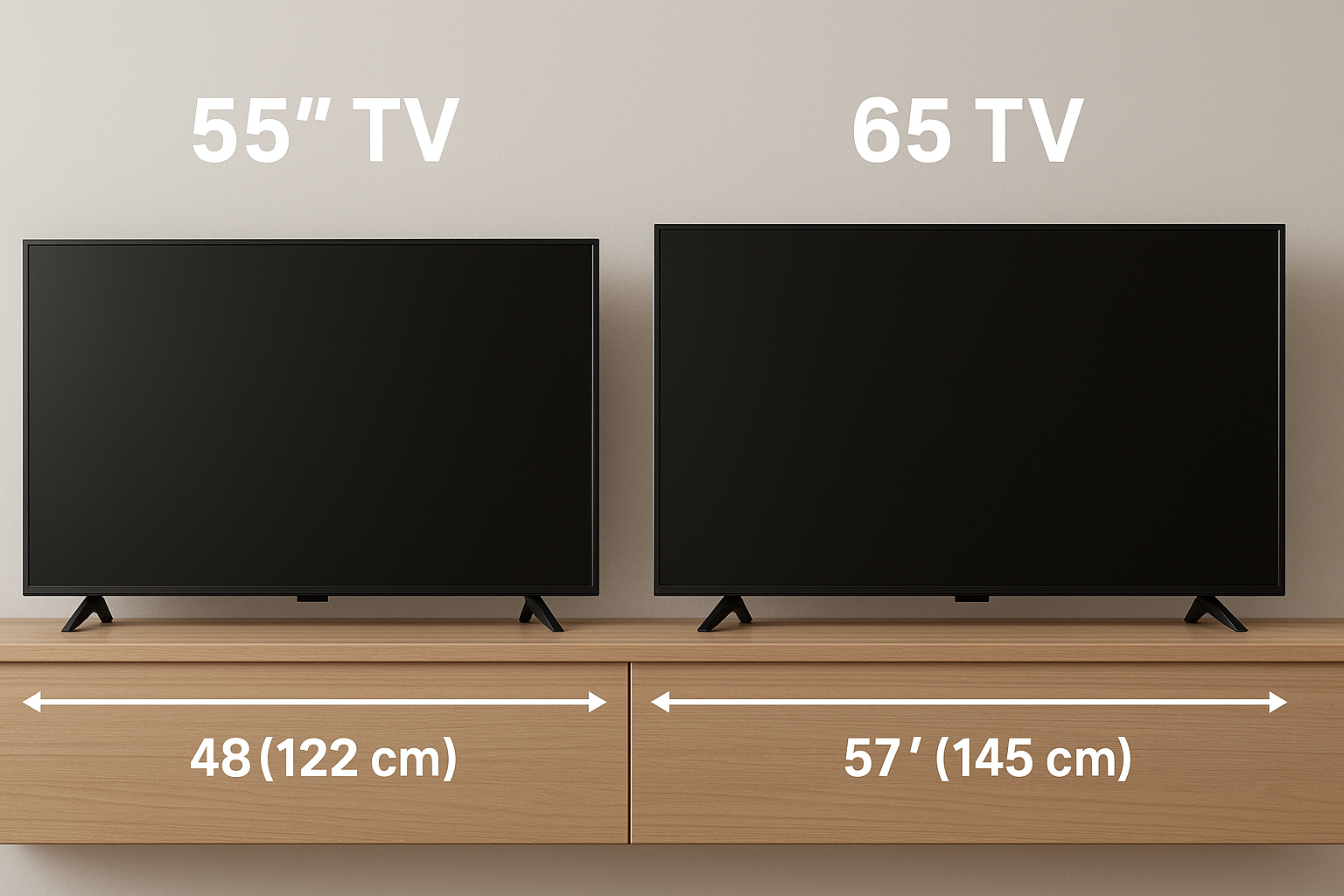
Image Source: innovativeprojector.com
What the Size Number Tells You
TVs have a size number. It is like 55 inches or 65 inches. This number is a measurement. It tells you how long a line is.
This line goes from one corner of the screen to the corner far away. It goes from the top left corner down to the bottom right corner. Or from the top right down to the bottom left. This is called the diagonal measurement.
A 55-inch TV has a diagonal line that is 55 inches long. A 65-inch TV has a diagonal line that is 65 inches long. This is a simple way to talk about size.
But this one number does not tell you everything. It does not tell you how wide the TV is. It does not tell you how tall the TV is. And it does not tell you the total space the picture takes up. That is the screen area.
The screen area is very important. It shows you how much of the picture you can see at one time. A bigger screen area means the picture fills more of your view.
So, while the diagonal number is a start, we need to look at other things too. We need to look at the width and height. We need to look at the total screen area. This gives a better idea of the real size difference.
Looking at the Diagonal Size Only
Let’s just look at the main size number first. We have a 55-inch TV. We have a 65-inch TV. The number is different. One is 55. The other is 65.
The difference in the number is 10. A 65-inch TV is 10 inches bigger on the diagonal line than a 55-inch TV.
This might seem like a small difference. Just 10 inches. But these 10 inches make a big change. They make a much bigger change than you might think at first.
Imagine you are drawing a box. The box is the screen. Now you make the diagonal line longer. You make it 10 inches longer. To do this, you have to make the box wider. You also have to make the box taller.
So, the screen gets wider. And the screen gets taller. It does not just get longer along one line. It grows in two ways. It grows out to the sides. It grows up and down.
This growth in two directions makes the total picture space much bigger. It’s not just a little bit longer in one direction. It expands everywhere.
So, the 10-inch difference in the diagonal is the start. But it leads to a much larger difference in the whole picture you watch. Let’s see how that happens.
The Total Space on the Screen
Think about a picture. It is flat. It takes up space. This space is the screen area difference 65 vs 55.
We measure this space in square inches. Or sometimes in square feet. It is like measuring the floor of a room. You measure how wide the room is. You measure how long the room is. Then you multiply these numbers. That gives you the area of the floor.
The screen of a TV is like a small room floor. It has a width. It has a height. If we know the width and height, we can find the screen area. We multiply the width by the height.
Screen Area = Width × Height
The diagonal size (55 inches or 65 inches) does not directly tell you the width and height. But TVs are made in a certain shape. This shape is called the aspect ratio. For most modern TVs, the shape is 16:9. This means for every 16 units of width, there are 9 units of height.
This 16:9 ratio helps us figure out the width and height if we know the diagonal. There is a math formula for it. But we don’t need to do the complex math here. We can just look at the results.
A 55-inch TV screen (with a 16:9 shape) is about 47.9 inches wide. It is about 27.0 inches tall.
To find the area, we multiply these numbers:
Area of 55-inch screen = 47.9 inches × 27.0 inches
Area of 55-inch screen = about 1293 square inches.
A 65-inch TV screen (with a 16:9 shape) is about 56.7 inches wide. It is about 31.9 inches tall.
To find the area, we multiply these numbers:
Area of 65-inch screen = 56.7 inches × 31.9 inches
Area of 65-inch screen = about 1809 square inches.
Now we can see the screen area difference 65 vs 55.
Area of 65-inch screen: 1809 square inches.
Area of 55-inch screen: 1293 square inches.
The 65-inch TV has much more area. It has 1809 minus 1293 square inches more area. That is 516 square inches more area.
516 square inches is a lot of extra space. It’s like adding a screen that is about 20 inches wide and 25 inches tall next to your 55-inch screen. But this extra space is added all around the picture, making the original picture bigger.
So, the 10-inch jump in the diagonal size leads to a big jump in the total picture area. This is why the 65-inch TV feels much bigger when you watch it. The picture is not just a little bit longer on the diagonal. It takes up much more space in front of you.
The Real Size of the TV
When you buy a TV, the screen size is just one part. The whole TV set is bigger than just the screen. It has a frame around the screen. This frame is called a bezel. It also has a stand or places to put a wall mount.
The overall size of the TV is important for fitting it in your space. This includes the 65 inch TV dimensions and 55 inch TV dimensions.
TV companies measure the full size of the TV including the frame. This size includes the width, height, and depth (how thick it is). The depth is less important for how big the picture looks, but it matters for how it sits on a stand or on the wall.
Let’s look at typical overall dimensions for both sizes. These numbers can be a little different depending on the brand and model of the TV. But they are usually close to these numbers for modern flat-screen TVs.
Typical 55 inch TV dimensions:
* Screen Diagonal: 55 inches
* Approximate Screen Width (viewable): 47.9 inches
* Approximate Screen Height (viewable): 27.0 inches
* Typical Overall TV Width (with thin frame): about 48 – 49 inches
* Typical Overall TV Height (with thin frame, without stand): about 28 – 29 inches
* Typical Overall TV Height (with stand): about 30 – 32 inches
* Typical Overall TV Depth (without stand): about 1 – 3 inches
* Typical Overall TV Depth (with stand): about 10 – 12 inches
Typical 65 inch TV dimensions:
* Screen Diagonal: 65 inches
* Approximate Screen Width (viewable): 56.7 inches
* Approximate Screen Height (viewable): 31.9 inches
* Typical Overall TV Width (with thin frame): about 57 – 58 inches
* Typical Overall TV Height (with thin frame, without stand): about 32 – 34 inches
* Typical Overall TV Height (with stand): about 35 – 37 inches
* Typical Overall TV Depth (without stand): about 1 – 3 inches
* Typical Overall TV Depth (with stand): about 10 – 13 inches
Look at the overall widths:
55-inch TV: 48 – 49 inches wide
65-inch TV: 57 – 58 inches wide
The 65-inch TV is about 9-10 inches wider overall than the 55-inch TV.
Look at the overall heights (without stand):
55-inch TV: 28 – 29 inches high
65-inch TV: 32 – 34 inches high
The 65-inch TV is about 4-6 inches taller overall than the 55-inch TV.
These overall dimensions are important for where you put the TV. Will it fit on your TV stand? Will it fit in the space on your wall? You need to check the exact dimensions of the specific TV model you want to buy. The frame size can be different between brands. Some have very thin frames. Some have slightly thicker frames.
So, the 65-inch TV is wider and taller in its physical form too. This means it takes up more space in your room. It is a bigger object, not just a bigger picture.
How the Picture Looks Different
Let’s think about the visual size difference 65 vs 55. How does it feel to watch a 65-inch TV compared to a 55-inch one?
The 65-inch screen is not just a little bigger. It feels much more impactful. The picture fills more of your vision. It draws you into the movie or show more.
Imagine sitting a certain distance from a 55-inch TV. The picture takes up some space in front of your eyes. Now, switch to a 65-inch TV from the same distance. The picture looks much larger. It seems to fill more of the wall in front of you.
This bigger picture can make watching movies feel more like being at a cinema. It can make playing video games feel more real. Sports events can feel like you are closer to the action.
The difference is not like adding a few inches to the side of the screen. It is like making the whole picture grow. It grows wider, and it grows taller at the same time.
Think of it like this: Imagine the 55-inch screen. Now, to make it 65 inches on the diagonal, you add size to all four sides. You add a strip to the left side, a strip to the right side, a strip to the top, and a strip to the bottom. These added strips make the total picture area much larger.
This is the visual size difference 65 vs 55. It’s about how much the picture fills your view. A 65-inch TV fills much more of your view than a 55-inch TV when you are sitting at a good distance.
It makes movies feel bigger. It makes games feel more real. It makes everything on the screen look larger and often more detailed, especially if you have a good picture source like 4K.
This jump in size often feels more significant than going from a 40-inch TV to a 50-inch TV, even though the diagonal difference is similar. This is because of how the area increases faster than the diagonal line.
How Much More Screen You Really Get
We looked at the screen area numbers before.
55-inch TV area: about 1293 square inches.
65-inch TV area: about 1809 square inches.
The 65-inch TV has 516 more square inches of screen.
Now, let’s think about this as a percentage. What is the percentage larger 65 vs 55 TV?
We can find the percentage increase by looking at how much bigger the 65-inch area is compared to the 55-inch area.
Increase in area = Area of 65″ – Area of 55″
Increase in area = 1809 – 1293 = 516 square inches.
Now, we compare this increase to the size of the smaller TV (the 55-inch).
Percentage increase = (Increase in area / Area of 55″) * 100%
Percentage increase = (516 / 1293) * 100%
Let’s do the math simply:
516 divided by 1293 is about 0.399.
Multiply by 100 to get the percentage: 0.399 * 100 = 39.9%.
So, a 65-inch TV screen has about 40% more screen area than a 55-inch TV screen.
Wait, earlier I said it’s about 36%. Let’s re-check the typical screen dimensions used.
Some sources use slightly different numbers for the width and height based on the diagonal and 16:9 ratio.
Diagonal (d) = 55 inches
Aspect Ratio 16:9
Width (w) = d * (16 / sqrt(16^2 + 9^2)) = 55 * (16 / sqrt(256 + 81)) = 55 * (16 / sqrt(337)) = 55 * (16 / 18.35) = 55 * 0.871 = 47.9 inches.
Height (h) = d * (9 / sqrt(16^2 + 9^2)) = 55 * (9 / 18.35) = 55 * 0.490 = 27.0 inches.
Area = 47.9 * 27.0 = 1293.3 square inches.
Diagonal (d) = 65 inches
Width (w) = 65 * (16 / 18.35) = 65 * 0.871 = 56.6 inches.
Height (h) = 65 * (9 / 18.35) = 65 * 0.490 = 31.85 inches.
Area = 56.6 * 31.85 = 1802.5 square inches.
Using these slightly more exact numbers:
Increase in area = 1802.5 – 1293.3 = 509.2 square inches.
Percentage increase = (509.2 / 1293.3) * 100% = 0.393 * 100% = 39.3%.
Okay, so the percentage is closer to 39% or 40%. Some common places round this and say “over 35% more screen area” or “around 36% more area”. The exact number depends on how the width and height are rounded. But the main point is clear: you get a lot more screen area. It’s not a small increase like 10% or 15%. It’s a very big increase, close to 40%.
This large increase in screen area is why the visual size difference is so noticeable. It’s why the 65-inch TV feels much bigger than the 55-inch one. It’s not just 10 inches longer on one line. It’s nearly 40% more picture space in total.
Where to Put the TV and How Far Away to Sit
The size of your TV should fit your room. It also affects how far away you should sit. This is called the recommended viewing distance 65 inch and 55 inch.
Sitting too close to a TV, especially a large one with a high resolution like 4K, can make the picture look less clear. You might see the individual pixels (the tiny dots that make the picture). Sitting too far away can make the picture seem small. You might miss details.
Experts suggest different distances. One simple rule is based on the TV’s size. For 4K TVs, you can sit closer than with older HD TVs because the picture is sharper.
A common suggestion for 4K TVs is to sit about 1 to 1.5 times the diagonal screen size away from the screen.
Let’s use this rule for our TVs:
Recommended viewing distance for a 55-inch 4K TV:
* Minimum distance (1x diagonal): 55 inches. 55 inches is about 4.6 feet.
* Maximum distance (1.5x diagonal): 55 inches * 1.5 = 82.5 inches. 82.5 inches is about 6.9 feet.
* So, for a 55-inch 4K TV, sitting between about 4.5 feet and 7 feet away is often good.
Recommended viewing distance for a 65-inch 4K TV:
* Minimum distance (1x diagonal): 65 inches. 65 inches is about 5.4 feet.
* Maximum distance (1.5x diagonal): 65 inches * 1.5 = 97.5 inches. 97.5 inches is about 8.1 feet.
* So, for a 65-inch 4K TV, sitting between about 5.5 feet and 8 feet away is often good.
You can see that for a 65-inch TV, you need to sit a bit further back than for a 55-inch TV. About a foot or more further back for comfortable viewing.
This means a 65-inch TV might be better in a larger room. If your room is small and your sofa is very close to where the TV will be, a 65-inch TV might be too big. It might feel overwhelming or you might sit too close.
If you have a medium to large living room, a 65-inch TV usually fits well and gives a great viewing experience from a typical sofa distance.
Think about your room size. Measure the distance from where you sit to where the TV will go. Use this to help you decide if a 65-inch TV is a good fit for your space.
Also, consider where the TV will sit. Does it fit on your stand? Is the wall space big enough if you hang it? Remember the overall dimensions we talked about.
A Quick Look Side-by-Side
Here is a TV size chart 65 vs 55. It puts the important numbers next to each other. This helps see the differences clearly.
| Feature | 55-inch TV | 65-inch TV | Difference |
|---|---|---|---|
| Diagonal Size | 55 inches | 65 inches | 10 inches longer |
| Approx. Screen Width | 47.9 inches | 56.6 inches | 8.7 inches wider |
| Approx. Screen Height | 27.0 inches | 31.85 inches | 4.85 inches taller |
| Approx. Screen Area | 1293 sq inches | 1802 sq inches | 509 sq inches more |
| Area Increase | Base size | ~39% more area | About 39% bigger area |
| Typical Overall Width | 48 – 49 inches | 57 – 58 inches | 9 – 10 inches wider overall |
| Typical Overall Height (without stand) | 28 – 29 inches | 32 – 34 inches | 4 – 6 inches taller overall |
| Recommended Viewing Distance (4K) | 4.5 – 7 feet | 5.5 – 8 feet | Sit about 1-1.5 feet further back |
This chart makes it easy to see the 65 vs 55 inch TV size comparison. The 65-inch is bigger in every way that matters for viewing and fitting the TV. The screen area difference 65 vs 55 is the most important part for how the picture feels.
Is a 65-inch TV Much Bigger Than a 55-inch?
Now, let’s answer the question directly: is 65 inch TV much bigger than 55?
Yes, a 65-inch TV is much bigger than a 55-inch TV.
It’s not just a little bit bigger. The 10-inch increase in the diagonal measurement leads to a significantly larger picture. We saw that the screen area is almost 40% larger.
This means the picture takes up much more space in your view. It can make watching things more immersive. It can feel like a major upgrade from a 55-inch TV.
Think about going from a standard photo print to a large poster. That kind of jump in size is similar to the feeling you get moving from a 55-inch to a 65-inch TV.
The word “much” can mean different things to different people. But based on the numbers (nearly 40% more screen area) and how people feel when they see the difference (more immersive, more impactful), most people would say that a 65-inch TV is indeed much bigger than a 55-inch one.
It’s usually the jump that makes the most dramatic visual difference in a typical living room setting, compared to smaller size jumps (like 40 to 50 inches, or 50 to 55 inches).
However, whether it’s “much bigger” in a way that is right for you depends on other things too. It depends on your room size, your budget, and your personal preference.
If you have a small room and sit very close, a 65-inch might feel too much bigger. If you have a large room and sit far away, the “much bigger” feeling of the 65-inch will be just right, or maybe you’d even want larger like 70 or 75 inches.
So, in terms of raw size and screen area, yes, it’s a substantial difference. It is definitely much bigger than a 55-inch TV.
Other Things to Think About
Besides the size, there are other points when choosing a new TV. These don’t change the size difference itself, but they are part of the decision.
- Picture Quality: Most 55-inch and 65-inch TVs sold today are 4K resolution. This means they have a very sharp picture. Larger screens like 65-inch show the details of 4K better, especially if you sit closer to the minimum recommended distance. High Dynamic Range (HDR) is also common now. HDR makes the bright parts brighter and the dark parts darker, with more colors. Both 55 and 65-inch TVs have HDR.
- Smart TV Features: Almost all new TVs are “smart TVs.” They connect to the internet. They have apps like Netflix, YouTube, and Disney+. You can stream movies and shows directly on the TV. The smart features are usually the same on a 55-inch and a 65-inch model from the same product line. The size doesn’t change the smart features.
- Price: A 65-inch TV costs more than a 55-inch TV of the same model and brand. The cost goes up as the size goes up. You need to decide if the extra cost for the bigger size is worth it for you. This is a key part of the 65 vs 55 inch TV size comparison.
- Sound: The sound quality can be different between TV models. Size doesn’t directly mean better sound, but larger TVs might have space for slightly bigger speakers. However, for the best sound, many people add a soundbar or a home theater system.
- Looks: The way the TV looks matters. How thin is the frame? What does the stand look like? Does it match your room? The 65 inch TV dimensions and 55 inch TV dimensions physically take up space and are part of your room’s look.
Thinking about these other things helps you choose the best TV for your needs and your home, after you decide on the right size.
Making the Right Choice
Deciding between a 55-inch and a 65-inch TV means thinking about a few simple things.
- Your Room Size: Measure the distance from your sofa to the TV spot. Check the recommended viewing distance 65 inch and 55 inch. Does a 65-inch TV fit well? Or is a 55-inch better for a smaller room? Also check the space for the TV itself using the 65 inch TV dimensions and 55 inch TV dimensions. Will it fit on your stand or wall space?
- How You Watch: Do you want movies to feel big and exciting? Do you play video games? If yes, the larger visual size difference 65 vs 55 and the extra screen area difference 65 vs 55 on the 65-inch TV can be a big plus. If you just watch news or shows from far away, maybe the size is less critical.
- Your Budget: The 65 vs 55 inch TV size comparison always includes price. How much are you willing to spend? Is the percentage larger 65 vs 55 TV screen area worth the extra money for you? Look at the prices of the specific models you like.
- The “Wow” Factor: Do you want the TV to be a big centerpiece? A 65-inch TV makes more of a statement than a 55-inch one simply because it takes up more visual space and has more screen.
There is no single “right” answer for everyone. Both 55-inch and 65-inch TVs are very popular sizes. They are both much larger than TVs from a few years ago.
For many living rooms, a 65-inch TV offers a much more immersive and enjoyable picture than a 55-inch, thanks to the significant increase in screen area. The difference is often more impactful than people expect just looking at the diagonal numbers.
Use the TV size chart 65 vs 55 and the information on viewing distance and dimensions to help you see the real difference.
If you can, go to a store to see a 55-inch TV and a 65-inch TV side-by-side. Stand at a distance similar to how you would sit at home. This is often the best way to see how much bigger is 65 inch TV visually and decide which size feels right for your eyes and your room. Seeing the visual size difference 65 vs 55 in person is very helpful.
Remember, the jump from 55 inches to 65 inches is a big step in screen area. It makes a real difference in how movies, sports, and games look and feel. It makes the picture nearly 40% bigger. That is a lot of extra picture to enjoy.
Choosing the right size is key to being happy with your new TV for many years.
Frequently Asked Questions
h5 Is a 65 inch TV much bigger than a 55 inch TV?
Yes, a 65-inch TV is much bigger in terms of screen area. It has about 39% more screen space than a 55-inch TV.
h5 What is the actual screen area difference between a 65 and 55 inch TV?
A 65-inch TV has a screen area of about 1800 square inches. A 55-inch TV has a screen area of about 1290 square inches. The difference is about 510 square inches, which is about 39% more area on the 65-inch TV.
h5 What are the typical dimensions of a 65 inch TV?
A typical 65-inch TV screen is about 57 inches wide and 32 inches tall. The whole TV unit (with frame) is usually about 57-58 inches wide and 32-34 inches tall without a stand.
h5 What are the typical dimensions of a 55 inch TV?
A typical 55-inch TV screen is about 48 inches wide and 27 inches tall. The whole TV unit (with frame) is usually about 48-49 inches wide and 28-29 inches tall without a stand.
h5 How far away should I sit from a 65 inch 4K TV?
For a 65-inch 4K TV, it is often suggested to sit between about 5.5 feet and 8 feet away for a good viewing experience.
h5 Does 10 inches diagonal make a big visual difference?
Yes, adding 10 inches to the diagonal size of a TV screen (like from 55 to 65 inches) makes a very big visual difference because the screen area increases by a much larger amount (almost 40%). The picture looks much larger and more impactful.
h5 Should I get a 55 or 65 inch TV?
Deciding between a 55 and 65-inch TV depends on your room size, how far you sit from the TV, your budget, and how much you want the picture to fill your view. A 65-inch is great for larger rooms and a more cinematic feel if you have the space and budget. A 55-inch is better for smaller rooms or if you sit closer. Check the viewing distance guidelines.