
How many amps does an RV air conditioner use? It changes. A standard RV AC might pull 15 to 20 amps while running. But it needs much more, sometimes 50 to 70 amps or even more, just to start. The size of the AC unit, if it has a soft start, and how old it is all change these numbers. Knowing your RV AC power draw is key to using your RV’s electrical system safely.
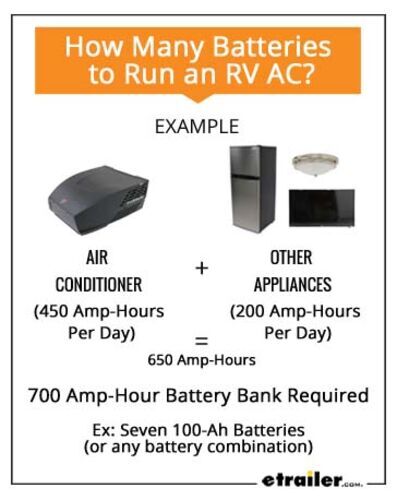
Image Source: www.etrailer.com
Grasping Why Amps Matter
Amps tell you how much electricity something is using right now. Think of it like water flowing through a pipe. Amps are the amount of water flowing. Volts are the water pressure. Watts are the total power, like how much work the flowing water can do.
This matters a lot for your RV. Your RV can only handle so much power at one time. This limit comes from where you get power:
* The power pole at a campground (shore power).
* Your generator.
* The wires and parts inside your RV.
If you try to use too many amps, it’s like trying to push too much water through a small pipe. You can blow a fuse or trip a circuit breaker. This stops the power.
Your RV air conditioner is one of the biggest power users in your RV. So, knowing its amp use is really important. It helps you figure out:
* Can you run the AC on your generator?
* Can you run the AC and other things at the same time?
* Why did the power suddenly shut off? (Maybe your RV AC circuit breaker tripped).
The Two Kinds of Amps
An RV air conditioner doesn’t use the same amount of power all the time it is on. It uses a lot for a short time when it first starts. Then it uses less power steadily as it runs.
Running Amps: Steady Power Use
Running amps are the amps your AC uses once its motor is going and it is cooling normally. It needs a steady amount of power to keep working.
This number is much lower than the starting amps. It is the number you care about for how much power the AC uses over time.
Typical Running Amps:
* 13500 BTU RV AC amps: Usually between 12 and 16 amps.
* 15000 BTU RV AC amps: Usually between 14 and 17 amps.
These numbers can be a bit different based on the brand, the exact model, and how well the unit is working.
Starting Amps: The Big Jolt
Starting amps are the amps your AC needs for just a moment when it turns on. The AC unit has a part called a compressor. The compressor is like a small engine that pumps the stuff that makes air cold.
Starting this “engine” takes a lot of power. It needs a quick, big surge of electricity to get moving from a stop. This is why starting amps are so much higher than running amps. This surge lasts for just a second or two.
The name for this big power need to start a motor is often called LRA, which means Locked Rotor Amps. It shows the most amps the motor might pull when it is trying hard to start.
Typical Starting Amps (without a soft start device):
* 13500 BTU RV AC amps: Often between 40 and 60 amps.
* 15000 BTU RV AC amps: Often between 50 and 70 amps, sometimes even 80 amps.
See the big difference? A unit that runs on 15 amps might need 60 amps just to start! This big jump is the main challenge for RV power systems, especially generators.
Comparing RV AC Sizes
RV air conditioners come in different sizes. The size is often measured in BTUs (British Thermal Units). BTU tells you how much heat the AC can remove from the air. More BTUs means more cooling power, and usually, more power use.
The two most common sizes in RVs are 13500 BTU and 15000 BTU.
13500 BTU RV AC Amps and Power
This is a common size for smaller RVs. It is also used sometimes as a second AC unit in larger RVs.
- Running Amps: Typically 12 to 16 amps.
- Starting Amps: Typically 40 to 60 amps (without a soft start).
- RV air conditioner wattage (Running): To find the power in watts, you can use a simple math idea: Watts = Volts x Amps. In an RV, power is usually around 120 volts. So, if a 13500 BTU AC uses 15 running amps at 120 volts, the wattage is 120 x 15 = 1800 watts. This is its RV air conditioner wattage when running steadily.
- RV air conditioner wattage (Starting): The starting wattage is much higher for a moment. If it needs 60 amps to start at 120 volts, that’s 120 x 60 = 7200 watts! This high number only lasts for a very short time.
15000 BTU RV AC Amps and Power
This is a larger size. It is used in bigger RVs or in places where it gets very hot. A 15000 BTU unit cools a larger space better than a 13500 BTU unit.
- Running Amps: Typically 14 to 17 amps.
- Starting Amps: Typically 50 to 70 amps or even more (without a soft start).
- RV air conditioner wattage (Running): Using the same math (Watts = Volts x Amps), if a 15000 BTU AC uses 16 running amps at 120 volts, its running wattage is 120 x 16 = 1920 watts.
- RV air conditioner wattage (Starting): The starting wattage surge can be very high. If it needs 70 amps to start at 120 volts, that’s 120 x 70 = 8400 watts for that brief moment.
As you can see, both sizes use similar running amps. But the 15000 BTU unit often has a slightly higher starting amp need. This is a key part of its RV AC power draw.
What Changes How Many Amps Your AC Uses?
The numbers above are typical. But the actual amps your RV AC uses can change a bit based on several things:
Outside and Inside Heat
If it is very hot outside and inside, your AC has to work harder to cool the air. When it works harder, it might pull slightly more running amps.
How Old or Clean the AC Is
An older AC unit might not be as efficient. If the coils that cool the air are dirty or clogged with dust, the AC has to work harder. This can make it use more running amps. Keeping your AC clean helps it run better and use less power.
Voltage Level
This is important. RVs use 120-volt power. But sometimes, especially at busy campgrounds, the voltage at the power pole can drop a little.
If the voltage goes down (say, to 110 volts or even lower), the AC motor needs to pull more amps to do the same amount of work. Think of it like needing more effort when the path is uphill. Lower voltage means higher amp draw for the same cooling power. Low voltage can damage your AC motor over time.
Ductwork and Airflow
If your RV’s air vents or return air filter are blocked, the AC can’t move air easily. This makes the motor work harder, which can slightly increase the running amps. Make sure your filters are clean and vents are open.
Deciphering the Amp Tag
You can often find the exact power needs for your specific RV AC unit on a label. This label is usually on the unit itself, maybe under the main cover on the roof or inside the air return grill inside the RV.
Look for a sticker or plate. It should list:
* The brand and model number.
* The BTU size.
* The voltage (V).
* The running amps (sometimes called RLA – Running Load Amps).
* The starting amps (sometimes called LRA – Locked Rotor Amps).
Checking this tag gives you the real numbers for your unit.
Managing the High Starting Amps
The biggest challenge with RV AC power draw is the large spike in starting amps. This spike can be too much for smaller generators or limited power hookups.
The RV AC Soft Start Solution
A great way to handle the high starting amps is to add a device called an RV AC soft start.
- What it is: A soft start kit is a small device. You install it inside your RV air conditioner unit.
- How it works: Instead of sending all the power to the compressor at once, the soft start sends power in a controlled way. It ramps up the power slowly over a few seconds.
- What it does: This gets the compressor motor spinning smoothly without the big power jolt. It dramatically lowers the starting amps needed. Instead of needing 60 amps for a moment, a soft start might help the AC start using only 15 to 20 amps.
Benefits of an RV AC soft start:
* Lowers Starting Amps: This is the main benefit.
* Allows Running on Smaller Generators: With a soft start, you might be able to start a 13500 BTU AC on a 2000-watt inverter generator. Without it, this is often not possible.
* Easier on Your Electrical System: The AC starts more smoothly, which is less stress on your generator, wires, and circuit breaker.
* May Allow Starting Multiple ACs: If you have two ACs and a 50 amp RV, soft starts on both might allow you to start them on a single larger generator that couldn’t handle two huge starting surges at once.
Adding an RV AC soft start is a popular upgrade for RVers who want more flexibility in where they can use their AC, especially when using generators or limited power.
Generator Needs for RV AC
If you plan to run your RV air conditioner using a generator, you need to pick the right size generator. This mostly depends on the AC’s starting amps.
Sizing Your Generator Right
Generators are rated by the power they can make. This is shown in watts. They usually have two watt numbers:
* Running Watts: The power they can make steadily.
* Starting Watts (or Peak Watts): The power they can make for a short moment to start a motor.
You need a generator that can handle the starting wattage of your AC, not just the running wattage.
Remember Watts = Volts x Amps. If your AC needs 60 starting amps at 120 volts, it needs 7200 starting watts for a second. A generator needs to be able to provide this quick burst of power.
-
Without a Soft Start:
- A 13500 BTU AC needing 60 starting amps (7200 watts) will likely need a generator with at least 3000 to 3500 starting watts. A 3000-watt running / 3500-watt starting generator is often the smallest that can start one RV AC without a soft start.
- A 15000 BTU AC needing 70 starting amps (8400 watts) might need a generator with 3500 to 4000+ starting watts. A 3500-watt running / 4000-watt starting generator or larger is a safer bet.
-
With a Soft Start:
- If a soft start lowers the starting amps to 15-20 (1800-2400 watts), a 2000-watt inverter generator (which often has a starting peak above 2000 watts) can likely start and run a 13500 BTU AC.
- A 2400-watt or 2500-watt inverter generator might be able to start a 15000 BTU AC with a soft start installed.
Always check the generator’s peak wattage rating and compare it to your AC’s potential starting wattage (especially after a soft start is installed). This is key for figuring out the correct Generator size for RV AC.
More Than One AC Unit
If your RV has two AC units (common on 50 amp RVs), running both at the same time without soft starts needs a very large generator, often 5000 watts or more. The challenge is starting both compressors if they both try to start at the same time.
With soft starts on both units, you might be able to start and run both on a smaller generator, maybe a 3500-watt or 4000-watt model, depending on how well the soft starts work and what else is running.
Shore Power and Circuit Breakers
When you plug your RV into power at a campground (shore power), you are using the campground’s electricity. The amount of power you can use is limited by the hookup.
30 Amp vs 50 Amp RVs
- 30 Amp Service: Many smaller and older RVs have 30 amp electrical service. This means the main circuit breaker for the RV is 30 amps. You can only use a total of 30 amps from all your appliances at one time.
- 50 Amp Service: Most larger and newer RVs have 50 amp service. This is different from a 50 amp breaker. A 50 amp RV plug actually has two separate 50 amp lines of power, usually 120 volts each. So, a 50 amp RV can actually use up to 100 amps total (50 amps on each side). This allows running multiple big power users like two ACs, a microwave, etc.
Consider a 30 amp RV with a 13500 BTU AC. The AC might use 15 amps running. That leaves only 15 amps for everything else: microwave, TV, lights, water heater on electric, converter (which charges batteries). If you try to start the microwave (10-15 amps) while the AC is running, you are close to 30 amps. If the AC then tries to restart or something else turns on, you can easily go over 30 amps. This trips the main 30 amp RV AC circuit breaker.
With a 50 amp RV and two ACs, each AC might have its own 15 or 20 amp breaker inside the RV. The total draw is split between the two 50 amp lines coming in.
Knowing your RV’s power limit (30 or 50 amp) and the amp draw of your AC and other items helps you avoid tripping breakers.
A Look at Dometic RV AC Amps
Dometic is a very common brand for RV air conditioners. Their units are found in many different RVs. The amp use for Dometic units is much like the general numbers we talked about.
For example:
* A Dometic Brisk Air II 13500 BTU unit might list running amps around 14-16 amps and LRA (starting amps) around 60 amps.
* A Dometic Brisk Air II 15000 BTU unit might list running amps around 15-17 amps and LRA around 65-70 amps.
These are typical Dometic RV AC amps. Just like with any brand, the exact numbers can vary slightly by model and age. Always check the label on your specific Dometic unit for the most accurate information.
Figuring Out RV Air Conditioner Wattage
While we talk a lot about amps, sometimes power is discussed in watts (like generators). It’s helpful to know how amps and watts relate.
The simple math is:
Watts = Volts x Amps
In an RV, the voltage is usually 120 volts.
So, if your RV AC uses:
* 15 running amps at 120 volts, the running wattage is 120 x 15 = 1800 watts.
* 70 starting amps at 120 volts, the starting wattage is 120 x 70 = 8400 watts.
This calculation shows the RV air conditioner wattage. It highlights again why starting the AC needs such a big burst of power. This wattage number is crucial when you are trying to match your AC to a generator.
Tips for Lowering AC Amps (A Little Bit)
While you can’t change the core design of your AC, a few things can help it run a little more easily and maybe pull slightly fewer running amps:
- Keep the Filter Clean: A dirty air filter makes the AC work harder to pull air through. Clean or replace your filter often.
- Clean the Coils: Over time, dust and dirt can build up on the outdoor cooling fins and indoor coil. Carefully cleaning these can help the AC cool better with less effort.
- Help the AC Cool: Do things that keep your RV cooler. Park in the shade. Use awnings. Close blinds on sunny windows. Vent hot air out before turning the AC on. If the AC doesn’t have to work as hard to cool a very hot space, it might run more efficiently.
- Check Voltage: If you are using shore power, use a voltage meter (or an RV power protector that shows voltage) to make sure the voltage is staying close to 120 volts. Low voltage makes the AC work harder and use more amps.
These tips mostly affect running amps by making the unit work more easily. They do not change the high starting amps needed by the compressor unless you install a soft start.
What if Your AC Uses Too Many Amps?
If your RV AC is tripping its circuit breaker often, or if you suspect it is pulling more amps than it should, here are a few things to check:
- Filter: Is the air filter very dirty?
- Coils: Are the cooling coils (inside and outside) clean?
- Voltage: Is the voltage coming into the RV too low? (Below 110 volts can cause problems).
- Airflow: Are the return air vents or output vents blocked? Is the fan working correctly?
- Capacitors: The AC has special parts called capacitors that help the motor start and run. If these are weak or failing, the motor can struggle and pull too many amps. This often needs a technician to check.
- Motor Problems: The compressor or fan motor could be having issues. Again, a professional might be needed here.
If the issue is simply the high starting amps tripping a small generator or a 30 amp breaker when other things are on, then adding an RV AC soft start is likely the best solution.
Putting It All Together
Knowing how many amps your RV air conditioner uses is important for managing your RV’s power.
* Starting amps are high (50-70+ amps) for a moment when the AC turns on. This is the biggest power challenge.
* Running amps are much lower (12-17 amps) when the AC is cooling steadily. This is the ongoing power use.
* The size (13500 BTU vs 15000 BTU) changes the numbers slightly, with 15k BTU units often needing a bit more power.
* Factors like heat, cleanliness, and voltage affect running amps.
* An RV AC soft start greatly lowers the starting amps, making it easier to run your AC on generators or limited power.
* Generator size for RV AC depends mostly on handling the starting amp surge.
* Your RV’s 30 amp or 50 amp service limits the total amps you can use. The RV AC circuit breaker protects the system.
* Dometic RV AC amps fall within the typical ranges discussed.
* You can figure out RV air conditioner wattage using Watts = Volts x Amps.
By understanding these amp numbers and how to manage them, you can keep your RV cool without power problems.
Questions Many People Ask (FAQ)
How many amps does a 13500 BTU RV AC use?
A 13500 BTU RV AC typically uses 12-16 amps while running. It needs a quick surge of 40-60 amps to start, unless a soft start is installed.
How many amps does a 15000 BTU RV AC use?
A 15000 BTU RV AC typically uses 14-17 amps while running. It needs a quick surge of 50-70+ amps to start, unless a soft start is installed.
What are starting amps?
Starting amps are the high number of amps an appliance with a motor, like an RV AC compressor, needs for a very short time (a second or two) to get the motor spinning from a stop.
What are running amps?
Running amps are the lower, steady number of amps an appliance uses once its motor is running smoothly and doing its job (like cooling air).
Does an RV AC soft start lower running amps?
No, an RV AC soft start primarily lowers the starting amps. It helps the compressor start more smoothly with less power surge. It does not significantly change the amps the unit uses while it is running steadily.
Can I run my RV AC on a 2000-watt generator?
Maybe, but usually only if your RV AC has a soft start installed. A 2000-watt generator often cannot handle the large starting amp surge of a standard RV AC unit without one. With a soft start, a 2000-watt generator can often start and run a 13500 BTU AC.
Why does my RV AC circuit breaker trip?
The breaker can trip for several reasons. Most often, it’s because the quick surge of starting amps from the AC (or another large appliance) goes over the breaker’s limit. It can also trip if you are using too many appliances at once and go over the total amp limit of the circuit or your RV’s main power service (30 amp or 50 amp). Low voltage can also make the AC pull more amps and trip the breaker.