
Image Source: www.sust-it.net
FAQ: How Much Electric Does A Portable Air Conditioner Use
How Much Electric Does A Portable Air Conditioner Use? A portable air conditioner uses power from your home’s electricity. The exact amount of power it uses depends on its size, how well it works (its energy efficiency), and how hot it is outside. But generally, a portable AC uses more electricity than a window air conditioner to cool the same size room. This means it can add a noticeable amount to your electricity bill portable AC running costs.
Figuring Out Portable AC Power Needs
A portable air conditioner needs power to work. It takes electricity from the wall outlet to make cool air. How much power it needs is often listed on a sticker on the unit or in the user book. This power use is usually measured in watts. Knowing the watts helps you understand how much electricity the unit uses while it is running. This is key to knowing the portable AC power consumption.
Different portable ACs use different amounts of power. A small one for a tiny room will use less power. A big one for a large room will use more power. It is like a small light bulb uses less power than a big TV.
How Many Watts Does a Portable AC Use?
People often ask, “How many watts does a portable AC use?” This is a simple but important question. The number of watts tells you how much power the unit pulls from the wall each second it is on.
Most portable air conditioners use between 500 watts and 1500 watts.
* A small portable AC might use around 500 to 800 watts.
* A medium-sized one might use 800 to 1200 watts.
* A large one might use 1200 to 1500 watts or even more.
This number can change a little bit while the AC is running. When it first turns on, it might use a bit more power for a short time. But the number listed is usually the average power use when it is cooling steadily.
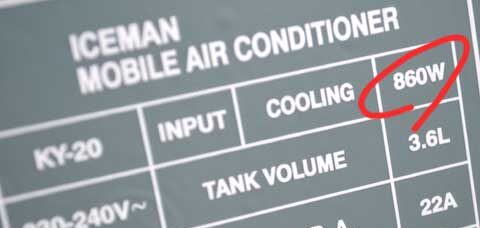
To find the exact watts for your unit, look at the sticker on the back or side. It will say something like “Power: 1000W” or “Input Power: 120V ~ 60Hz 10 Amps”. If it gives amps and volts, you can roughly figure out watts by multiplying amps by volts (e.g., 10 Amps * 120 Volts = 1200 Watts). This figure is crucial for calculating the running cost portable air conditioner.
BTU and Portable Air Conditioner Energy Usage
What does BTU mean? BTU stands for British Thermal Unit. It is a way to measure how much heat an air conditioner can take out of a room. A higher BTU number means the AC can cool a bigger room or cool a room faster.
- 5,000 to 8,000 BTU units are for small rooms (150-250 square feet).
- 8,000 to 10,000 BTU units are for medium rooms (250-400 square feet).
- 10,000 to 14,000 BTU units are for larger rooms (400-500+ square feet).
There is a link between BTU and portable air conditioner energy usage (watts). A unit with more BTUs needs more power to move that much heat. So, a 14,000 BTU unit will generally use more watts than an 8,000 BTU unit.
But it’s not a perfect link. Two ACs with the same BTU might use slightly different amounts of power. This is where energy efficiency comes in. A more energy efficient 10,000 BTU unit might use fewer watts than a less efficient 10,000 BTU unit.
So, when you look at a portable AC, check both the BTU (size of the room it cools) and the watts (how much power it uses). Both numbers are important for understanding its performance and how much it will cost to run.
Energy Efficiency in Portable Air Conditioners
Energy efficiency is a key factor in how much electricity a portable AC uses. An energy efficient portable air conditioner does a better job of cooling a room using less power.
How can you tell if a portable AC is energy efficient? Look for its Energy Efficiency Ratio (EER). EER is a number that shows how much cooling (BTUs) you get for each watt of power used.
The formula for EER is: EER = BTUs / Watts
A higher EER number means the portable AC is more energy efficient. For example:
* An AC that is 10,000 BTU and uses 1000 watts has an EER of 10 (10,000 / 1000 = 10).
* Another AC that is 10,000 BTU but uses only 800 watts has an EER of 12.5 (10,000 / 800 = 12.5).
The second AC is more energy efficient because it gives the same amount of cooling (10,000 BTU) but uses less power (800 watts instead of 1000 watts). This difference in energy efficiency portable air conditioner models can save you money on your electricity bill over time.
There is a standard called the Seasonal Energy Efficiency Ratio (SEER) for central air conditioners and heat pumps. Portable ACs used to use EER, but newer rules sometimes use a different test method and a different number, like CEER (Combined Energy Efficiency Ratio). CEER is similar to EER but includes the power used when the unit is on but not actively cooling (like just the fan).
Look for the Energy Star label. Products with the Energy Star label meet strict standards for energy efficiency. An Energy Star portable AC will use less power than a standard model with the same cooling power (BTUs). Choosing an Energy Star unit is a good way to lower your portable AC power consumption.
Figuring Out Running Costs
How much does it actually cost to run a portable air conditioner? This is the running cost portable air conditioner question many people want answered. It depends on a few things:
- How many watts your AC uses: This is the power draw we talked about earlier.
- How long you run it: Do you run it for a few hours a day, or all night?
- How much electricity costs in your area: This price is set by your local power company. It is usually measured in cents per kilowatt-hour (kWh).
A kilowatt-hour (kWh) is a way to measure energy used over time. 1000 watts running for one hour is equal to 1 kWh.
Formula for Calculating Cost:
Cost per hour = (Watts used / 1000) * Cost per kWh
Let’s do an example. Suppose you have a portable AC that uses 1200 watts. And let’s say electricity costs 15 cents per kWh in your town.
- Convert watts to kilowatts: 1200 watts / 1000 = 1.2 kW
- Cost per hour: 1.2 kW * $0.15 per kWh = $0.18 per hour
So, this portable AC costs about 18 cents to run for one hour. This is the cost to run portable AC per hour.
If you run it for 8 hours a day:
Daily cost = Cost per hour * Hours per day
Daily cost = $0.18 * 8 hours = $1.44 per day
If you run it for 30 days in a month:
Monthly cost = Daily cost * Days per month
Monthly cost = $1.44 * 30 days = $43.20 per month
This example shows how the running cost portable air conditioner adds up. Remember, this is just an example. Your actual cost will be different based on your AC’s watts and your electricity price.
Sample Cost Table (Example Costs):
| AC Watts | Cost per kWh (Example: $0.15) | Cost per Hour | Cost per Day (8 hours) | Cost per Month (30 days) |
|---|---|---|---|---|
| 800W | $0.15 | $0.12 | $0.96 | $28.80 |
| 1000W | $0.15 | $0.15 | $1.20 | $36.00 |
| 1200W | $0.15 | $0.18 | $1.44 | $43.20 |
| 1400W | $0.15 | $0.21 | $1.68 | $50.40 |
Note: Your actual costs may be higher or lower depending on your local electricity rate.
This table gives you a rough idea of the electricity bill portable AC can cause. It shows that using a higher-wattage unit for many hours each day will cost more.
Factors Affecting Energy Usage
Many things can change how much electricity a portable AC uses. It is not always the same amount every hour.
- Outside Temperature: When it is very hot outside, the AC has to work harder to cool the room. This means it will run more often and use more power. On milder days, it won’t need to work as hard.
- Room Size: If the AC is too small for the room, it will run constantly and might not even cool the room enough. This uses a lot of power with poor results. If the AC is the right size (correct BTU for the square footage), it can cool the room, turn off when it reaches the set temperature, and then turn back on only when needed. This stop-and-start operation is usually more energy efficient than running all the time.
- Room Insulation: A room with good insulation keeps cool air in and hot air out. This means the AC does not have to work as hard. Poor insulation (like drafty windows or thin walls) lets hot air leak in, making the AC run more.
- Sunlight: Direct sunlight coming through windows heats up a room quickly. Closing blinds or curtains can block the sun and reduce the heat the AC has to fight against.
- Setting the Temperature: Setting the temperature very low (like 68°F) makes the AC work much harder than setting it to a more moderate temperature (like 75°F). Every degree cooler you set it costs more energy.
- Using the Timer or Sleep Mode: Many portable ACs have timers or sleep modes. Using these can save energy. A timer can turn the unit off after you leave or when you go to sleep. Sleep mode often raises the temperature a few degrees overnight after you are asleep, so the AC does not have to cool as much.
- Condition of the Unit: A dirty air filter or a unit that is not working right can use more power. Regular cleaning and maintenance help the unit run more efficiently.
All these factors play a role in the total energy usage portable air conditioner shows over time. Thinking about these can help you use your AC more smartly and potentially lower your electricity bill portable AC impacts.
Portable AC Versus Window AC Energy Use
Many people wonder if a portable AC uses more or less electricity than a window AC. Generally, a portable AC uses more energy than a window AC to cool the same size space. This means the portable AC vs window AC energy use comparison usually favors the window unit for efficiency.
Why is this true? There are a few reasons:
- Design: Portable ACs sit inside the room and have a large hose (or sometimes two hoses) going out a window. This hose gets hot as it sends warm air outside. This hot hose is inside the room you are trying to cool, actually adding some heat back into the room. Window ACs have most of their hot parts outside the window, so they don’t add heat to the room they are cooling.
- Air Leakage: The hose setup for a portable AC often leaves gaps around the window or uses a window kit that is not perfectly sealed. This lets warm outside air leak into the room, making the AC work harder. Window ACs usually fit more snugly in the window opening.
- Air Pressure: Portable ACs typically push air out through the exhaust hose, creating a slight negative pressure in the room. This negative pressure can pull warm air from outside or from other parts of the house into the room through any small gaps or under doors. This “leaky” air needs to be cooled, using more energy. Some portable ACs have two hoses (one for intake, one for exhaust), which helps reduce this negative pressure effect and can make them a bit more efficient, but still often less efficient than a window unit.
- Cooling Power: To provide the same amount of cooling (BTUs) as a window unit, a portable AC often needs a higher power input (watts). This means for the same cooling effect, the portable AC consumes more electricity.
Because of these reasons, the running cost portable air conditioner is often higher than the running cost of a window AC with the same BTU rating. If energy efficiency is your main concern and you can install a window unit, it is usually the more energy-efficient choice. However, portable ACs are useful when window units are not allowed or possible.
Energy Usage Portable Air Conditioner Per Day
Calculating the energy usage portable air conditioner uses per day helps you see the daily impact on your electricity use.
The daily energy usage depends on:
* The unit’s power rating (watts).
* How many hours per day it runs.
* How often the compressor cycles on and off (which depends on the room, temperature setting, etc.).
Let’s use the example of a 1000-watt portable AC.
If it runs continuously for 8 hours:
Energy used = Watts * Hours
Energy used = 1000 watts * 8 hours = 8000 watt-hours
To convert this to kilowatt-hours (kWh), divide by 1000:
8000 watt-hours / 1000 = 8 kWh
So, running a 1000W portable AC non-stop for 8 hours uses 8 kWh of electricity.
But portable ACs don’t usually run non-stop for 8 hours. They cycle on and off as the room temperature changes. Let’s say over 8 hours, the compressor (the part that cools the air and uses the most power) is actually running for only 60% of the time.
Effective running time = 8 hours * 60% = 4.8 hours
Energy used = 1000 watts * 4.8 hours = 4800 watt-hours
Energy used = 4.8 kWh
So, the energy usage portable air conditioner shows per day can be much lower than the maximum possible use, depending on how much it cycles.
The actual energy usage per day can range widely.
* A small, efficient unit in a well-insulated room on a mild day might use just a few kWh over several hours.
* A large, less efficient unit in a hot, poorly insulated room running most of the day and night could use 15 kWh or more per day.
To get a good estimate for your unit, you can use a power meter. This device plugs into the wall, and you plug the AC into it. The meter will track exactly how many kWh the AC uses over a day or week. This gives you a much more accurate picture of your actual electricity bill portable AC contribution.
Portable Air Conditioner Energy Saving Tips
Using a portable air conditioner can increase your electricity bill portable AC costs. But there are many things you can do to reduce the running cost portable air conditioner. These are portable air conditioner energy saving tips.
- Pick the Right Size (BTU): Don’t buy an AC that is too small for your room. It will run all the time and not cool well, wasting energy. Don’t buy one that is too big either; it will cool the room too quickly, cycle on and off often (which is less efficient than running steadily), and might not remove humidity well. Use online guides to match the BTU to your room size.
- Improve Room Sealing: Make sure the exhaust hose kit fits snugly in the window. Use foam or tape to seal any gaps around the kit or the window itself. Close the door to the room you are cooling so you are not trying to cool the whole house. Blocking drafts helps a lot.
- Limit Heat Sources: Close curtains or blinds during the hottest part of the day to block sunlight. Turn off lights and electronics that give off heat in the room if you don’t need them.
- Set a Reasonable Temperature: You don’t need to make the room feel like a refrigerator. Set the thermostat to a comfortable temperature, maybe 75°F (24°C) or a little higher. Each degree you lower the thermostat can increase energy use by 3-5%.
- Use the Timer and Sleep Modes: If your AC has a timer, set it to turn off after you leave the room or after you’ve fallen asleep. Sleep mode often uses less power overnight.
- Use with a Fan: A ceiling fan or a small room fan can help circulate the cool air from the portable AC. This makes the room feel cooler, so you might be able to set the AC thermostat higher and still be comfortable. Fans use much less power than an AC.
- Keep it Clean: Regularly clean the air filter. A dirty filter blocks airflow, making the AC work harder and use more power. Check the user manual for how to clean the filter and how often (usually every few weeks).
- Check the Exhaust Hose: Make sure the exhaust hose is as straight and short as possible. Bends in the hose can restrict airflow, making the unit less efficient. Also, check that the hose isn’t blocked.
- Insulate the Exhaust Hose: The exhaust hose gets hot and adds heat to the room. Some people wrap the hose with insulation (like a thermal blanket or foil insulation) to keep the heat inside the hose and stop it from warming the room. This can help improve efficiency.
- Consider a Two-Hose Model: Two-hose portable ACs are often more efficient than single-hose models because they use outside air for cooling the condenser coils instead of conditioned air from the room. This reduces the negative pressure effect.
By using these portable air conditioner energy saving tips, you can significantly lower your portable AC power consumption and reduce your electricity bill portable AC causes. Even small changes can add up over the cooling season.
Grasping the Costs
Let’s look at the costs more closely. The running cost portable air conditioner is directly tied to how much electricity you use and the price of that electricity. We already saw the formula: (Watts / 1000) * Hours * Price per kWh.
Imagine you use a 1200W portable AC for 10 hours a day. Let’s say electricity costs $0.18 per kWh in your area.
Daily cost: (1200 / 1000) * 10 hours * $0.18 = 1.2 kW * 10 hours * $0.18 = 12 kWh * $0.18 = $2.16 per day.
Over a hot summer month (30 days):
Monthly cost: $2.16 * 30 = $64.80
Over a full 3-month cooling season:
Seasonal cost: $64.80 * 3 = $194.40
This shows that while the cost to run portable AC per hour might seem small, it can add up quickly over many hours and days. This is why maximizing energy efficiency portable air conditioner use is important.
Compare this to a window AC that might use fewer watts for the same cooling effect. A 1000W window AC running for 10 hours at $0.18/kWh:
Daily cost: (1000 / 1000) * 10 hours * $0.18 = 1 kW * 10 hours * $0.18 = 10 kWh * $0.18 = $1.80 per day.
Monthly cost: $1.80 * 30 = $54.00
Seasonal cost: $54.00 * 3 = $162.00
In this example, the window AC costs about $30 less per month and $90 less per season to run than the portable AC, even with just a 200W difference in power draw. This difference comes from the portable AC generally needing more power to provide the same cooling as discussed in the portable AC vs window AC energy use section.
Your actual costs will depend on your specific unit, how much you run it, and your local electricity price. Electricity prices vary a lot depending on where you live and the time of year or even time of day. Check your electricity bill to find your exact price per kWh.
Checking the Power Label
When you look at a portable air conditioner, find the label that lists its power needs. This label is usually required by law and helps you compare different units.
The label might show:
* Voltage: Usually 115V or 120V in North America.
* Frequency: Usually 60Hz.
* Amperage: The number of amps the unit draws.
* Wattage: The power consumption in watts (W). This is often listed as “Cooling Power Input” or similar.
* BTU: The cooling capacity.
* EER or CEER: The energy efficiency rating.
Focus on the wattage and the EER/CEER.
* The wattage tells you how much power it uses when running. This is directly linked to the portable AC power consumption and the cost to run portable AC per hour.
* The EER/CEER tells you how efficient it is at turning that power into cooling. A higher number means better energy efficiency portable air conditioner design.
Don’t just compare watts without looking at BTU. A higher watt unit might simply be a larger BTU unit meant for a bigger room. Compare the watts for units with similar BTUs, and then look at the EER/CEER to see which one is more efficient.
For example, comparing:
* Unit A: 10,000 BTU, 1000 Watts, EER 10
* Unit B: 10,000 BTU, 800 Watts, EER 12.5
Unit B uses less power (800W vs 1000W) for the same cooling (10,000 BTU). Its higher EER (12.5 vs 10) confirms it is more energy efficient. Choosing Unit B will lead to lower electricity bill portable AC costs than Unit A.
Interpreting the Energy Guide Label
In the United States, many appliances, including portable air conditioners, have an Energy Guide label. This yellow label gives you helpful information about the unit’s energy use and estimated yearly operating cost.
The label usually shows:
* The type of appliance (e.g., Portable Air Conditioner).
* The cooling capacity in BTUs.
* The estimated yearly electricity use in kWh.
* The estimated yearly operating cost.
The estimated yearly cost is based on:
* Typical hours of use per year (often 8 hours/day for 3 months).
* An average national electricity price (this price is listed on the label and might be different from your local price).
The label also often includes a range showing the estimated costs for similar models, from the least energy efficient to the most energy efficient. This lets you see how the unit compares to others like it.
To use this label effectively for figuring out your electricity bill portable AC costs:
1. Note the estimated yearly kWh usage.
2. Find your actual price per kWh on your electricity bill.
3. Calculate your estimated yearly cost: (Estimated yearly kWh) * (Your price per kWh).
For example, if the label says “Estimated Yearly Electricity Use: 700 kWh” and your electricity costs $0.18 per kWh:
Your estimated yearly cost = 700 kWh * $0.18/kWh = $126.00.
Remember that this is just an estimate based on typical use. If you use your AC for more hours, in a hotter climate, or in a less efficient room, your actual energy usage portable air conditioner will be higher, and your costs will be greater. But the Energy Guide label is a great starting point for understanding the potential running cost portable air conditioner.
Comparing Electricity Use Over Time
Let’s think about portable AC power consumption over longer periods like a month or a whole cooling season. Small differences in watts or efficiency can add up to big differences in your electricity bill portable AC total.
Suppose you use your portable AC for 500 hours over a summer season (e.g., about 5.5 hours per day for 3 months).
* A 1200W unit: Total kWh = (1200W / 1000) * 500 hours = 1.2 kW * 500 hours = 600 kWh.
* A more efficient 1000W unit (with similar BTU): Total kWh = (1000W / 1000) * 500 hours = 1 kW * 500 hours = 500 kWh.
If electricity is $0.15 per kWh:
* 1200W unit cost: 600 kWh * $0.15/kWh = $90.00
* 1000W unit cost: 500 kWh * $0.15/kWh = $75.00
In this case, the more efficient unit saves you $15 over the season. If you run it longer, or if electricity prices are higher, the savings will be even greater.
This highlights why paying a little more upfront for an energy efficient portable air conditioner model with a higher EER/CEER can save you money in the long run through lower energy usage portable air conditioner over its lifetime.
Learning About Different Modes
Most portable air conditioners have different modes of operation. These modes affect how much power the unit uses.
- Cool Mode: This is the main mode for cooling. The compressor runs to make cold air. This mode uses the most power (closest to the listed wattage).
- Fan Mode: The unit only runs the fan to circulate air. The compressor is off. This uses much less power than Cool mode, often just 50-100 watts.
- Dry Mode (Dehumidify Mode): The unit removes moisture from the air, making it feel cooler even if the temperature doesn’t drop much. The compressor usually runs in this mode, but often at a lower speed or cycling differently than in Cool mode. Power usage is usually less than Cool mode but more than Fan mode.
- Auto Mode: The unit picks between Cool, Fan, or Dry mode based on the room temperature and humidity it senses. Power usage will vary depending on which mode it chooses.
- Sleep Mode: Often starts in Cool mode and slowly raises the temperature setting over several hours. This saves energy overnight as your body’s temperature drops. Power usage decreases over the night.
- Economy Mode / Energy Saver Mode: These modes try to reduce power use. They might turn off the fan when the compressor turns off (unlike standard Cool mode where the fan might run constantly).
Using Fan mode when it’s not extremely hot, or using Sleep/Economy modes, can help reduce portable AC power consumption and lower your electricity bill portable AC costs.
Reviewing Energy Saving Tips
Let’s revisit the portable air conditioner energy saving tips because they are the most practical way you can control your running cost portable air conditioner.
- Right Size, Right Room: A 12,000 BTU unit in a small bedroom is overkill and inefficient. An 8,000 BTU unit in a large living room won’t keep up. Get the BTU size recommended for your specific room size.
- Seal the Room: This is crucial for portable ACs. The hose kit must be sealed well in the window. Close the door! Treating the room like a sealed box helps the AC cool it efficiently.
- Use Blinds: Stop direct sun heat from entering. Simple, but effective.
- Higher Temp Setting: Try setting it just a degree or two higher. You might not notice the temperature difference, but your electricity meter will notice the power saving.
- Fans Help: Fans don’t cool the air, but they make you feel cooler by moving air across your skin. Using a fan lets you set the AC thermostat higher.
- Clean Filter = Happy AC: A clean filter means good airflow. Good airflow means the AC doesn’t have to work as hard.
- Hose Management: Shorter, straighter, insulated hoses reduce heat added back into the room.
Implementing these tips can significantly reduce the energy usage portable air conditioner consumes daily and seasonally.
Frequently Asked Questions (FAQ)
Here are some common questions people ask about how much electricity portable air conditioners use.
Q1: Is it expensive to run a portable air conditioner?
A1: Yes, portable air conditioners generally use a good amount of electricity. The running cost portable air conditioner depends on the unit’s size and efficiency, how long you use it, and your electricity price. They often cost more to run than window ACs of the same size.
Q2: How can I find out the exact power usage of my portable AC?
A2: Look for a label on the unit or in the user manual. It should list the power consumption in watts. To get a very accurate reading of energy usage portable air conditioner shows over time, you can use a separate power meter that plugs into the wall.
Q3: Does a higher BTU mean higher electricity use?
A3: Usually, yes. Units with higher BTU ratings are designed to cool larger spaces and require more power (watts) to do so. However, the energy efficiency portable air conditioner (EER/CEER) also matters. A more efficient unit with higher BTU might still use less power than a less efficient unit with slightly lower BTU.
Q4: What is EER and why is it important?
A4: EER stands for Energy Efficiency Ratio. It measures how much cooling (BTU) an AC provides for each watt of power it uses. A higher EER means the unit is more energy efficient and will cost less to run over time.
Q5: How does using a portable AC affect my electricity bill?
A5: Using a portable AC will increase your electricity bill portable AC costs, especially if you use it often and for long periods. The amount of increase depends on the unit’s power use, hours of operation, and your electricity rate.
Q6: Is a portable AC less efficient than a window AC?
A6: Yes, generally portable ACs are less energy efficient than window ACs with the same cooling capacity (BTU). This is mainly due to their design (hose adding heat to the room) and potential for air leaks. The portable AC vs window AC energy use comparison usually shows window units are more efficient.
Q7: Can I save energy by running my portable AC fan only sometimes?
A7: Yes, using the fan-only mode uses much less electricity than the cool mode because the power-hungry compressor is turned off. Use fan mode when you just need air circulation, not cooling.
Q8: Does room insulation matter for portable AC energy use?
A8: Yes, a lot. A well-insulated room holds cool air better and keeps hot air out. This means the portable AC doesn’t have to run as often or as hard, leading to lower energy usage portable air conditioner and lower electricity bills.
Q9: How much does it cost to run a portable AC per hour?
A9: The cost to run portable AC per hour varies. For a 1000W unit, it costs about the same as running ten 100-watt light bulbs. You can calculate it using the formula: (Watts / 1000) * Cost per kWh in your area. It typically ranges from about $0.10 to $0.30 per hour depending on the unit and local electricity prices.
Q10: Are there simple ways to reduce the energy use of my portable AC?
A10: Yes! Use portable air conditioner energy saving tips like sealing the window kit well, closing the door to the room, using blinds to block sun, setting the temperature higher (like 75°F), using timer/sleep modes, cleaning the filter, and using a fan along with the AC.
In Summary
Portable air conditioners provide cooling where needed, but it’s important to be aware of their electricity use. They use power, measured in watts, to create cool air, and this power consumption adds to your electricity bill portable AC costs. The running cost portable air conditioner depends on the unit’s size (BTU), its energy efficiency portable air conditioner rating (EER/CEER), how long you run it, and your local electricity price.
While portable ACs are generally less efficient than window ACs (the portable AC vs window AC energy use comparison often shows this), you can still manage their energy usage portable air conditioner. By choosing the right size unit for your room, properly sealing the window exhaust, using timers, keeping filters clean, and using other portable air conditioner energy saving tips, you can help reduce the cost to run portable AC per hour and keep your cooling costs in check. Knowing how many watts does a portable AC use and how that relates to its BTU portable air conditioner energy usage is the first step in making smart choices about using your unit.