
How many amps does an RV air conditioner pull? An RV air conditioner uses a lot of power, pulling around 12 to 16 amps when it is running. However, when it first starts, it pulls much more power, often between 40 and 60 amps for a brief moment. Knowing this helps figure out things like what size generator for RV AC you need or if you can run your AC on just shore power. This difference between the power needed to start the AC and the power needed to keep it running is important for RV AC electrical requirements.
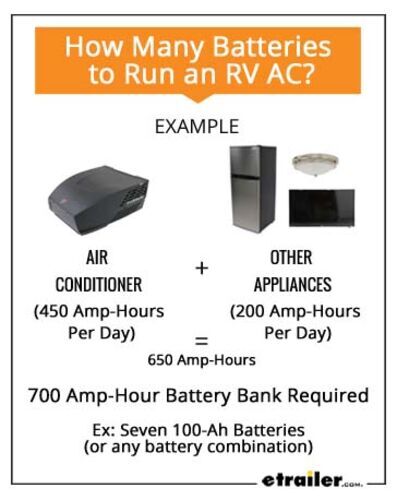
Image Source: www.etrailer.com
Grasping RV AC Power Needs
RV air conditioners are powerful helpers on hot days. They cool your rig down fast. But they need a good bit of electricity to do their job. The amount of power they use is measured in amps. Amps tell you how much electric current is flowing. The more amps something pulls, the more power it uses at that moment.
Thinking about RV AC power consumption is key. It affects what you can run at the same time. It also matters when you are not hooked up to power at a campground. Like when you use a generator or your batteries and inverter.
Running Amps vs Starting Amps RV AC
This is a really important idea when talking about RV air conditioners. There are two main numbers for amps:
- Running Amps: This is the power the AC uses after it has been running for a little while. It runs smoothly. This number is much lower than the starting amps.
- Starting Amps: This is the power the AC needs the exact moment the compressor kicks on. The compressor is the part that does the main cooling work. Getting it going needs a big jolt of power. This surge lasts for only a second or two. But it is a very big surge.
Think of pushing a heavy car. Getting it to roll needs a big push. Once it is rolling, it is much easier to keep it going with a smaller push. The big push is like the starting amps. The smaller push is like the running amps.
For an RV AC, the running amps might be 14 amps. But the starting amps could be 50 amps! That big starting surge is what often limits what power source you can use.
Looking at Common RV AC Sizes
RV air conditioners come in different sizes. Size is often talked about in BTU. BTU stands for British Thermal Units. It measures how much heat the AC can remove from the air. A higher BTU means a bigger, more powerful AC that cools a larger space or cools faster.
The two most common sizes you will see are 13500 BTU and 15000 BTU.
13500 BTU RV AC Power Draw
A 13500 BTU RV AC is a standard size. It is often found in smaller to medium-sized RVs.
- Running Amps: Typically pulls about 12 to 14 amps.
- Starting Amps: Can pull anywhere from 35 to 50 amps or even a bit more.
So, the 13500 BTU RV AC power draw when running is manageable. But the starting amps require a good power source that can handle that quick spike.
15000 BTU RV AC Power Usage
A 15000 BTU RV AC is a larger size. It is used in bigger RVs or for people who want faster cooling.
- Running Amps: Typically pulls about 14 to 16 amps.
- Starting Amps: Can pull 50 to 65 amps or possibly more.
As you can see, the 15000 BTU RV AC power usage is higher than the 13500 BTU model. Both for running and especially for starting. This extra need for power means you might need a bigger generator or different setup to run it easily.
These numbers are just guides. The exact amps can change based on:
* The specific brand and model of the AC.
* How old the AC is. Older ones might pull more power.
* How hot it is outside.
* How cold you are trying to make the inside of the RV.
Converting Amps to Watts
Sometimes you see power talked about in watts. Watts measure the total power being used. Amps measure the flow of electricity. They are related.
To get watts from amps, you use a simple math idea:
Watts = Amps × Volts
In North America, RVs use 120 volts of electricity for the AC.
So, let’s figure out the RV air conditioner watts:
- For a 13500 BTU AC (using 13 running amps):
Watts = 13 amps × 120 volts = 1560 watts - For a 15000 BTU AC (using 15 running amps):
Watts = 15 amps × 120 volts = 1800 watts
These watt numbers tell you the continuous power draw. When thinking about generators, you often look at their wattage capacity. Generators list both running watts and peak (starting) watts. The peak watts need to be high enough to handle the AC’s starting amps translated into watts.
For starting watts, using the high end of the amp range:
- For a 13500 BTU AC (using 50 starting amps):
Watts = 50 amps × 120 volts = 6000 watts - For a 15000 BTU AC (using 65 starting amps):
Watts = 65 amps × 120 volts = 7800 watts
See how high those starting watts are? This is why starting amps are so important! A generator must be able to provide this huge burst of watts for a moment, even if its running watt rating is much lower.
Factors Affecting RV Rooftop AC Amperage
Several things can make your RV rooftop AC amperage higher or lower than the typical numbers:
- Outside Temperature: When it is very hot outside, the AC works harder. This can cause it to pull a bit more power.
- Inside Temperature Setting: If you set the temperature much lower than the outside temp, the AC runs longer and might pull slightly more power while running.
- Condition of the Unit: An older or poorly maintained AC unit might run less efficiently. It could pull more amps to do the same amount of cooling work. Dirty filters or coils make the motor work harder.
- Voltage Levels: If the voltage coming in is a little low (like under 115 volts), the AC motor might pull more amps to try and do its job. This is bad for the motor.
- Ductwork Issues: Leaks or blockages in the air ducts can make the AC work harder. This might increase the amps.
- Startup Load: As mentioned, the starting amps are the biggest factor for brief periods. How long the unit has been off can affect the exact startup load.
Knowing these factors helps explain why your meter might show slightly different numbers than the averages.
Figuring Out RV AC Electrical Requirements
Your RV’s electrical system is designed to handle a certain amount of power. This is important for the RV AC electrical requirements.
- Circuit Breakers: Your RV has circuit breakers, just like a house. Each circuit breaker is rated for a certain number of amps (e.g., 15 amps, 20 amps). Your AC is connected to a specific breaker. This breaker must be rated higher than the AC’s running amps. It also needs to handle the starting amps for that quick moment without tripping. Most RV ACs are on a 20-amp breaker. This 20-amp breaker is enough for the 12-16 running amps. But it relies on the breaker’s ability to handle a short surge above its rating. If the starting surge is too long or too high (maybe due to a problem with the AC), the breaker can trip.
- Wiring Size: The wires in your RV must be thick enough to safely carry the maximum current (amps) expected on that circuit. The wiring for your AC is sized for its needs, including the starting surge.
- Shore Power Cord/Hookup: When you plug into a campground, you connect to shore power. This hookup has a limit, usually 30 amps or 50 amps for the whole RV. A 30-amp hookup provides a total of 30 amps for everything running in the RV. A 50-amp hookup provides much more (actually two lines of 50 amps, acting more like 100 amps total capacity). Running a 13-amp AC on a 30-amp hookup leaves about 17 amps for lights, microwave, TV, etc. This is usually fine. But starting the AC might push the total rig usage close to or over 30 amps for a second. On a 50-amp hookup, running an AC is no problem at all.
It is vital that your RV’s electrical parts can handle the power the AC needs. This prevents blown fuses, tripped breakers, or even damaged wires.
Why Knowing Amps Matters So Much
Knowing how many amps your RV air conditioner pulls is not just for fun facts. It helps you make important decisions and avoid problems.
- Generator Sizing: This is one of the biggest reasons people ask about AC amps. If you want to run your AC using a generator, the generator must be powerful enough. It needs to handle both the running amps and the much higher starting amps.
- Using Inverters: If you have batteries and an inverter, you might wonder if you can run your AC off them. Inverters turn battery power (DC) into power for appliances (AC). An inverter must be big enough to handle the AC’s power needs. This often means a very large inverter and a big battery bank, which is not common for running a standard AC.
- Avoiding Tripped Breakers: At home or at a campground, knowing the amps helps you avoid overloading circuits. You know not to start the AC, microwave, and coffee maker all at the exact same time on a 30-amp hookup.
- Troubleshooting: If your AC won’t start or keeps tripping a breaker, knowing the typical amp draw helps figure out if the AC is pulling too much power (maybe something is wrong with it) or if the power source is too small.
- Choosing a Soft Start: Knowing about high starting amps leads many people to consider a soft start device.
What Size Generator For RV AC?
This question comes up a lot! The answer depends mainly on those tricky starting amps.
You need a generator that can handle the continuous running watts of your AC, plus all other things you want to run at the same time. BUT, more importantly, it must handle the peak surge watts needed to start the AC.
Generators list two power ratings:
1. Running Watts: The power it can provide constantly.
2. Starting Watts (or Peak Watts): The higher power it can provide for a very short time (seconds).
Your generator’s starting watts must be higher than your AC’s starting watts. Its running watts must be higher than the total running watts of everything you plan to use at once (AC + microwave + lights + etc.).
Let’s look at typical needs:
- To run just one 13500 BTU AC: You might need a generator with at least 2500 to 3500 starting watts. Its running watts could be lower, maybe 1800-2000 watts. A 2200-watt inverter generator often has a high enough starting capacity (around 2500-3000 peak watts) to maybe start a 13500 BTU AC, especially if nothing else is running. Success can vary by generator model and AC unit.
- To run just one 15000 BTU AC: You likely need a generator with at least 3000 to 4000 starting watts. Its running watts might be 2000-2500 watts. A 3000-watt inverter generator is often needed for this.
- To run the AC plus other things (like microwave): You will need a bigger generator. Running a microwave often adds 1000-1500 running watts. So, you add the AC running watts and the microwave running watts, plus a little extra. And the starting watts still need to be high enough for the AC. This is why many people choose 3500-watt or 4000-watt generators for more flexibility.
- To run two ACs: This needs a much bigger generator, often 5000 watts or more. Or you might use two smaller inverter generators linked together (parallel).
Minimum Generator Size for RV AC
The minimum generator size for RV AC depends on the AC size and if you run anything else.
- For just a 13500 BTU AC, sometimes a 2200-watt inverter generator (with ~2500-3000 peak watts) is the minimum, but it might struggle. A 2500-watt or 3000-watt generator is more reliable as a minimum.
- For just a 15000 BTU AC, a 3000-watt generator is usually the minimum recommended size.
It’s always safer to have a bit more generator power than you think you need. Starting other appliances while the AC is running adds to the load, and that starting surge from the AC is key.
Soft Start for RV AC: A Helping Hand
Remember those big starting amps? They can make it hard to run your AC on smaller generators, standard 20-amp home outlets, or even your RV’s inverter/battery system.
A soft start for RV AC is a device you install on your air conditioner. What does it do? It changes how the AC compressor starts. Instead of letting the compressor motor demand a huge amount of power all at once, a soft start slowly ramps up the power.
How a Soft Start Works (Simply)
Think about gently pushing that heavy car instead of giving it one big shove. A soft start gives the compressor a gentle, controlled increase in power over a few seconds.
This smooth startup greatly reduces the starting amp surge.
Benefits of Using a Soft Start
Installing a soft start unit on your RV AC offers several nice benefits:
- Run AC on Smaller Generators: This is a major reason people buy soft starts. A soft start can often lower the starting amps by 60-70%. This can allow a 13500 BTU AC to start on a small 2200-watt inverter generator. A 15000 BTU AC might then start on a 2500 or 3000-watt generator. This saves weight and money on generators.
- Run AC on 20-Amp Outlets: Many homes have standard 15 or 20-amp outdoor outlets. A soft start can make it possible to run your RV AC on one of these without tripping the house breaker.
- Easier on Your Equipment: Reducing the sudden electrical surge is easier on the AC compressor and the power source (generator, inverter, shore power system). This could help your AC last longer.
- Potential for Inverter Use: With a very efficient AC and a soft start, plus a large battery bank and inverter, some people can run their AC off battery power for a while. This is usually only for short periods or very small ACs, but the soft start makes it much more possible.
- Avoid Tripping RV Breakers: While RV ACs are on 20-amp breakers designed for some surge, a soft start ensures the surge stays well within the breaker’s comfort zone, reducing nuisance trips.
Installing a soft start usually involves wiring it into the AC unit, often on the roof. It is a popular upgrade for RVers who want more power flexibility.
Getting a Sense of the Numbers (Approximate)
Here is a table showing rough estimates for RV AC amperage and wattage. Remember, these can vary by model and conditions.
| AC Size (BTU) | Typical Running Amps | Typical Running Watts (at 120V) | Typical Starting Amps | Typical Starting Watts (at 120V) |
|---|---|---|---|---|
| 8,000 | 7 – 9 | 840 – 1080 | 20 – 30 | 2400 – 3600 |
| 11,000 | 9 – 11 | 1080 – 1320 | 30 – 45 | 3600 – 5400 |
| 13,500 | 12 – 14 | 1440 – 1680 | 35 – 50 | 4200 – 6000 |
| 15,000 | 14 – 16 | 1680 – 1920 | 50 – 65 | 6000 – 7800 |
This table clearly shows that the starting amps (and watts) are the main challenge. A 15000 BTU AC pulling 65 starting amps needs a power source that can instantly provide over 7800 watts for a second!
Tips for Lowering RV AC Power Use
While you can’t change the basic design of your AC, you can do things to help it run more efficiently and maybe pull slightly fewer amps or just run less often. This impacts your total RV AC power consumption over time.
- Keep Filters Clean: A dirty air filter makes the AC work much harder to pull air through. This can increase power draw and reduces cooling. Check and clean or replace your filter often.
- Clean Coils: The coils on both the inside and outside of the AC unit get dirty. This stops them from transferring heat well. Cleaning them (carefully!) helps the AC run better.
- Improve RV Insulation: A well-insulated RV keeps cool air in and hot air out. This means the AC does not have to run as much. Add insulation to windows (reflectix), vents, and consider sealing air leaks.
- Shade Your RV: Parking in the shade makes a huge difference. Direct sun heats up your RV fast. If you can’t get shade, use awnings or window covers to block the sun.
- Ventilate Before Cooling: If the inside of your RV is much hotter than outside, open windows and vents for a few minutes before turning on the AC. Let the super hot air escape first.
- Use Fans: Ceiling fans or small portable fans help move the cool air around. This makes you feel cooler even if the temperature is a degree or two higher. This lets you set the thermostat a bit higher, meaning the AC runs less.
- Run AC Early: On a hot day, turn on the AC before the RV gets scorching hot. It uses less power to maintain a temperature than to cool a very hot RV down many degrees.
These simple steps help your RV rooftop AC amperage stay within its normal range and reduce how long it needs to run, saving power overall.
Learning More About Your Specific AC
The best way to know exactly how many amps your RV air conditioner pulls is to check its label. Most appliances have a label (often called a “data plate” or “nameplate”) somewhere on them. For rooftop ACs, this label is usually under the air filter cover inside the RV, or sometimes on the unit itself on the roof.
The label will list:
* Model number
* Serial number
* Voltage (V)
* Frequency (Hz)
* Running Amps (often listed as “RLA” or “AMPS”)
* Locked Rotor Amps (often listed as “LRA”). This is a different, very high number related to starting, but often higher than the actual surge you see. The real starting surge is somewhere between the running amps and the LRA.
Look for the “AMPS” or “RLA” number for running amps. Knowing this specific number is better than using general estimates. The starting amps are harder to find listed directly, but knowing the running amps and the LRA gives you an idea.
Conclusion
Knowing how many amps your RV air conditioner pulls is very useful. It helps you understand your RV’s power needs. You learned about the difference between running amps vs starting amps RV AC, and why the starting surge is so powerful. We looked at the typical 13500 BTU RV AC power draw and 15000 BTU RV AC power usage, and how to figure out RV air conditioner watts.
We also covered what size generator for RV AC you need, including the minimum generator size for RV AC, keeping those starting amps in mind. We talked about RV AC electrical requirements and why a soft start for RV AC can be a great help by lowering starting amps. Understanding your RV rooftop AC amperage is a key part of managing your RV’s power, whether you are plugged in or using a generator.
By paying attention to these numbers and taking steps to use your AC smartly, you can keep cool without overloading your system or running out of power.
Frequently Asked Questions (FAQ)
Q: Can I run my RV AC on a regular extension cord from my house?
A: Maybe, but be very careful. A standard thin household extension cord is usually not thick enough to handle the high amps needed by an RV AC, especially the starting surge. Using the wrong cord can cause voltage drops, make the AC work too hard, or even cause a fire. It’s best to use a heavy-duty, RV-rated power cord. Even then, a standard 15-amp house outlet might not handle the starting amps unless you have a soft start installed on your AC. A 20-amp house outlet is better, but still might trip without a soft start.
Q: Will running my AC off the generator hurt the AC?
A: No, running your AC on a generator that is properly sized and providing stable power (especially an inverter generator) will not harm your AC. The key is “properly sized” and “stable power.” An undersized generator might struggle or provide power that is not clean, which could be hard on the AC over time.
Q: How can I tell if my generator is big enough to start my AC?
A: The best way is to try it! If the generator starts and runs the AC without struggling, dimming lights, or tripping breakers, it is likely big enough. If the generator engine bogs down heavily when the AC tries to start, or if breakers trip, it is probably too small for the AC’s starting amps. Checking the generator’s peak watt rating against the AC’s estimated starting watts (or seeing if your AC has a soft start) helps predict this.
Q: Does a soft start save power while the AC is running?
A: No, a soft start only helps with the power needed to start the AC compressor. Once the compressor is running smoothly, the soft start is bypassed or no longer affecting the power usage. It does not lower the running amps or watts. Its benefit is solely in reducing that large initial power surge.
Q: My AC trips the breaker when it tries to start. What could be wrong?
A: Several things could cause this.
1. The starting amps of the AC might be higher than normal (unit aging, capacitor issue).
2. The circuit breaker itself might be weak.
3. You might be trying to run too many other things at the same time, so the total load when the AC starts exceeds the breaker or power source limit.
4. The power source (shore power or generator) might not be providing stable voltage or enough current to handle the surge.
A soft start can often fix this by lowering the starting surge. If it still trips, have an RV technician check the AC unit and the electrical system.