
The best height for a TV is usually when the center of the screen sits at your eye level when you are sitting in your main viewing spot. For many people on a standard couch, this means the bottom of the TV screen might be about 24 to 30 inches (60 to 75 cm) off the floor. This puts the middle of the screen comfortably in line with your sitting eye height.
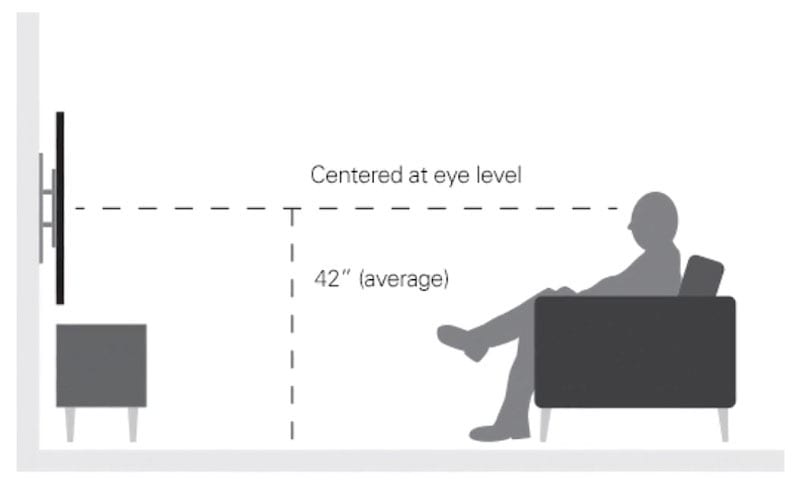
Image Source: www.hellotech.com
Why TV Height Matters for Good Watching
Putting your TV at the right height is very important. It makes watching much more fun and comfortable. If the TV is too high or too low, it can cause problems.
One big problem is neck strain. You do not want to look up or down for a long time. This puts stress on your neck and shoulders. Finding the best height for your TV helps you avoid this.
Another reason is getting the full picture. When the TV is at the right level, you see the picture as it should be. You feel more like you are part of the action. This is part of getting the most comfortable viewing angle.
Think about movie theaters. The screen is big, but you usually look slightly up or straight ahead. Your seat helps put you in a good spot. You want to do the same in your home. Find the ideal viewing height for your room and furniture.
Finding Your Sitting Eye Height
To find the right TV height, you first need to know your sitting eye height. This is simple to do.
Sit where you will watch TV most often. Use your favorite couch or chair. Sit back like you normally would when watching a movie or show.
Have someone use a tape measure. They should measure from the floor straight up to your eyes. This number is your sitting eye height.
If you watch from different spots, pick the one you use most. If you have different chairs with different heights, you might aim for a height that works reasonably well for all of them. Or, you might set the height for the main watching spot.
Your sitting eye height is key. It tells you where the middle of your TV screen should likely go. This measurement helps you find the recommended TV height for your room.
Screen Size and Watching Distance
How big your TV is and how far away you sit from it also change things. These factors help you find the optimal viewing distance. The viewing distance affects how high your TV should be.
Let’s say you have a very big TV. You will likely sit farther away from it. Sitting farther away means your comfortable viewing angle might be slightly different. You might be able to place the TV a little higher. But the main rule still holds: the center of the screen should be near your eye level.
Industry groups like THX and SMPTE give ideas for viewing angles. They suggest how much of your view the screen should fill. This helps create an immersive feeling. For home viewing, THX suggests a viewing angle of about 28 degrees to 40 degrees. SMPTE suggests about 30 degrees. This basically means the TV should fill a certain amount of your vision without you having to move your head much.
Sitting too close to a big TV means you have to move your eyes or head to see the whole screen. Sitting too far makes the screen feel small. The right distance makes the picture fill your view nicely.
Here is a simple idea for viewing distance based on screen size:
H4: Simple Viewing Distance Guide
Think about the size of your TV screen. Screen size is measured on the diagonal.
- For 1080p HD TVs: Sit about 1 to 1.5 times the screen size (measured diagonally) away. A 55-inch TV? Sit about 55 to 82 inches away.
- For 4K Ultra HD TVs: You can sit closer because the picture is clearer. Sit about 0.5 to 1 times the screen size away. A 55-inch 4K TV? Sit about 27 to 55 inches away.
Let’s make that easier with a table:
H4: Suggested Minimum Viewing Distances for 4K TVs
| TV Size (Diagonal) | Minimum Sitting Distance |
|---|---|
| 40 inches | About 3.5 feet (42 inches) |
| 50 inches | About 4 feet (48 inches) |
| 55 inches | About 4.5 feet (54 inches) |
| 65 inches | About 5.5 feet (66 inches) |
| 75 inches | About 6 feet (72 inches) |
| 85 inches | About 7 feet (84 inches) |
This table gives you a basic idea. Your room size and comfort matter most. Find the spot where you feel the picture is just right, not too big or too small. This spot is your optimal viewing distance. This distance impacts the ideal viewing height.
Once you know where you sit and your sitting eye height, and you have an idea of your viewing distance based on TV size, you can figure out the wall mount TV height or stand height.
Calculating the Right TV Height
Here is a step-by-step TV height calculation process. It helps you find the center of screen height and then where the bottom of the TV should be.
H4: Step-by-Step Height Finding
- Sit and Measure: Sit on your favorite couch or chair. Have someone measure from the floor to your eye level. Write this number down. This is your sitting eye height. This is the target height for the center of your TV screen.
- Find TV Height: Look up the height of your TV. This is the height of the screen area itself, not the diagonal size. Find the measurement from the very bottom edge to the very top edge of the TV screen.
- Calculate Half Height: Divide the TV’s height (from step 2) by 2. This gives you the distance from the center of the screen to the bottom edge.
- Find Bottom Edge Height: Subtract the ‘Half Height’ (from step 3) from your sitting eye height (from step 1). This tells you how high the bottom edge of the TV screen should be off the floor.
Let’s use an example.
H5: Example Calculation
- Your sitting eye height is 40 inches from the floor.
- Your TV screen height is 28 inches.
- Half the TV height is 28 / 2 = 14 inches.
- To find the bottom edge height: 40 inches (eye level) – 14 inches (half TV height) = 26 inches.
So, in this example, the bottom of your TV screen should be about 26 inches off the floor. This places the center of the 28-inch tall screen at your 40-inch sitting eye height. This gives you the ideal viewing height.
This method works for finding the recommended TV height whether you use a stand or a wall mount. If you use a stand, measure the height of the stand top. If it is lower than your needed bottom edge height, the stand is too low. If it is higher, it is too high. If wall mounting, you will use this bottom edge height to mark where to place the mount.
TV Stands vs. Wall Mounts and Height
The type of furniture or mount you use makes a difference in how you achieve the right height. The target height for the center of the screen or the bottom edge remains the same based on your sitting eye height and TV size.
H4: Using TV Stands
Most TV stands have a set height. When you put the TV on the stand, the bottom of the TV screen will be at the height of the stand’s top surface.
You need to check if a stand puts your TV at the right height. Measure the height of the stand. Measure the height of your TV screen. Do the calculation we talked about.
If your calculation says the bottom of your TV should be 26 inches off the floor, look for a stand that is about 26 inches tall. Remember that TV stands have legs or bases, so the usable top surface might be a little lower than the total stand height shown in a store. Always check the height of the flat surface where the TV will sit.
Using a stand is easier than wall mounting. But you have less control over the exact height. You might have to pick a stand that gets you close to the ideal viewing height.
H4: Using Wall Mounts
Wall mounting gives you much more control over the TV height. You can place the TV exactly where your calculation tells you it should go.
When installing a wall mount, you will need to measure from the floor up to mark the spot for the mount. Different wall mounts work in different ways. Some attach to the center back of the TV. Others use rails that screw onto the back of the TV and then hook onto a wall plate.
To find the wall mount position:
- Find the bottom edge height: Use your calculation (sitting eye height – half TV height).
- Find the VESA mount points: Look at the back of your TV. There are screw holes for mounting. Measure the distance from the very bottom edge of your TV screen frame to the center of these VESA screw holes.
- Calculate mount height: Add the ‘bottom edge height’ (from step 1) and the distance from the TV bottom to the VESA holes (from step 2). This gives you the height from the floor to where the center of the VESA mount on the wall plate should be.
Let’s refine the previous example for wall mounting:
H5: Wall Mount Calculation Example
- You calculated the bottom edge height should be 26 inches.
- You measure from the bottom edge of your TV to the center of the VESA holes on the back. Let’s say this is 10 inches.
- To find the height of the mount center on the wall: 26 inches (bottom edge height) + 10 inches (distance to VESA holes) = 36 inches.
You would then mark a spot 36 inches up from the floor on your wall where the center of the wall mount plate should go. Always double-check your mount instructions, as they might have specific ways to measure. Wall mounting takes more work but lets you hit the recommended TV height precisely for optimal viewing.
Ergonomic Viewing for Better Health
Ergonomic viewing means setting up your watching area so it is comfortable and healthy for your body. Putting your TV at the correct recommended TV height is a big part of this.
When the TV is at your eye level, you do not have to tilt your head. Your neck stays in a natural, relaxed position. This prevents pain and stiffness over time. This is good for your long-term health.
Sitting eye height varies from person to person. It also changes based on the furniture. A low, deep couch will give you a lower sitting eye height than a firm, upright chair. You must measure your own sitting eye height in your actual viewing spot.
Also, consider the comfortable viewing angle. You want the TV screen to be mostly straight in front of you. A mount that lets you tilt the TV down slightly can help if you have to place the TV a little higher, maybe over furniture. But tilting should be minor. If you have to tilt a lot, the TV is too high. Tilting too much can also affect the picture quality and colors on some TVs.
Ensuring ergonomic viewing means thinking about the TV height along with:
- Your posture: Sit comfortably upright or slightly reclined, not slouched.
- Lighting: Avoid glare on the screen.
- Breaks: Take short breaks from watching.
All these things work together for a good viewing experience and better physical comfort.
Different Rooms, Different Heights?
While the eye level rule is the main guide, different rooms have different uses. This might mean slightly different ideas about the ideal viewing height.
H4: Living Room TV Height
This is where most people do their serious TV watching. The main goal here is comfortable, long viewing sessions. The eye-level rule (center of screen at sitting eye height) is most important here.
Measure your sitting eye height from your main couch or chair. Use this for your TV height calculation. For most living rooms with standard sofas, this results in the center of the screen being about 40-45 inches off the floor. The bottom of the TV might be 24-30 inches high, depending on the TV size. This is the standard recommended TV height for a living room.
H4: Bedroom TV Height
Watching TV in the bedroom is different. People might watch while sitting up against pillows or while lying down.
If you watch mostly while sitting up in bed, measure your sitting eye height in that position. The TV height should place the center of the screen at this level. You might need to wall mount the TV.
If you watch while lying down, your eye level is much lower. Putting the TV at that low level on the wall might look strange and not work when you are sitting up. For lying down, people often place the TV higher on the wall and tilt it down. This allows you to watch without craning your neck up too much.
There is no single perfect bedroom TV height. It depends on how you watch. Find a height that works best for the position you use most often. A wall mount with tilt is very useful here.
H4: Kitchen TV Height
Kitchen TVs are often watched while standing or while quickly glancing from different spots. Eye level while standing is much higher than sitting eye height.
A kitchen TV might be placed higher on the wall, perhaps above cabinets or on a shelf. The goal is visibility from different spots, not critical viewing angles. The height needs to clear counter space or other obstacles.
While eye level is ideal, in a kitchen, convenience and visibility are often bigger factors. Just make sure it is not so high it is hard to see or causes neck strain for short glances.
H4: Other Areas
For areas like a home gym, the TV might be higher so you can see it while standing or using equipment. Again, the main rule applies: try to get the center as close to eye level as possible for the main way you use the space.
In short, the “best” height can change a little based on the room’s purpose and how you use the space. But the principle of TV eye level as the starting point is always key for comfortable viewing.
Common Mistakes to Avoid
Knowing the right TV height is important, but it is also good to know what can go wrong. Here are some common mistakes people make:
H4: Mounting Too High Over a Fireplace
This is a very common mistake. Fireplaces are often focal points in rooms. People think putting the TV over it makes sense. However, fireplaces are usually quite high. Mounting a TV here almost always puts it way above the ideal viewing height and your sitting eye height.
Watching a TV over a fireplace means you have to look up constantly. This is bad for your neck and causes strain. It also reduces the comfortable viewing angle.
Heat from the fireplace can also be bad for the TV electronics. It can shorten the life of the TV.
If you have a fireplace, it is usually better to find another wall for the TV. Or, place the TV on a stand next to the fireplace if space allows. Avoid mounting high over it if comfortable viewing is your goal.
H4: Guessing the Height
Do not just guess how high to put the TV. Always measure. Your sitting eye height is unique to you and your furniture. A little bit too high can make a difference in comfort over time. Use the TV height calculation.
H4: Only Thinking About Looks
Making the TV look nice in the room is good. But do not let looks be the only thing you consider. Placing the TV too high just because it “looks better” on a large wall is a mistake if it makes watching uncomfortable. Ergonomic viewing should come first.
H4: Not Considering Soundbar or Center Speaker
If you use a soundbar or a center channel speaker, think about where it will go. It usually sits right below the TV. Make sure you leave space for it. This means the bottom of the TV needs to be high enough to fit the soundbar below it, either on a stand or mounted slightly higher to clear the speaker. Factor this into your bottom edge height plan.
Fine-Tuning Your Comfortable Viewing Angle
Even at the right height, other things affect your comfortable viewing angle.
- Tilt: As mentioned, a small downward tilt can help if the TV is slightly above eye level. But keep it minimal.
- Swivel: A mount that lets you swivel the TV left or right is useful if you watch from different seats in the room. This lets everyone get a good, direct view of the screen.
- Distance: Remember the optimal viewing distance. Being too close or too far affects how much the screen fills your view and how easy it is to see the whole picture without moving your head.
Finding the perfect spot involves all these factors. The recommended TV height based on sitting eye height is the main rule, but slight adjustments using tilt or swivel can improve the comfortable viewing angle for your specific room setup.
Detailed Look at Screen Size and Height
Let’s go deeper into how screen size really impacts height.
A larger TV is taller than a smaller TV. If your sitting eye height is 42 inches, the center of the screen should be around 42 inches off the floor.
- For a 40-inch TV, the screen height might be about 20 inches. Half the height is 10 inches. The bottom of the TV would be 42 – 10 = 32 inches off the floor.
- For a 65-inch TV, the screen height might be about 32 inches. Half the height is 16 inches. The bottom of the TV would be 42 – 16 = 26 inches off the floor.
- For an 85-inch TV, the screen height might be about 42 inches. Half the height is 21 inches. The bottom of the TV would be 42 – 21 = 21 inches off the floor.
See how the bottom edge height changes even though the target center height (eye level) stays the same? This is why considering the height of your specific TV model is important for your TV height calculation.
If you are getting a new, much larger TV, you might find the bottom edge is lower than your old, smaller TV, even if the center is at the same eye level. This is normal. It is the location of the center of screen height relative to your eyes that matters most for comfort.
The Goal: Best Viewing Experience
The goal of finding the ideal viewing height is simple: to make watching TV as comfortable and enjoyable as possible.
This means:
- No neck strain from looking up or down.
- Getting an immersive picture at the right distance.
- Having a comfortable viewing angle.
- Placing the TV at your personal TV eye level.
Following the steps to measure your sitting eye height and doing the TV height calculation helps you achieve this. Whether you use a stand or a wall mount, knowing the recommended TV height for your setup is the first step to getting the best viewing.
Remember that furniture height is a big factor. A low, modern sofa means a lower sitting eye height and thus a lower TV height compared to a high, traditional armchair. Always measure from your main viewing spot.
Ergonomic viewing is not just a fancy term. It is about setting up your space so your body is comfortable while your eyes enjoy the picture. The position of the center of screen height is the most critical factor in ergonomic viewing for TV.
Planning for Your Setup
Before you buy a stand or drill holes for a wall mount, plan it out.
- Decide on your main viewing spot: Which couch or chair will you use most?
- Measure your sitting eye height: Get that number from the floor to your eyes while seated.
- Check your TV’s height: Find the actual height of the screen area.
- Do the calculation: Find the target bottom edge height.
- Consider furniture/mount:
- If using a stand, will its height work?
- If wall mounting, use the calculation to find the mounting point. Factor in space for a soundbar if needed.
- Check the viewing distance: Sit at your planned distance. Does the screen size feel right? Too close? Too far? Adjust your seating if needed.
- Think about angles: Do you need tilt or swivel?
Taking these steps ensures you get the wall mount TV height or stand height just right. This leads to the ideal viewing height and a comfortable viewing angle for hours of watching.
Do not rush this process. Getting the height wrong means living with an uncomfortable setup or having to redo the installation, which is much harder than planning correctly the first time.
Frequently Asked Questions
H4: What is the standard height for mounting a TV?
There is no single standard height in inches that works for everyone. The best height depends on your sitting eye height and the size of your TV. However, for many living rooms with standard couches, the center of the screen often ends up being around 40-45 inches from the floor, putting the bottom edge roughly 24-30 inches high.
H4: Is it OK to mount a TV above a fireplace?
Usually, no. Fireplaces are often too high for comfortable, ergonomic viewing. Mounting a TV high over a fireplace can cause neck strain and might also expose the TV to damaging heat. It is better to find an alternate location.
H4: Should the bottom of the TV be at eye level?
No, the bottom of the TV should not be at eye level. The center of the TV screen should be at your sitting eye level. This means the bottom edge will be lower than your eyes, and the top edge will be higher.
H4: How far away should I sit from my TV?
The best distance depends on your TV’s size and resolution (like 1080p or 4K). For 4K TVs, a common rule is to sit about 0.5 to 1 times the screen size (diagonal measurement) away. So for a 65-inch 4K TV, sit about 3 to 5.5 feet away. Pick a distance where the screen fills a good part of your view without making you move your head.
H4: Can I tilt my TV if it is mounted too high?
A slight downward tilt can help if the TV is mounted a little higher than ideal. However, tilting the TV a lot means it is likely too high for comfortable viewing. Too much tilt can also make the picture look worse on some TVs. It is best to mount it at the correct height if possible.
H4: Does TV size change the ideal height?
Yes, TV size changes where the bottom of the TV goes, even if the center stays at eye level. A larger TV is taller, so if the center is at eye level, the bottom edge will be lower than on a smaller TV placed at the same eye level. The calculation uses the TV’s actual height.
H4: What is ergonomic viewing?
Ergonomic viewing means setting up your TV watching area to be comfortable and healthy for your body. This includes putting the TV at the correct height (center at eye level), sitting at the right distance, using comfortable seating, and controlling room lighting.
H4: How high should the TV be in a bedroom?
It depends on how you watch. If you sit up in bed, measure your sitting eye height in that position. If you lie down, you might place the TV higher on the wall and tilt it down slightly for a comfortable viewing angle.
H4: Is there a simple rule for TV height?
The simplest rule is: put the center of the TV screen at your eye level when you are sitting in your main watching spot. All other calculations help you achieve this.
Getting the height of your TV right off the floor is one of the most important steps for a great home viewing setup. It helps you get the ideal viewing height, ensures ergonomic viewing, and provides a comfortable viewing angle for everyone watching. Take the time to measure and calculate, and you will enjoy your TV much more.