
Your air conditioner might keep shutting off for several simple reasons. It could be something basic like a dirty air filter stopping air flow, a frozen evaporator coil caused by low air flow or low refrigerant, electrical issues like a tripped breaker or a failing capacitor, or problems with the thermostat telling the unit what to do. Sometimes, an overheating compressor or a refrigerant leak can also cause the system to shut down as a safety measure.
Sometimes your AC unit starts, runs for a short time, and then stops. This is called short cycling AC. It can happen for many reasons, big and small. Let’s look at the common issues that make your AC stop working the way it should.
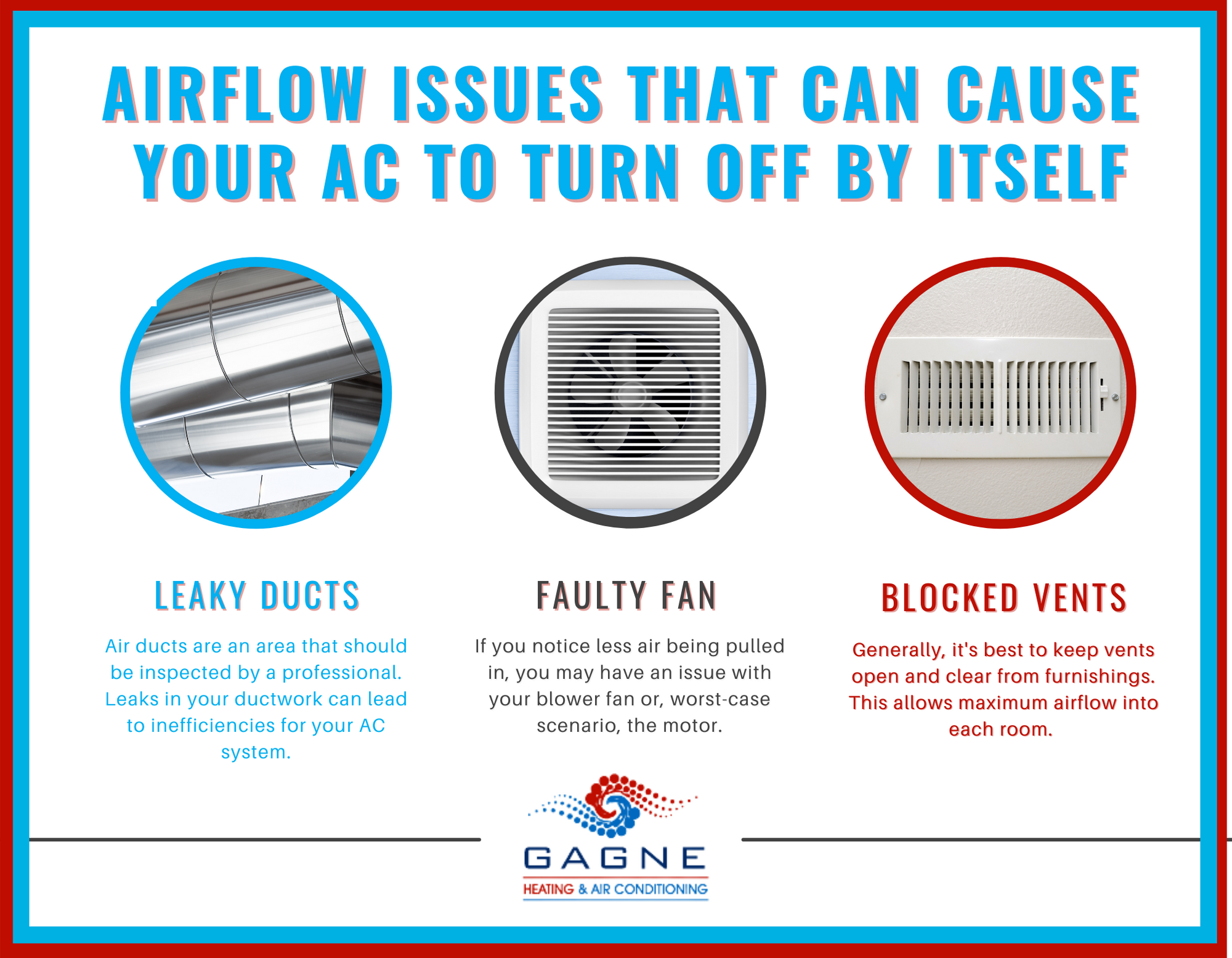
Image Source: gagneac.com
Common Reasons Your AC Stops
Air conditioners are built to handle a lot of work, but sometimes things go wrong. Many parts must work together. If one part has a problem, the whole system can shut down. This is often a safety step. It stops bigger damage from happening.
We will look at the main reasons this happens. Most problems fall into a few groups: airflow issues, electrical problems, refrigerant problems, and control problems (like the thermostat).
Grasping Filter Problems
One of the easiest things to check is your air filter. A clean filter helps your AC work well. A dirty one causes many problems.
The Dirty Filter Issue
Think of your air filter like a mask for your AC system. It catches dust, dirt, pet hair, and other tiny bits in the air. This keeps the inside parts of your AC clean. But if you do not change the filter often, it gets clogged up.
When the filter is full of dirt, air cannot pass through it easily. This is a big problem for your AC. The system needs a lot of air flowing over the cooling coil. This air is what gets cooled and blown into your house.
If there is not enough air flow because of a dirty air filter AC, the cooling coil gets too cold. It can even drop below freezing. When this happens, moisture from the air turns into ice on the coil.
This ice blocks air flow even more. It becomes a cycle. Less air means more ice. More ice means even less air. Your AC struggles to cool the house. It might run longer and longer without reaching the right temperature. Or, it might shut down completely.
Why does it shut down? Many AC systems have safety switches. They can sense when things are not working right. A common safety switch checks the temperature or pressure of the cooling coil. If it gets too cold (because of ice) or the pressure is wrong, the switch tells the AC to stop. This protects the compressor, the most costly part.
So, a simple dirty air filter AC can cause your AC to stop running. It might run for a bit, then shut off. Or it might not turn on at all because of the safety switch.
-
Symptoms:
- Air coming from vents is not very cold.
- Weak air flow from vents.
- Ice forming on the indoor coil or the copper lines near the indoor unit.
- The outside unit running but the inside fan not blowing much air.
- The AC turns on and off too often (short cycling AC).
-
What to Check:
- Find your AC’s air filter. It is usually near the indoor air handler, in a return vent in the wall or ceiling, or near the furnace.
- Pull out the filter. Hold it up to a light. Can you see light through it? If not, it is very dirty.
- Check the date you last changed it. Filters should be changed often, usually every 1-3 months, depending on the type of filter and how much you use your AC and furnace.
- If it is dirty, replace it with a clean one of the correct size. Make sure to put the new filter in the right way (there is usually an arrow showing the air flow direction).
Changing your filter is the simplest fix and should be the first thing you try if your AC is shutting off.
Deciphering Coil Freezing
As we just talked about, a frozen evaporator coil is a common result of air flow problems. The evaporator coil is the part of your AC system inside your house where the air gets cooled.
When the air flowing over this coil is too low, or if there is not enough refrigerant (the cooling liquid), the coil gets too cold. It can go below 32°F (0°C). Water from the air (humidity) freezes onto the coil fins. This builds up over time.
A frozen coil looks like a block of ice covering the metal fins. This ice stops air from moving over the coil completely. With no air flow, the AC cannot cool your house. It will likely shut down. Again, this is often due to a safety switch. The AC might try to start, but quickly stop because the system pressure is wrong due to the ice.
-
Causes of a Frozen Coil:
- Dirty Air Filter: The most common cause, as discussed above. Poor air flow.
- Blocked Vents or Return Grilles: If too many vents in your house are closed, or if furniture blocks the return air grilles (where the AC sucks air in), there is not enough air flow.
- Problem with the Blower Fan: The indoor fan blows air over the coil. If it is running too slow, or not running at all, the coil will freeze.
- Low Refrigerant: This is a serious problem. If the system has a refrigerant leak air conditioner, there is not enough cooling liquid. The remaining liquid gets too cold, causing the coil to freeze. We will talk more about refrigerant leaks later.
- Dirty Evaporator Coil: Over time, the coil itself can get coated in dirt and grime, even with a good filter. This layer of dirt can act like a blanket, stopping the coil from absorbing heat and making it freeze.
- Running the AC in Very Cold Weather: AC systems are designed for certain outside temperatures. Running one when it is too cold outside can make the coil freeze, as the system cannot handle the low heat load correctly.
-
Symptoms:
- Ice on the indoor coil, refrigerant lines (the insulated copper pipe), or even on the outside unit’s line (the smaller copper pipe).
- The AC unit is running, but no cold air comes out, or air flow is very weak.
- Water leaks around the indoor unit (as the ice melts).
- The AC AC unit making noise then stops. Sometimes the fan hits the ice, or the system sounds strained before shutting off.
-
What to Do:
- Turn the AC Off Immediately: Do not try to run it with ice on the coil. This can damage the compressor. Turn the system switch to “Off” or “Fan Only.”
- Let the Ice Melt: This can take several hours. You can speed it up by running the indoor fan (set the thermostat to “Fan On”) if the fan is working. This blows room air over the coil to melt the ice.
- Check for the Cause: While it is melting, check your air filter. Make sure vents and return grilles are open and not blocked.
- After Melting: Once all the ice is gone, turn the system back to “Cool.” Watch it carefully. If it freezes again quickly, there is a bigger problem like low refrigerant, a bad blower, or a very dirty coil.
If the frozen evaporator coil comes back after ensuring good air flow, you likely need a professional.
Interpreting Electrical Hiccups
Electrical problems are another big reason why an AC might shut off. These can range from simple tripped breakers to failing parts like the capacitor or even the compressor itself.
Circuit Breaker Woes
Your AC system uses a lot of electricity, especially when the compressor starts up. It has its own circuit breaker or fuse in your home’s electrical panel. This breaker is a safety device. If too much electricity flows through the circuit, or if there is a short circuit, the breaker trips. This stops the power to the AC unit, preventing fires or damage.
An AC tripped breaker means the circuit was overloaded or there was an electrical fault.
-
Causes of a Tripped Breaker:
- Normal Start-Up Surge: Sometimes, older breakers or those that are weak can trip just from the normal surge of power when the AC starts.
- Overheating Unit: If the outdoor unit (condenser) gets too hot, the fan or compressor might pull more power than usual, tripping the breaker. This can be caused by dirty coils or lack of airflow around the unit.
- Electrical Fault: A short circuit in the wiring, motor (fan or compressor), or capacitor can cause a sudden spike in power draw, tripping the breaker.
- Dirty Outdoor Coil: If the outdoor coil (condenser coil) is covered in dirt and debris, the compressor has to work much harder to get rid of heat. Working harder means using more electricity, which can trip the breaker.
- Problem with a Motor: If the fan motor or compressor motor is failing, it might try to draw too much power.
-
Symptoms:
- The AC unit is completely dead. No lights, no sound.
- The switch on the circuit breaker panel is flipped to the “Off” or middle position.
-
What to Do:
- Go to your electrical panel. Find the breaker labeled for your air conditioner (it might say “AC,” “Furnace,” or have a number).
- If it is tripped: Flip it firmly all the way to the “Off” position, then back to the “On” position. Do NOT just push it back to “On” if it is in the middle position; you must reset it by turning it fully Off first.
- Try starting the AC again.
-
When to Call a Pro:
- If the breaker trips again right away. This means there is a serious electrical problem or a failing part pulling too much power.
- If the breaker trips often. This is a sign of a problem that needs fixing.
- If you smell burning near the panel or the AC unit.
Resetting an AC tripped breaker is a quick check, but repeated tripping is a warning sign.
Capacitor Troubles
The capacitor is an electrical part in your AC unit, usually in the outdoor unit. Think of it like a battery that gives a big jolt of electricity to help start the fan motor and the compressor motor. There is usually one capacitor for the fan and one for the compressor, or a dual capacitor that does both jobs.
Capacitors can get weak over time, especially in hot weather. A failing or bad AC capacitor failure cannot give that strong starting jolt.
-
Symptoms of Capacitor Failure:
- The outdoor unit makes a humming or buzzing sound but does not start, or only the fan runs but the compressor does not.
- The unit tries to start but quickly shuts off.
- The AC unit runs for a while, but then stops cooling and might shut down (AC unit making noise then stops – the noise might be the hum of a motor trying to start).
- The fan or compressor starts slowly.
- The breaker might trip because the motor is trying to start but cannot.
-
What to Do:
- There is not much a homeowner can do safely with a capacitor. They store electricity, even after the power is off, and can give you a serious shock.
- If you suspect a capacitor problem based on the symptoms, turn off the power to the AC unit at the breaker box.
- Call an HVAC technician. They have the tools and knowledge to test the capacitor safely and replace it.
A failing AC capacitor failure is a common cause for an AC unit that struggles to start or keeps shutting off shortly after starting.
Compressor Overheating
The compressor is the heart of your AC system, located in the outdoor unit. It is a big, powerful electric pump. It takes the cool refrigerant gas, squeezes it (compresses it) into a hot, high-pressure gas, and pushes it through the outdoor coil to release heat.
The compressor gets very hot from doing its job. It needs to cool down. It relies on the refrigerant flowing through it and air flowing over the outdoor coil (blown by the outdoor fan) to cool off.
If the compressor cannot cool down properly, it will overheat. AC systems have internal thermal overload switches in the compressor. If the compressor gets too hot, this switch turns the compressor off to prevent it from burning out.
-
Causes of Overheating Compressor:
- Dirty Outdoor Coil: If the fins on the outdoor unit are clogged with dirt, grass clippings, or leaves, heat cannot escape. The compressor has to work harder and gets hotter.
- Low Refrigerant: If there is a refrigerant leak air conditioner, there is less refrigerant flowing. This means less cool refrigerant returning to the compressor to help cool it. The compressor also has to work harder to try and cool the house with less refrigerant. This makes it run hotter.
- Bad Outdoor Fan Motor: If the fan on the outdoor unit is not running, running too slow, or the fan blades are broken, air cannot flow over the hot coil. The compressor will overheat quickly.
- Electrical Problems: Issues like a bad capacitor (making the compressor work harder to start) or voltage problems can cause the compressor to overheat.
- Running in High Temperatures: On extremely hot days, especially if the unit is old or has other issues, the compressor might struggle to keep up and overheat.
- Blocked Airflow Around Unit: Shrubs, fences, or other things too close to the outdoor unit can stop air from flowing through the coil, leading to overheating.
-
Symptoms of Overheating Compressor:
- The outdoor unit hums or makes a loud noise, then shuts off. The fan might still be running, or everything might stop.
- The unit runs for a short time, cools a little, then shuts off (short cycling AC).
- The metal case of the compressor (the big black part inside the outdoor unit) feels very hot to the touch (DO NOT TOUCH IT WHILE IT IS RUNNING!).
- The breaker might trip.
-
What to Do:
- Turn the AC Off: Let the unit cool down for a few hours.
- Check the Outdoor Unit: Make sure the fins are clean. Gently spray them with a hose from the inside out (with power off!). Remove any debris from around the unit. Make sure the fan is running when the unit is supposed to be on (be careful!).
- Check Refrigerant Lines: Is there ice? This could point to low refrigerant.
If the unit still overheats and shuts off after cleaning the outdoor coil and ensuring good airflow, it is likely a more serious issue like low refrigerant, a failing motor, or an aging compressor. An overheating AC compressor often needs professional help.
Fathoming Refrigerant Issues
Refrigerant is the special liquid (or gas, depending on its state) that makes cooling possible. It flows through the coils, absorbing heat from inside your house and releasing it outside. The system is sealed. The amount of refrigerant put in at the factory is the correct amount for the system to work right.
A refrigerant leak air conditioner means some of this cooling liquid has escaped. Refrigerant is not used up like fuel; it just cycles through the system. So, if your AC is low on refrigerant, it means there is a leak somewhere.
Low refrigerant causes several problems:
1. The system cannot absorb as much heat from your home.
2. The pressure inside the system changes.
3. The indoor coil can get too cold, causing it to freeze (frozen evaporator coil).
4. The compressor has to work harder, which can make it overheat (overheating AC compressor).
All these issues can cause the AC to shut off. The safety switches respond to the low pressure, the coil freezing, or the compressor overheating.
-
Symptoms of a Refrigerant Leak:
- Air from the vents is not cold enough.
- Ice on the indoor coil or the large copper line outside.
- The AC runs constantly but does not cool the house well.
- A hissing or bubbling sound (this is the refrigerant leaking).
- Higher electricity bills (the AC runs longer to try and cool).
- The unit might be short cycling AC because it cannot reach the set temperature.
-
What to Do:
- Turn off the AC.
- Call an HVAC professional. Refrigerant leaks are serious. Adding more refrigerant without finding and fixing the leak is a temporary fix and harmful to the environment. Technicians use special tools to find leaks and properly repair them before adding the correct amount of refrigerant.
- Handling refrigerant is dangerous and requires special training and tools. Do not try to add refrigerant yourself.
A refrigerant leak air conditioner is a common, but serious, reason for an AC to keep shutting off. It needs expert repair.
Addressing Thermostat Confusion
The thermostat is the control center for your AC. It tells the unit when to turn on, when to turn off, and what temperature to maintain. Problems with the thermostat can easily cause your AC to behave strangely, including shutting off unexpectedly or short cycling AC.
-
Causes of Thermostat Issues:
- Wrong Settings: Simple things like being set to “Fan On” instead of “Auto,” being in “Heat” mode instead of “Cool,” or the temperature setting being too close to the room temperature can cause issues.
- Dead Batteries: Many digital thermostats use batteries. If they are low, the thermostat might not work right or lose power completely.
- Poor Location: If the thermostat is in direct sunlight, near a heat source (like a lamp or TV), or on a wall above a heat register, it will sense the wrong temperature. It might think the room is cool enough and turn the AC off too soon.
- Loose Wiring: The wires connecting the thermostat to the AC system can become loose or corroded. This breaks the communication between the thermostat and the unit.
- Faulty Thermostat: Like any electronic device, the thermostat itself can fail.
-
Symptoms of Thermostat Issues AC:
- The AC does not turn on when you set the temperature lower.
- The AC turns off before the house reaches the set temperature.
- The AC turns on and off too often (short cycling AC).
- The thermostat display is blank or shows strange readings.
- The temperature in the house does not match the thermostat reading.
-
What to Do:
- Check the Settings: Make sure the thermostat is set to “Cool” and “Auto.” Set the temperature at least 5 degrees lower than the current room temperature to test it.
- Replace Batteries: If your thermostat uses batteries, try putting in fresh ones.
- Check Location: Is anything heating up the thermostat directly? Is there a draft from a window or door nearby that could affect the reading?
- Clean it: Dust can sometimes affect older thermostats.
- Check Breaker: Ensure the breaker for the HVAC system (furnace) is not tripped, as this often powers the thermostat as well.
If you have checked these simple things and still suspect thermostat issues AC, you might need an HVAC technician or an electrician to check the wiring or replace the thermostat.
When the AC Unit Makes Noise
Sometimes, before your AC unit shuts off, you hear strange or loud noises. An AC unit making noise then stops is often a sign that a part is failing or something is wrong inside the unit. The noise is the problem happening, and the stopping is the system reacting or a safety shutoff.
-
Types of Noises and What They Might Mean:
- Grinding or Squealing: Can be a fan motor or the compressor motor bearings failing. This extra friction can cause the motor to overheat or seize, leading to a shutoff.
- Loud Banging or Clanking: Something might be loose and hitting a fan blade or other parts. If a fan blade breaks off, it can cause noise, vibration, and unbalance that might make the motor fail or the unit shut down.
- Humming or Buzzing: As mentioned with capacitor failure, this can be a motor trying to start but unable to.
- Hissing or Bubbling: Often means a refrigerant leak air conditioner.
- Clicking: A series of rapid clicks could be a relay or contactor trying to engage but failing, possibly due to electrical issues or a failing part.
-
Why Noise Leads to Shutoff:
- Failing motors can pull too much power, tripping the breaker or causing internal safety switches to activate.
- Loose parts or broken fan blades can cause vibration that triggers safety switches or damages components, leading to a shutoff.
- Compressors making loud grinding noises are often failing and will eventually shut down due to internal overload or seizing.
-
What to Do:
- Turn the AC Off Immediately: If you hear loud, unusual noises, especially grinding or banging, turn the system off right away to prevent further damage.
- Listen Carefully: Try to figure out where the noise is coming from (indoor unit, outdoor unit, vents).
- Call a Professional: Unusual noises, especially mechanical ones, usually mean a part is broken or about to break. This requires a technician to diagnose and repair safely.
An AC unit making noise then stops is a clear sign that something is wrong mechanically or electrically. Do not ignore these noises.
What is Short Cycling?
We have mentioned short cycling AC several times. Let’s take a closer look. Short cycling is when your air conditioner turns on, runs for a very short period (maybe just a few minutes), shuts off, and then turns back on again soon after. A normal cooling cycle should last at least 15-20 minutes, sometimes longer on hot days.
Short cycling is bad for your AC and your wallet.
* It wears down the components faster, especially the compressor, which uses the most power to start. Constant starting and stopping reduces its lifespan.
* It wastes energy because the unit uses a lot of power each time it starts.
* It does not cool your home effectively. The system needs to run long enough to remove heat and humidity from the air.
Short cycling AC is not usually the cause of the problem; it is a symptom of another issue forcing the unit to turn off prematurely.
-
Common Causes of Short Cycling:
- Oversized AC Unit: If your AC is too big for your home, it will cool the house very quickly. It reaches the thermostat setting fast and shuts off. Then the temperature goes up slightly, and it turns back on. This repeats often.
- Low Refrigerant: As discussed, low refrigerant makes the unit work harder but cool less. It might run briefly, struggle, trigger a safety, and shut off, then try again (refrigerant leak air conditioner).
- Frozen Evaporator Coil: Ice buildup prevents proper cooling and airflow. The system struggles, might overheat or sense low pressure, and shut off (frozen evaporator coil).
- Dirty Air Filter: Restricts airflow, leading to freezing or poor cooling (dirty air filter AC).
- Thermostat Issues: A bad thermostat or one in a bad location can tell the AC to shut off too soon (thermostat issues AC).
- Electrical Problems: A failing capacitor or an overheating AC compressor can cause the unit to shut down shortly after starting. A repeatedly AC tripped breaker might also be linked if it resets quickly.
- Clogged Drain Line: If the drain line that carries away condensation is clogged, water can back up. Some systems have a safety switch that turns the AC off if the water level gets too high.
-
What to Do:
- Identify the root cause. Short cycling is a symptom. Check the filter, look for ice, check the thermostat settings.
- If the problem is not obvious (like a very dirty filter or simple thermostat setting), call a professional. They can diagnose the specific reason for the short cycling.
An AC that is short cycling AC needs attention. Ignoring it can lead to costly repairs down the road.
Troubleshooting Steps When Your AC Stops
When your AC unit keeps shutting off, do not panic. There are a few simple things you can check yourself before calling for help. These steps cover the most common and easiest-to-fix problems. This is your basic guide to troubleshooting AC unit turning off.
Here is a step-by-step checklist:
-
Check the Thermostat:
- Is it set to “Cool”?
- Is it set to “Auto” for the fan? (Not “On” unless you want the fan running all the time).
- Is the temperature set low enough? (Try setting it at least 5 degrees below the current room temp).
- Are the batteries good? Replace them if needed.
- Is the thermostat in direct sunlight or near a heat source?
-
Check the Air Filter:
- Find the filter location (usually near the indoor unit or in a return vent).
- Pull it out. Is it clogged with dirt and dust?
- If it is dirty, replace it with a clean filter of the correct size. Make sure the airflow arrow points towards the air handler/furnace.
-
Check for Ice:
- Look at the large copper line outside the house connected to the outdoor unit. Is there ice on it?
- Look at the indoor coil (inside your air handler/furnace). Is there ice on it?
- If there is ice (frozen evaporator coil), turn the AC system switch to “Off” immediately. Let it melt (can take hours). Run the fan (“Fan On”) to speed this up if the fan works. Do NOT try to run the AC again until all ice is gone.
-
Check the Circuit Breaker:
- Go to your home’s electrical panel.
- Find the breaker for the AC unit (and possibly the furnace/air handler, as they might be on the same circuit).
- If a breaker is tripped (AC tripped breaker), turn it firmly to “Off” and then back to “On.”
- If it trips again right away, stop trying to reset it.
-
Check the Outdoor Unit:
- Is the power switch near the outdoor unit turned on? (It looks like a light switch in a box on the wall).
- Is the unit free of leaves, grass, and debris around it? Is the coil clean (fins not clogged)?
- Is the outdoor fan running when the AC is trying to cool? (Look through the top grille – BE CAREFUL not to touch anything inside).
- Do you hear strange noises (AC unit making noise then stops)?
-
Listen and Observe:
- When the AC tries to turn on, listen carefully. Do you hear a hum but nothing starts? Does it try to start and then stop? Does it make loud noises before stopping?
- Does it run for a short time and then stop (short cycling AC)?
These checks cover the most common issues. If you find a problem like a dirty filter or tripped breaker, fixing it might solve your issue. If you find ice, follow the steps to melt it and then watch the unit.
However, if the ice comes back, the breaker keeps tripping, you hear bad noises, or the unit still does not work right after these checks, it is time to call a professional.
When to Call a Pro
While some AC problems are simple fixes you can do yourself, many require the skills, tools, and knowledge of a trained HVAC technician. Do not try to fix complex issues like electrical problems inside the unit, refrigerant leak air conditioner repairs, or replacing parts like the compressor or capacitor yourself. This can be dangerous and can cause more damage.
Call a professional if:
* The circuit breaker for the AC unit keeps tripping after you reset it.
* There is ice on your coil, and it comes back after you melt it and ensure good air flow. This points to a low refrigerant issue (refrigerant leak air conditioner) or a major air flow problem.
* The outdoor unit hums or buzzes but does not start, or the fan or compressor does not run (AC capacitor failure).
* You hear loud, unusual noises coming from the unit (AC unit making noise then stops).
* The unit is short cycling AC, and you have ruled out the simple causes like a dirty filter or thermostat setting.
* The unit is not cooling well, and you suspect a refrigerant leak air conditioner (ice, hissing sound).
* You suspect the overheating AC compressor.
* You have followed the basic troubleshooting AC unit turning off steps and cannot find or fix the problem.
* The problem involves electrical components inside the unit.
* You are unsure about what is causing the issue.
A qualified technician can diagnose the exact problem safely and perform the necessary repairs. Regular maintenance can also help prevent many of these issues from happening in the first place.
Frequently Asked Questions (FAQ)
Here are answers to some common questions people ask when their AC keeps shutting off.
Q: Is it bad if my AC keeps turning on and off quickly?
A: Yes, this is called short cycling AC, and it is bad. It puts extra stress on the system, especially the compressor, and wastes energy. It is usually a sign of an underlying problem that needs to be found and fixed.
Q: How often should I change my air filter?
A: It depends on the type of filter and how much you use your system. Thin, cheap filters need changing every 1-3 months. Thicker filters (3-4 inches) can last 6-12 months. If you have pets or allergies, you might need to change filters more often. Check your filter monthly. If it looks dirty, change it. A dirty air filter AC is a very common cause of problems.
Q: What does it mean if my AC breaker trips?
A: An AC tripped breaker means the circuit is drawing too much electricity, more than the breaker can handle safely. This can be due to a temporary overload, a failing part (like a motor or capacitor) trying to start, or a short circuit. If it trips once, you can try resetting it. If it trips again, there is a problem that needs professional diagnosis.
Q: Can low refrigerant cause my AC to freeze up?
A: Yes, absolutely. Low refrigerant (due to a refrigerant leak air conditioner) is a major cause of a frozen evaporator coil. With less refrigerant, the system pressures drop, and the remaining refrigerant gets too cold, freezing moisture on the coil.
Q: Why would my outdoor AC unit be humming but not running?
A: This is often a sign of a failing start capacitor (AC capacitor failure) in the outdoor unit. The motor (fan or compressor) is trying to start but does not get the necessary jolt of power from the capacitor. It needs to be checked and likely replaced by a technician.
Q: Is it normal for my AC to make noise before shutting off?
A: Some noise during operation is normal, but loud, unusual sounds like grinding, banging, or persistent buzzing just before the unit stops are not normal. An AC unit making noise then stops suggests a mechanical or electrical issue that needs immediate attention.
Q: Can a thermostat issue cause my AC to short cycle?
A: Yes, thermostat issues AC are a common cause of short cycling. A faulty thermostat, low batteries, or the thermostat being in a bad location (like direct sun) can cause it to read the temperature incorrectly or send the wrong signals to the AC unit, making it turn on and off too often.
Q: My AC compressor seems very hot. Is that normal?
A: The compressor gets hot when it runs, but it should not be excessively hot. If it is overheating AC compressor and shutting down, it indicates a problem. Common causes are dirty outdoor coils preventing heat release, low refrigerant making the compressor work too hard, or a bad outdoor fan.
Q: How can I prevent my AC from shutting off like this?
A: Regular maintenance is key. Change your air filter regularly, keep the outdoor unit clean and free of debris, ensure vents are open, and get professional tune-ups once a year. Catching small problems early can prevent bigger issues like a frozen evaporator coil or overheating AC compressor.
By checking these common issues and knowing when to call for expert help, you can get your AC back to cooling your home properly and keep it running smoothly for years to come. Remember, ignoring the signs can lead to more expensive repairs later.