
Determining the correct BTU (British Thermal Unit) for your air conditioner is crucial for efficient cooling and comfort. The BTU rating indicates an air conditioner’s cooling capacity; higher BTU means more cooling power. To figure out how much BTU you need, you must consider your room size in square footage, the ceiling height, insulation quality, window types and number, and the number of people and heat-generating appliances typically present in the space.
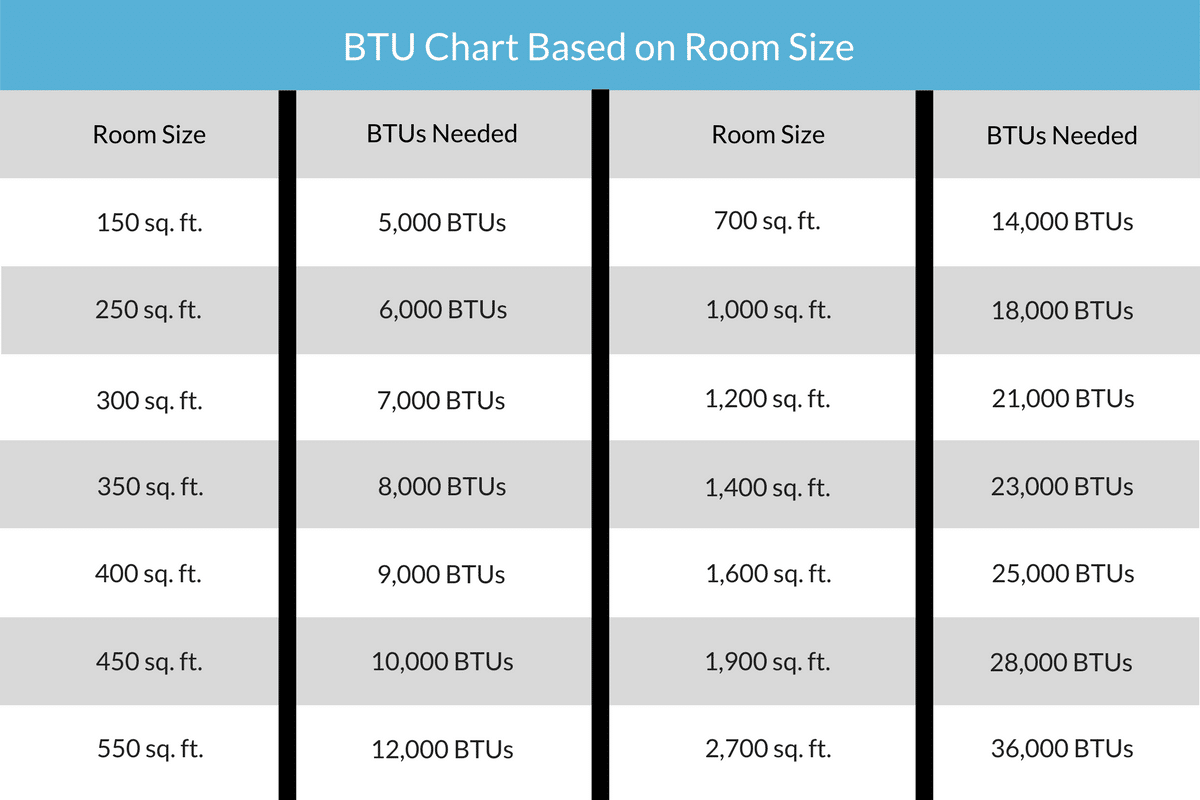
Image Source: lirp.cdn-website.com
Deciphering Your Cooling Needs: The Importance of BTU
When the mercury rises, the promise of a cool, comfortable home becomes paramount. But what’s the secret to achieving that oasis of chill? It all boils down to something called BTU – British Thermal Units. This seemingly simple acronym holds the key to unlocking your perfect home cooling experience.
What are British Thermal Units (BTU)?
Think of BTU as the measurement of how much heat an air conditioner can remove from a space in one hour. The higher the BTU number, the more heat the unit can tackle. It’s the power behind your cool air. If your air conditioner has too few BTUs, it will struggle to cool your space effectively, running constantly and failing to reach your desired temperature. On the other hand, an AC with too many BTUs can be just as problematic. It will cool the space too quickly, shutting off before it has a chance to remove humidity. This leads to a clammy, uncomfortable environment and wasted energy.
Why Air Conditioner Sizing Matters So Much
Getting the air conditioner sizing right is about more than just comfort; it’s about efficiency, longevity, and your wallet. An appropriate AC size ensures your unit operates optimally.
- Too Small: An undersized unit will run non-stop, never quite reaching the set temperature. This leads to excessive wear and tear, higher energy bills, and persistent discomfort.
- Too Big: An oversized unit will cool your room very quickly and then cycle off. This short-cycling prevents the AC from dehumidifying the air effectively, leaving your home feeling cool but sticky. It also leads to inefficient energy use and can shorten the lifespan of the compressor.
Calculating Your Cooling Capacity: The BTU Calculator and Room Size
The most fundamental factor in determining your air conditioner’s BTU requirement is the room size in square footage. However, it’s not the only factor. Several other elements play a significant role in how much cooling capacity you’ll need.
The Basics: Square Footage and BTU Needs
A general rule of thumb is to use a BTU calculator or a chart that correlates square footage to BTU. This provides a baseline for your calculations.
Here’s a simplified guide:
| Room Square Footage | Recommended BTU |
|---|---|
| 100-150 | 5,000 |
| 150-250 | 6,000 |
| 250-300 | 7,000 |
| 300-350 | 8,000 |
| 350-400 | 9,000 |
| 400-450 | 10,000 |
| 450-550 | 12,000 |
| 550-700 | 14,000 |
| 700-1000 | 18,000 |
| 1000-1200 | 21,000 |
| 1200-1400 | 23,000 |
| 1400-1700 | 24,000 |
| 1700-2000 | 30,000 |
Note: This is a general guideline. Other factors can adjust these numbers.
How to Measure Your Square Footage
Measuring your room’s square footage is straightforward:
- Measure the length of the room in feet.
- Measure the width of the room in feet.
- Multiply the length by the width.
Example: If your living room is 15 feet long and 20 feet wide, the square footage is 15 ft * 20 ft = 300 sq ft. According to the chart, you would need around a 7,000-8,000 BTU air conditioner for this space.
Beyond the Walls: Factors Affecting BTU Needs
While square footage is your starting point, several other factors influence your home cooling needs and can significantly alter the BTU recommendation from a basic chart.
Ceiling Height
Higher ceilings mean a larger volume of air to cool. For rooms with ceilings significantly higher than the standard 8 feet, you may need to increase the BTU rating by 10-20%.
Sunlight Exposure
Rooms that receive a lot of direct sunlight, especially through south or west-facing windows, will heat up more. If your room has large windows or is exposed to intense sun for much of the day, consider increasing the BTU by up to 10%.
Insulation Quality
The better insulated your home is, the less heat will enter from the outside. Poor insulation means more heat gain, requiring a higher BTU unit. Conversely, a well-insulated space requires less powerful cooling.
Window Types and Number
Single-pane windows are less efficient at blocking heat than double-pane or energy-efficient windows. The more windows a room has, and the less efficient they are, the more heat will enter, necessitating a higher BTU.
Room Location and Usage
- Kitchens: Kitchens generate a lot of heat from appliances like ovens, stovetops, and refrigerators. A general rule is to add about 4,000 BTUs to the calculated need for a kitchen.
- Sunrooms: These rooms are designed to capture sunlight and can become very hot, often requiring a significant BTU boost.
- Occupancy: Each person in a room adds body heat. For every person typically occupying the room beyond two, add about 600 BTUs.
- Appliances: Heat-generating appliances like computers, televisions, and lamps contribute to the cooling load. While often minor, in densely equipped spaces, this can add up.
Climate Considerations
If you live in a very hot and humid climate, you might need a slightly higher BTU unit than the general recommendations, even for a given square footage. This is because the AC will work harder to remove both heat and moisture from the air.
Using an Online BTU Calculator
Many reputable HVAC manufacturers and retailers offer free online BTU calculator tools. These calculators are designed to factor in the various elements mentioned above, providing a more personalized recommendation for your cooling capacity. Simply input your room dimensions, ceiling height, window details, and other relevant factors, and the tool will suggest an appropriate BTU range.
Choosing the Right Air Conditioner: Types and Features
Once you’ve determined your required BTU, the next step is selecting the right type of air conditioner and considering its features, particularly its efficiency rating.
Types of Air Conditioners
- Window Air Conditioners: These are the most common and affordable option for single-room cooling. They are designed to fit into a window opening and are relatively easy to install.
- Portable Air Conditioners: Similar to window units, but they sit on the floor and vent hot air through a hose out a window. They offer flexibility but are often less efficient than window units.
- Ductless Mini-Split Systems: These systems consist of an outdoor compressor and condenser unit and one or more indoor air-handling units. They are highly efficient and allow for zone cooling, meaning you can cool individual rooms or areas independently. They are more expensive upfront but can be very cost-effective in the long run.
- Central Air Conditioning: This is a whole-house system that cools your entire home through a network of ducts. It’s the most comprehensive cooling solution for larger homes.
The Significance of Efficiency Rating
When you purchase an air conditioner, you’ll notice an efficiency rating, most commonly the Energy Efficiency Ratio (EER) or Seasonal Energy Efficiency Ratio (SEER).
- EER (Energy Efficiency Ratio): This measures an air conditioner’s efficiency at a specific outdoor temperature (95°F). A higher EER means greater efficiency.
- SEER (Seasonal Energy Efficiency Ratio): This is a more comprehensive measure, as it reflects efficiency over an entire cooling season, taking into account varying temperatures. The higher the SEER rating, the more energy-efficient the unit.
A higher efficiency rating might mean a slightly higher upfront cost, but it translates to lower electric usage and savings on your energy bills over time. It’s a wise investment for your home cooling needs.
Factors Affecting Electric Usage
The BTU of your air conditioner is a primary determinant of its power consumption, but other factors also influence your electric usage:
- Efficiency Rating (SEER/EER): As mentioned, higher efficiency units use less electricity to achieve the same cooling effect.
- Thermostat Settings: Every degree you lower the thermostat increases electric usage. Setting your thermostat to a comfortable but not excessively cold temperature makes a big difference.
- Usage Habits: Frequent opening and closing of doors and windows while the AC is running allows cool air to escape and warm air to enter, forcing the unit to work harder.
- Maintenance: A well-maintained air conditioner, with clean filters and coils, operates more efficiently and uses less electricity. Neglected units can see their energy consumption rise significantly.
- Ambient Temperature: On extremely hot days, your air conditioner will naturally run more and consume more electricity to maintain your desired temperature.
- Home Insulation: As discussed earlier, good insulation keeps cool air in and warm air out, reducing the workload on your AC and thus lowering electric usage.
Adjusting BTU for Specific Scenarios
Let’s delve deeper into how to adjust the baseline BTU calculations based on specific circumstances for your residential HVAC needs.
H3: Scenario Adjustments to BTU Requirements
When using your BTU calculator or a chart, remember to consider these common adjustments:
-
Adding for Occupancy:
- If more than two people regularly use the room, add 600 BTUs per additional person.
- Example: A 300 sq ft room (needs 7,000 BTU baseline) regularly occupied by four people would need 7,000 + (2 * 600) = 8,200 BTUs.
-
Adding for Kitchen Use:
- For kitchens, add approximately 4,000 BTUs to the calculated need.
- Example: A 200 sq ft kitchen (needs 6,000 BTU baseline) would require 6,000 + 4,000 = 10,000 BTUs.
-
Adjusting for Sunlight:
- If the room has significant sun exposure (e.g., large south or west-facing windows), add 10% to the BTU.
- Example: A 400 sq ft room (needs 9,000 BTU baseline) with very sunny windows might need 9,000 * 1.10 = 9,900 BTUs.
-
Adjusting for Ceiling Height:
- For ceilings over 8 feet, add 10-20% to the BTU.
- Example: A 350 sq ft room (needs 8,000 BTU baseline) with 10-foot ceilings might need 8,000 * 1.15 = 9,200 BTUs.
H4: Putting it All Together: A Comprehensive Example
Let’s calculate the BTU needed for a living room:
- Room Size: 18 ft x 22 ft = 396 sq ft.
- Baseline BTU (from chart): Approximately 9,000 BTU for 396 sq ft.
- Ceiling Height: Standard 8 ft (no adjustment needed).
- Sunlight: One large west-facing window (add 10%).
- 9,000 BTU * 1.10 = 9,900 BTU.
- Occupancy: Typically 3 people.
- 9,900 BTU + 600 BTU = 10,500 BTU.
- Appliances: A large TV and computer (consider adding a small percentage, perhaps 5-10% if these are very high-power units and always on; for this example, we’ll skip a specific addition for standard electronics, but acknowledge their contribution).
Final Recommended BTU: Around 10,500 BTU. You would likely look for a 10,000 or 12,000 BTU air conditioner in this case, leaning towards the slightly higher end to ensure adequate cooling without over-sizing.
When to Consult a Professional
While these guidelines and tools are helpful for determining your cooling capacity, there are times when seeking professional advice is the best course of action.
H5: Professional HVAC Consultation
For complex situations, such as multi-room cooling, unusual room shapes, homes with significant energy efficiency upgrades or retrofits, or if you’re considering a whole-house system, consulting a qualified HVAC technician is highly recommended. They can perform a more detailed load calculation (known as a Manual J calculation) that accounts for all the specific nuances of your home’s construction, insulation, air leakage, and local climate. This ensures the most accurate air conditioner sizing for your home cooling needs.
Frequently Asked Questions (FAQ)
Q1: Can I use a bigger AC than I need?
Yes, you can, but it’s generally not recommended. An oversized air conditioner will cool your space too quickly and shut off before it has a chance to remove humidity, leading to a cool but damp environment. It also wastes energy and can put unnecessary strain on the unit. It’s better to get the appropriate AC size.
Q2: Does the color of my walls or roof affect BTU needs?
While lighter colors generally reflect more heat, the impact on the BTU needed for a specific room is usually minor compared to factors like insulation and window exposure. It’s not typically a primary consideration in standard air conditioner sizing.
Q3: How often should I replace my air filters?
You should check and replace your air filters regularly, typically every 1-3 months, depending on the filter type and environmental factors (like pets or allergies). Clean filters are crucial for efficient operation and good indoor air quality, impacting electric usage.
Q4: What is the difference between BTU and Watts?
BTU measures cooling capacity (heat removal), while Watts measure electrical power consumption. An air conditioner that removes a lot of heat (high BTU) might consume a significant amount of power (high Watts), but the efficiency rating helps determine how much power it uses per unit of cooling.
Q5: How do I find the efficiency rating of an air conditioner?
The efficiency rating (EER or SEER) is usually clearly displayed on the unit’s packaging, in the product manual, and often on an EnergyGuide label required by the government. Always check this rating when making a purchase to ensure you’re getting good value and energy savings for your residential HVAC system.
By carefully considering your room size, potential heat gains, and other contributing factors, you can confidently select an air conditioner with the right cooling capacity and efficiency rating for your home cooling needs, ensuring a comfortable and energy-efficient environment.