
Most home fridges need about 100 to 200 watts to run normally. But they need a lot more watts for a moment when the motor starts up. This quick power bump, called the starting watts, can be 800 to 1200 watts, or even more for some fridges. So, a generator needs enough power for this big starting surge, not just the lower running watts. Knowing both numbers is key to picking the right generator size for your refrigerator.
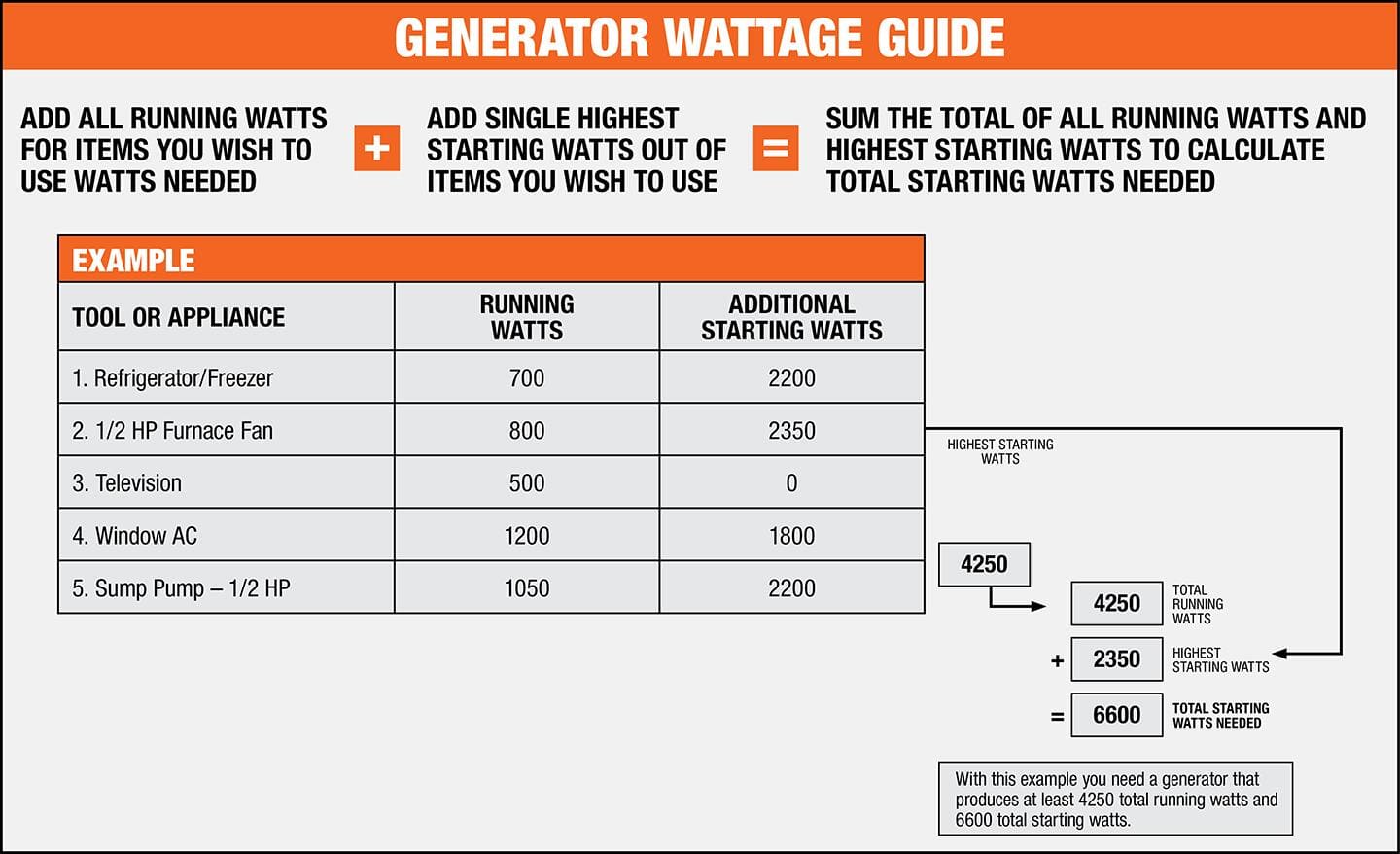
Image Source: dam.thdstatic.com
Why Knowing Fridge Watts Matters
Knowing how much power your fridge uses is a big deal if you plan to run it from a generator. Why would you do this?
- Power Goes Out: A storm or other problem can cut off your home’s power. Your fridge keeps food cold and safe. Knowing its power needs helps you keep it running.
- Going Camping or RVing: If you have a fridge in a camper or want to bring a small fridge, you need to know if your portable generator can handle it.
- Working Off-Grid: Maybe you have a cabin or need power in a place far from power lines. A generator is your power source.
If you don’t know the power needs, you might buy a generator that is too small. It won’t start the fridge. Or you might overload a small generator, which can hurt it or the fridge. Getting the right generator size for refrigerator is important for safety and keeping your food from spoiling.
Grasping Fridge Power Use
Appliances use electricity, and we measure this use in watts. Think of watts as the amount of work the electricity is doing each second. For a fridge, it’s the power needed to cool things down.
Refrigerator power consumption isn’t always the same. It changes depending on what the fridge is doing. The main part that uses power is the compressor. This is the pump that makes the cold air.
Running Watts: The Steady Need
Once a fridge is running and cooled down, the compressor turns on and off to keep the temperature right. When the compressor is on, it uses a steady amount of power. This is called the running watts refrigerator. It’s the power needed minute after minute while the compressor is working. This number is much lower than the power needed to start.
Starting Watts: The Quick Boost
Starting a motor, like the one in a fridge compressor, takes a lot more effort than keeping it going. Think about pushing a heavy box. Getting it to move takes a big push. Keeping it sliding is easier. Electric motors are like that.
When the fridge compressor kicks on, it needs a quick, powerful burst of electricity. This is the starting watts refrigerator. It only lasts for a second or less, but it’s much higher than the running watts. This power surge is also called appliance surge watts.
Why Starting Watts are Bigger
The motor needs to overcome inertia. Inertia is the tendency of things to stay still. To get the parts moving, the motor pulls a lot of current quickly. This high current at startup causes the wattage to spike way up. A generator needs to handle this spike for just a moment. If the generator can’t provide this quick surge of power, the fridge won’t start. The generator might just hum, strain, or even shut down.
Average Refrigerator Wattage
Knowing typical power use helps you guess what you might need. Remember, these are just averages. Your fridge might be different.
Standard Fridge Watts
A regular kitchen fridge usually uses power in these ranges:
- Running Watts: Often between 100 and 200 watts.
- Starting Watts: Often between 800 and 1200 watts. Some big or older fridges might need more.
Let’s look at a table with common sizes:
| Fridge Type | Running Watts (Approx) | Starting Watts (Approx) |
|---|---|---|
| Standard Kitchen Fridge | 120 – 180 | 800 – 1200 |
| Large Kitchen Fridge | 150 – 200 | 1000 – 1500+ |
| Older/Inefficient Fridge | 150 – 250+ | 1200 – 2000+ |
These are just guides for average refrigerator wattage. The actual numbers depend on the fridge’s size, age, model, and how efficient it is. Newer fridges are often more efficient and might have lower running and starting watts than older ones.
Mini Fridge Watts
Smaller fridges, like those for dorm rooms or offices, use much less power.
- Running Watts: Often between 50 and 100 watts.
- Starting Watts: Often between 300 and 500 watts.
Here’s a look at common mini fridge power:
| Fridge Type | Running Watts (Approx) | Starting Watts (Approx) |
|---|---|---|
| Small Mini Fridge | 50 – 80 | 300 – 400 |
| Larger Mini Fridge | 70 – 100 | 400 – 500 |
Knowing the lower mini fridge watts means you can often use a smaller portable generator for fridge needs compared to a standard kitchen fridge.
Other Fridge Types
Fridges come in many styles:
- Side-by-side
- French door
- Top freezer
- Bottom freezer
The style matters less for power use than the size and features. A very large fridge with an ice maker might use a bit more running power and have a higher starting surge than a simple top-freezer model of the same age. Wine coolers or chest freezers also have their own power needs. A chest freezer might have lower running watts but can still have a notable starting surge.
Finding Your Appliance Watts
Guessing is okay for a rough idea, but it’s best to find the exact power needs for your specific fridge. This helps you choose the right generator for your generator wattage for appliances.
Check the Data Plate
Most appliances have a label or plate, usually on the back or inside the door. This data plate has important information. Look for:
- Volts (V): Usually 115V or 120V in North America.
- Amps (A): This is the electric current it uses.
- Watts (W): Sometimes it lists watts directly, often just the running watts.
- Locked Rotor Amps (LRA): This is key! It’s the current the motor pulls when it’s starting or “locked.” This is related to the starting watts.
If it only gives Volts and Amps (A), you can roughly figure out running watts using a simple formula:
- Watts = Volts × Amps
Example: If the label says 120V and 1.5A, the running watts are roughly 120V × 1.5A = 180 watts.
Finding the starting watts from the label is harder. The LRA number is useful. Starting watts are often 3 to 8 times higher than running watts, based on the LRA. A common rule of thumb is to multiply the running watts by 3 to 5 times, but this is just a guess. Looking up your specific model online is often better.
Use a Power Meter
For the most accurate numbers, you can use a special power meter. These meters plug into the wall, and you plug the appliance into the meter. They can measure running watts and often catch the high spike of the starting watts. This gives you the real refrigerator power consumption for your unit.
Check the Manual or Website
Your fridge’s user manual or the manufacturer’s website might list the power needs. Search for the model number. Look under “Specifications” or “Technical Data.” This is a good place to find reliable information.
Deciphering Generator Size for Refrigerator
You have your fridge’s watts, especially the tricky starting watts. Now, how do you use that information to pick a generator? This is where knowing the needed generator size for refrigerator comes in.
Why Generator Size Matters
Generators have two main power ratings:
- Running Watts (or Rated Watts): This is the power the generator can put out continuously for a long time.
- Starting Watts (or Peak Watts, Surge Watts): This is the extra power the generator can provide for a short time (usually a few seconds) to start motors.
For appliances with motors, like fridges, air conditioners, or pumps, the starting watts rating on the generator is super important. The generator’s starting watts must be higher than the appliance’s starting watts.
The Calculation: Starting Watts Rule
To run just a fridge, your generator needs:
- Enough running watts to cover the fridge’s running watts (plus anything else you want to run at the same time).
- Enough starting watts to cover the fridge’s starting watts (plus the largest starting watts of any other appliance that might start at the same time).
The critical number is the starting watts. If the generator can’t handle the fridge’s startup surge, it won’t matter if the running watts are enough.
Formula: Generator Watts >= Fridge Starting Watts (plus other loads)
A simple way to think about it for just a fridge:
- Generator’s Starting Watt Rating must be at least as high as your fridge’s Starting Watts. It’s safer if the generator rating is higher, maybe 1.5 to 2 times the fridge’s starting watts, to be sure.
- Generator’s Running Watt Rating must be at least as high as your fridge’s Running Watts. Again, having extra is good.
Let’s say your fridge needs 1000 starting watts and 150 running watts.
- You need a generator with a Starting Watt rating of at least 1000 watts.
- You need a generator with a Running Watt rating of at least 150 watts.
A generator listed as 1500 Starting Watts / 1200 Running Watts would likely work. A generator listed as 800 Starting Watts / 700 Running Watts would likely not work for the startup.
Accounting for Other Appliance Surge Watts
What if you want to run the fridge and a few lights, maybe charge a phone, and run a fan? You need to add up the running watts of everything you want to run at the same time. Then, look at the starting watts. You only need the generator to handle the single biggest starting surge that might happen.
Example: You want to run:
* Fridge: 1000 starting watts, 150 running watts
* Fan: 50 running watts (no significant start surge)
* Lights: 100 running watts (no significant start surge)
Total Running Watts Needed: 150 (fridge) + 50 (fan) + 100 (lights) = 300 running watts.
Biggest Starting Watts Needed: 1000 watts (from the fridge).
So, you would need a generator with:
* Running Watt rating of at least 300 watts.
* Starting Watt rating of at least 1000 watts.
It’s wise to have some extra power margin. A generator rated around 1500-2000 starting watts and 1200-1600 running watts would give you room for your fridge and other small items. Planning your total generator wattage for appliances is key. Always add a little extra for safety.
Picking the Right Generator
Now you know the wattage you need. What kind of generator should you get? Different types work better for different needs.
Portable Generator for Fridge
A standard portable generator for fridge backup is a common choice. These generators are often powered by gasoline engines. They can be loud but offer a lot of power for their cost.
- Pros: Can provide high starting watts for their size, good for running things like power tools or multiple appliances.
- Cons: Loud, can produce power waves that are not ideal for sensitive electronics (like computers or modern fridges with complex electronics), not very fuel-efficient at low loads.
If you just need basic backup power for a fridge and maybe a few lights, a portable generator can work. Make sure its starting wattage rating is high enough for your fridge’s surge.
Inverter Generator for Refrigerator
Inverter generator for refrigerator use is often a better choice, especially for modern fridges or if you want to run other sensitive items.
- Pros: Quieter than standard generators, more fuel-efficient (they can adjust engine speed to match the power needed), produce “clean” power waves that are safe for electronics, often lighter and more portable.
- Cons: Generally cost more for the same power output, the highest starting watts might be lower than a conventional generator of similar running watts.
Many newer fridges have complex electronic controls. Clean, stable power from an inverter generator is safer for these electronics than the less stable power from some standard portable generators. If your budget allows, an inverter generator is a strong option for running a fridge.
Generator Wattage for Appliances: Totaling Up
When choosing a generator, list all the appliances you might want to run at the same time during an outage or trip.
- List: Write down each appliance.
- Find Watts: Look up or estimate the running watts and starting watts for each.
- Sum Running: Add up the running watts for all the appliances on your list. This is your total continuous power need.
- Find Biggest Start: Look at the starting watts for each appliance. Pick the single highest starting wattage number. This is the biggest surge your generator needs to handle at one moment. (Note: It’s unlikely two large motor appliances like a fridge and a window AC will start at the exact same millisecond, but it’s good practice to size for the largest single surge).
- Choose Generator: Select a generator with:
- A Running Watt rating higher than your total running watts sum.
- A Starting Watt rating higher than your biggest starting wattage number.
Adding a 20% safety margin to both your calculated running and starting needs is a smart move.
Best Ways to Run Your Fridge on a Generator
Once you have your generator, here are some tips for running your fridge safely and effectively.
Connect Safely
- Use heavy-duty, outdoor-rated extension cords. The cord must be thick enough (low gauge number) for the distance and power. A thin cord can overheat or cause voltage drops, which can hurt the fridge motor.
- Plug the fridge directly into the generator using a suitable cord, or into a safe outlet connected to the generator (like through a transfer switch if powering circuits).
- Never run the generator indoors or in a garage. Generators produce carbon monoxide, a deadly gas. Always run them outside, far from windows and doors.
- Ensure the generator is on a flat, dry surface.
Don’t Overload
Your generator has limits. Don’t try to plug in too many things or things that use too much power. If the generator struggles or the engine sounds strained, unplug some items. Overloading can damage the generator and the appliances plugged into it. Stick to your calculated generator wattage for appliances.
Start the Fridge First
When you plug the fridge into the generator, the fridge might try to start its compressor right away. This uses the high starting watts. It’s often best to plug in the fridge first (or turn on the circuit it’s on) before plugging in other things. This ensures the generator’s starting wattage capacity is fully available for the fridge’s surge. Once the fridge is running steadily (using only running watts), you can plug in other items, making sure you don’t exceed the generator’s running watt limit.
Let the Generator Warm Up
Before plugging in the fridge or other appliances, start the generator and let it run for a few minutes. This lets the engine get up to speed and the power output become stable.
Manage Power Needs
If your generator is just big enough for the fridge’s running watts plus a few other small things, you might need to manage when things are on. For example, don’t run a coffee maker (high watts) at the same time the fridge compressor is likely to start or is already running.
Monitor Fridge Temperature
Check your fridge’s temperature now and then to make sure it’s staying cold. Running on a generator might not be as consistent as utility power, especially if the generator is undersized or running out of fuel.
Questions Many People Ask
Can a 1000-watt generator run a fridge?
Maybe, but maybe not a standard kitchen fridge. A 1000-watt generator (meaning 1000 starting watts or peak watts, and likely lower running watts, maybe 800-900) could probably run a mini fridge watts (needs 300-500 starting watts). But a standard kitchen fridge often needs 800-1200+ starting watts. A 1000-watt peak generator is likely too small for the starting surge of a regular fridge. You’d need a generator with a starting wattage rating higher than your fridge’s needs.
How long can a fridge run on a generator?
This depends on:
1. Generator Fuel Tank Size: A larger tank holds more fuel, so it runs longer.
2. Fuel Efficiency: Smaller, inverter generators are usually more fuel-efficient, especially when the fridge compressor is off (which is much of the time).
3. Load: The more appliances you run along with the fridge, the more fuel the generator uses, and the faster it runs out.
4. Fridge Efficiency: Newer, more efficient fridges run their compressors less often, saving power (and fuel).
There’s no single answer, but a typical portable generator might run for 8-12 hours on a tank at half load. Running only a fridge on an efficient inverter generator might last even longer. Check the generator’s specifications for run time at different loads.
Is an inverter generator better for a fridge?
Yes, usually. An inverter generator for refrigerator use is often better because it produces cleaner, more stable power. This is safer for the electronic control boards found in many modern fridges. They are also quieter and more fuel-efficient, especially when the fridge is just cycling on and off. While a standard portable generator can run a fridge, an inverter generator is generally the preferred choice for sensitive appliances.
Can I run other things with the fridge?
Yes, if the generator is big enough. You need to figure out the total generator wattage for appliances you want to run at the same time. Add up the running watts of all items and ensure the generator’s running wattage is higher. Also, make sure the generator’s starting wattage can handle the biggest surge from any single appliance you might start. Don’t try to start two large motor items (like a fridge and a window AC) at the exact same time if their combined starting watts exceed the generator’s peak capacity.
In short, figure out your total needs (running and the single biggest starting surge), and pick a generator with ratings higher than those needs.
Knowing your fridge’s power needs, especially the starting watts, is key to picking the right generator. Don’t just guess. Check the label, manual, or use a meter. Size your generator based on the starting watts first, then make sure it has enough running watts for the fridge and anything else you need. Choosing the right generator size for refrigerator and other appliances will keep your food safe and your power on when you need it.