
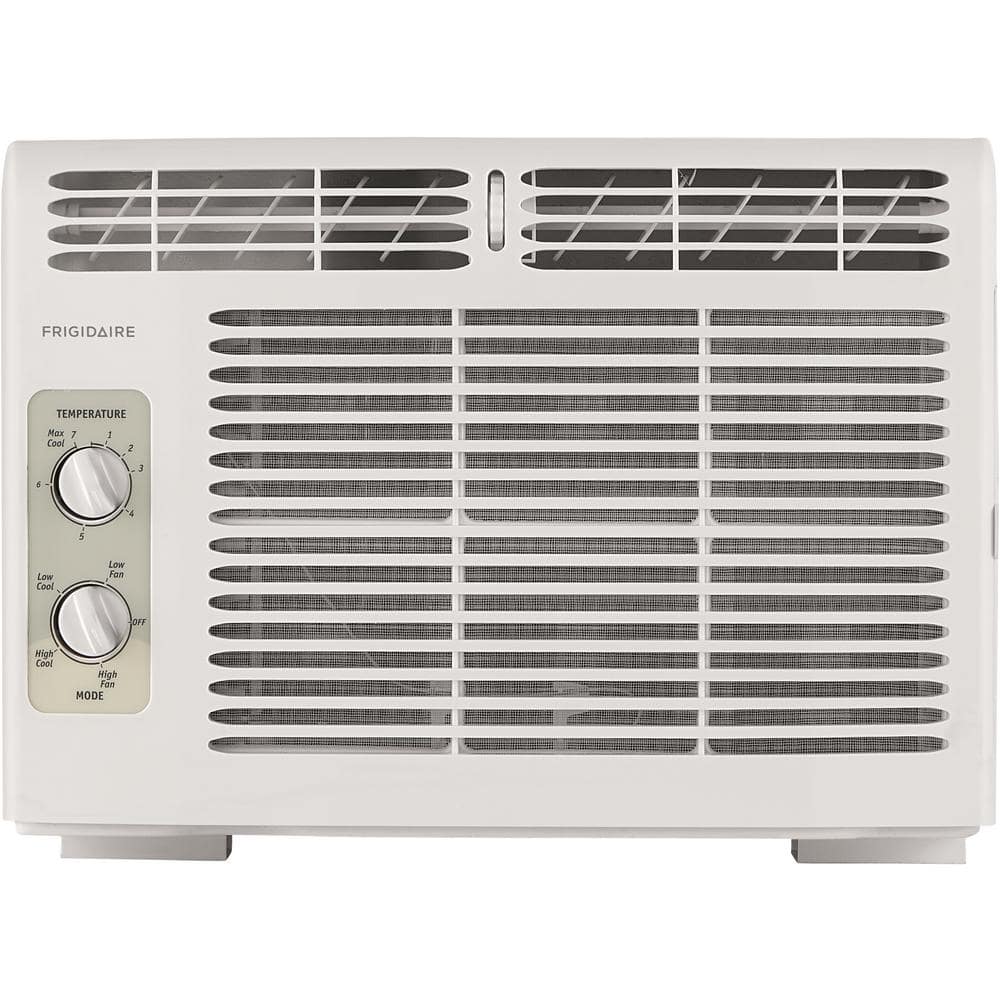
Image Source: images.thdstatic.com
How Many Amps Is A 5000 Btu Air Conditioner? What To Know
A 5000 BTU air conditioner typically uses around 4 to 5 amps when it is running. This size AC unit is one of the smallest you can buy. It is designed for cooling small spaces like a single room. To work safely, these units usually need a standard 15-amp household circuit operating at 115 volts. Getting the right electrical setup is key to make sure the air conditioner runs well and does not cause problems.
What BTU Means for Cooling Power
Let’s talk about what BTU means first. BTU stands for British Thermal Unit. It is a way to measure heat energy. In air conditioners, BTU tells you how much heat the unit can remove from a space in one hour. A higher BTU number means the air conditioner can cool a larger area.
A 5000 BTU air conditioner is made for small rooms, maybe up to 150 square feet. Think of a small bedroom or a home office. It is not meant for cooling a large living room or an open-plan space.
Power Needs: Watts, Volts, and Amps Explained Simply
Electricity flows into your air conditioner to make it work. We measure this flow and power in a few ways:
- Volts (V): This is like the push or pressure that makes electricity move through wires. Most homes in the US use 115 volts or 120 volts for standard wall outlets. Large appliances might use 230 or 240 volts, but small AC units usually use 115 volts.
- Amps (A): This is like the amount of electricity flowing through the wires, like how much water flows through a pipe. It tells you the current. This is what we want to figure out for the 5000 BTU AC unit.
- Watts (W): This is the total power the appliance uses. It tells you how much work the electricity is doing. Watts are related to volts and amps. A simple way to think about it is: Watts = Volts x Amps.
So, if we know the watts and volts, we can figure out the amps.
Finding the Amps for a 5000 BTU AC
For a 5000 BTU air conditioner, the power use is quite low compared to bigger units. These are often called small AC units.
Typical Wattage for a Small AC Unit
A 5000 BTU air conditioner often uses between 400 and 600 watts when it is running. The exact number depends on how well the unit is made and its energy efficiency rating (like the EER or SEER). A unit with a higher efficiency rating will use fewer watts to produce the same amount of cooling (BTUs).
Calculating Amps from Watts and Volts
Most 5000 BTU units use 115-volt power. We can use our simple formula (Watts = Volts x Amps) to get an idea of the amps. We can change the formula to find amps: Amps = Watts / Volts.
Let’s use a range of watts to see the range of amps:
- If a unit uses 400 watts at 115 volts:
Amps = 400 watts / 115 volts
Amps is about 3.5 amps. - If a unit uses 600 watts at 115 volts:
Amps = 600 watts / 115 volts
Amps is about 5.2 amps.
This shows that the running amps for a 5000 BTU unit will likely be in the range of 3.5 to 5.5 amps.
Average Amp Draw for 5000 BTU
Based on common models, the average amp draw 5000 BTU air conditioner is usually right around 4 to 5 amps while it’s actively cooling. This number is often listed on the unit’s energy guide sticker or its nameplate.
Startup Amps vs. Running Amps
It is important to know that an air conditioner uses more amps for a short time when it first turns on. This is called the startup surge or starting amps.
Think of pushing a heavy box across the floor. It takes a big push to get it moving (startup). Once it is moving, it takes less effort to keep it sliding (running).
The compressor in an AC unit is like that heavy box. It needs a lot of power to start. The startup amps can be 1.5 to 3 times higher than the running amps.
- If a unit runs at 5 amps, its startup surge might be 7.5 to 15 amps.
This short surge is normal, but it is why the electrical circuit needs to handle more than just the running amps.
Factors That Change Amp Draw
The actual number of amps a 5000 BTU unit pulls can change based on a few things:
- Model and Brand: Different manufacturers design their units slightly differently. This affects efficiency and power use.
- Energy Efficiency Rating (EER/SEER): Units with higher ratings use less power (fewer watts and amps) to cool.
- How Hot It Is: If the room is very hot, the AC works harder to cool it down. This might make it use slightly more amps within its normal range.
- Condition of the Unit: An older or dirty unit might work harder and use more power than a new, clean one.
- Voltage Fluctuations: Small changes in the house’s voltage can slightly affect the current (amps) drawn.
Even with these factors, the running amps for a 5000 BTU unit usually stay within that 4 to 5.5 amp range. The main thing to care about for wiring is the maximum amps it might draw, including the startup surge.
Why Amperage Matters: Electrical Requirements
Knowing the amperage is very important for safety and making sure the unit works right. You need to connect the air conditioner to an electrical circuit that can handle the power it needs.
Air Conditioner Circuit Size
Electrical circuits in your home are designed to handle a certain amount of electrical flow (amps). If you try to pull too many amps from a circuit, the wires can get hot. This is a fire risk. Circuit breakers or fuses are safety devices. They stop the flow of electricity if it goes above the safe limit for that circuit.
For a 5000 BTU window air conditioner operating at 115V, you need to know the right air conditioner circuit size. Most small window AC units like this are designed to plug into a standard 15-amp household circuit.
Minimum Circuit Ampacity AC
Electrical codes give rules for how big a circuit needs to be for appliances. For air conditioners, they talk about ‘minimum circuit ampacity’ and ‘maximum overcurrent protection’.
- Minimum Circuit Ampacity: This is the lowest number of amps the wiring and parts of the circuit must safely handle continuously. For an AC unit, this is usually calculated based on the unit’s maximum listed amp draw (sometimes called the RLA – Rated Load Amps). Electrical codes often require the circuit wiring to handle at least 125% of the AC unit’s RLA.
- Maximum Overcurrent Protection: This is the biggest size breaker or fuse allowed on that circuit. It is there to protect the wires from getting too hot.
For a 5000 BTU AC unit with a running amp draw around 4-5 amps and a potential peak (RLA) listed closer to maybe 6-7 amps, the calculation might look like this:
Minimum Circuit Ampacity = RLA * 1.25
Minimum Circuit Ampacity = 6 amps * 1.25 = 7.5 amps (example)
This means the circuit wiring needs to be rated for at least 7.5 amps continuous use. Standard household wiring for a 15-amp circuit is usually thick enough (like 14-gauge wire) to easily handle this.
The maximum overcurrent protection (the breaker size) is usually chosen to be slightly larger than the minimum circuit ampacity, but also rated to protect the wire. For a circuit with wire rated for at least 15 amps continuous, a 15-amp breaker is the standard and safe choice.
So, for a 5000 BTU, 115V air conditioner amps generally mean it is okay to plug into a standard 15-amp circuit. However, there is a key point: it should be a dedicated circuit.
The Need for a Dedicated Circuit
What is a dedicated circuit? It is a circuit that only powers one appliance. In this case, the 5000 BTU air conditioner should be the only thing plugged into the outlets on that circuit.
Why is this important?
- Avoid Overloading: If you plug the AC unit and other high-power items (like a vacuum cleaner, a toaster, or a hair dryer) into the same circuit, the total amps needed can easily go over the 15-amp limit. This will cause the breaker to trip.
- Handles Startup Surge: A dedicated circuit ensures that the brief, higher startup amps of the AC do not compete with the power needs of other devices. This lowers the chance of tripping the breaker when the AC turns on.
- Safety: Overloaded circuits can overheat wiring, even if the breaker does not trip immediately (due to nuisance tripping tolerance). A dedicated circuit prevents this risk for the AC unit’s power needs.
Most building codes and air conditioner manuals recommend or require a dedicated circuit for air conditioners, even small ones.
Checking Your Circuit
Before plugging in your 5000 BTU AC:
- Find the breaker box: This is usually in a basement, garage, or utility closet.
- Identify the circuit: If you have labeled breakers, look for one that says “Living Room Outlets,” “Bedroom 2,” etc.
- Test the circuit: Plug a lamp into the outlet where you plan to put the AC. Go to the breaker box and turn off the breaker you think powers that outlet. If the light goes off, that’s the breaker.
- Check other outlets: See what other outlets or lights are on the same circuit by testing them with the breaker off.
- Check the breaker size: Look at the switch on the breaker. It will have a number like 15 or 20. You need at least a 15-amp breaker for a 5000 BTU unit.
- Is it dedicated? If other things (especially other outlets in different parts of the room or house, or lights) are on that same breaker, it is not a dedicated circuit.
If the circuit is not dedicated or is less than 15 amps, you might need an electrician to install a new dedicated 15-amp circuit for the air conditioner outlet.
Grasping Energy Usage and Costs
The 5000 BTU AC power consumption affects your electricity bill. Watts tell you how much power is used at any moment. To figure out how much energy is used over time, we use kilowatt-hours (kWh).
1 kWh is 1000 watts used for one hour.
Let’s estimate the energy usage 5000 BTU AC unit might have.
- Assume the unit uses an average of 500 watts when running.
- Assume your electricity rate is $0.15 per kWh (this varies a lot by location).
If the AC runs for 8 hours a day:
- Daily watt-hours = 500 watts * 8 hours = 4000 watt-hours
- Daily kilowatt-hours = 4000 / 1000 = 4 kWh
- Daily cost = 4 kWh * $0.15/kWh = $0.60
If it runs like this for 30 days in a month:
- Monthly kWh = 4 kWh/day * 30 days = 120 kWh
- Monthly cost = 120 kWh * $0.15/kWh = $18.00
This is just an example. How much energy usage a 5000 BTU AC actually has depends on:
- How many hours per day it runs.
- What temperature you set it to.
- How hot the room is and how well-insulated it is.
- The unit’s specific wattage and efficiency.
- Your electricity rate.
Even so, compared to larger air conditioners or central AC, the energy usage 5000 BTU AC is quite low, making them cost-effective for cooling small, specific areas.
Deciphering BTU to Amp Conversion
Sometimes people ask for a direct “BTU to amp conversion.” It is important to understand that you cannot directly convert BTUs to amps using a simple fixed number. BTUs measure cooling power (energy removed), while amps measure electrical current.
The link between BTUs and amps involves:
- Energy Efficiency: How many watts (electrical power) it takes to produce a certain number of BTUs (cooling power). This is shown by the EER (Energy Efficiency Ratio) or SEER (Seasonal Energy Efficiency Ratio). A higher EER/SEER means better efficiency – fewer watts per BTU.
- Voltage: The voltage the unit uses (usually 115V or 230V).
The relationship is roughly:
- BTUs / EER = Watts (This tells you the electrical power needed)
- Watts / Volts = Amps (This tells you the current flow)
So, to find the amps from BTUs, you really need to know the unit’s efficiency (EER/SEER) and its voltage.
Example:
* A 5000 BTU unit with an EER of 11.0 (a decent efficiency for this size).
* It uses 115V power.
- Watts = 5000 BTU / 11.0 EER ≈ 455 watts
- Amps = 455 watts / 115 volts ≈ 3.96 amps
This calculation gives you the running amps. It is a good way to see why different 5000 BTU models might have slightly different amp draws – their efficiency (EER) is different.
So, while there isn’t a direct “BTU to amp conversion” factor, the unit’s efficiency and voltage are the missing pieces needed to relate the two.
Air Conditioner Electrical Requirements Summary
Let’s put together the key electrical requirements for a 5000 BTU, 115V window air conditioner:
- Voltage: Typically 115V or 120V. Uses a standard household plug (NEMA 5-15P).
- Running Amps: Usually 4 to 5.5 amps.
- Startup Amps: Can be 10 to 15 amps (briefly).
- Wattage: Usually 400 to 600 watts.
- Circuit Type: Dedicated circuit recommended/required.
- Circuit Size: 15-amp minimum circuit ampacity AC wiring (like 14-gauge).
- Breaker Size: 15-amp breaker or fuse.
- Outlet Type: Standard 3-prong grounded 15-amp outlet (NEMA 5-15R).
This ensures the small AC unit watts and amps can be handled safely by your home’s electrical system.
Comparing 5000 BTU Amps to Bigger Units
Knowing the amperage for a 5000 BTU unit helps show how much more power larger AC units need.
| AC Size (BTU) | Typical Voltage | Typical Running Amps | Typical Wattage | Typical Circuit Requirement |
|---|---|---|---|---|
| 5,000 | 115V | 4 – 5.5 A | 400 – 600 W | 15A Dedicated Circuit |
| 8,000 | 115V | 6 – 8 A | 700 – 900 W | 15A Dedicated Circuit |
| 12,000 | 115V or 230V | 9 – 12 A (115V) / 5-7A (230V) | 1000 – 1400 W | 15A (115V) or 20A (230V) Dedicated Circuit |
| 15,000+ | 230V | 7 – 10 A | 1500 – 2000+ W | 20A Dedicated Circuit |
As you can see, larger units use more watts and amps, or they switch to higher voltage (230V) to keep the amp draw lower for the same amount of power. A 5000 BTU unit is on the low end of the amperage scale, making it generally easier to accommodate electrically, provided you use a dedicated circuit.
Placing Your 5000 BTU AC Unit Safely
When you install your window air conditioner, think about where you plug it in.
- Use a Wall Outlet: Plug it straight into a wall outlet.
- Avoid Extension Cords: Do not use extension cords. Extension cords can overheat and cause fires, especially with appliances that draw significant power like AC units. The small AC unit watts might seem low, but the startup surge is too much for most extension cords.
- Check the Outlet Condition: Make sure the outlet is in good shape. It should be a modern, grounded, three-prong outlet. It should not feel loose or show signs of heat damage.
- Ideal Location: Place the unit near the dedicated 15-amp outlet you plan to use.
Following these steps helps ensure the air conditioner operates safely and reliably according to its air conditioner electrical requirements.
Fathoming the Unit’s Nameplate
Every air conditioner has a label, often called a nameplate or rating plate. This is usually on the side or back of the unit, or maybe in the instruction manual. This label has important electrical information.
Look for these things on the nameplate:
- Voltage (V): Should say 115V or 120V.
- Frequency (Hz): Should say 60 Hz for North America.
- Watts (W): Might list the running wattage.
- Amps (A) or RLA (Rated Load Amps): This is the running amp draw.
- LRA (Locked Rotor Amps): This is the startup amp surge. It’s the amps the compressor needs when it’s trying to start but can’t move (like if it’s stuck or just beginning to turn). This number is high but only lasts a fraction of a second.
- Minimum Circuit Ampacity: Might be listed.
- Maximum Overcurrent Protection: Might be listed (e.g., “Max Fuse or Breaker: 15A”).
This nameplate information is the most accurate source for the specific electrical needs of your unit. Always check it to be sure, rather than relying only on general numbers for a 5000 BTU unit. The values on the nameplate define the minimum circuit ampacity AC needs and the breaker size.
Why This All Matters for You
Knowing about the amps, watts, and circuit needs for your 5000 BTU air conditioner helps you:
- Stay Safe: Avoid electrical hazards like overheating wires and fires by using the right circuit.
- Prevent Tripped Breakers: Ensure your AC unit runs without constantly turning off the power in the room.
- Get Good Performance: An AC unit on a proper circuit gets the power it needs to cool effectively.
- Meet Code: Follow electrical codes for safe installation in your home.
So, while a 5000 BTU unit has a low average amp draw 5000 BTU, paying attention to the 115V air conditioner amps and ensuring you have the correct air conditioner circuit size is crucial. The air conditioner electrical requirements, even for a small unit, should be taken seriously.
Frequently Asked Questions (FAQ)
Is 5 amps a lot for an air conditioner?
No, 4 to 5 amps is very low for an air conditioner. This is why 5000 BTU units are considered small AC units. Larger ACs use much more power and draw significantly more amps, or they use higher voltage to manage the current.
Can I plug a 5000 BTU AC into any outlet?
You can physically plug it into any standard 115V outlet. However, it is strongly recommended to plug it into a dedicated 15-amp circuit. Plugging it into a circuit that also powers other appliances might cause the breaker to trip or overload the circuit.
Does a 5000 BTU AC unit need a special plug?
No, a typical 5000 BTU, 115V unit uses a standard 3-prong grounded plug (NEMA 5-15P). You do not need a special 230V outlet or a different type of plug.
What size breaker do I need for a 5000 BTU air conditioner?
A 15-amp breaker is usually needed. This matches the requirement for a 15-amp dedicated circuit, which is standard for these small units. Always check the unit’s nameplate for the maximum overcurrent protection recommended.
What is the difference between running amps and startup amps?
Running amps are the amps the unit uses continuously while the compressor is cooling. Startup amps are a higher spike in amps the unit uses for a fraction of a second when the compressor first turns on. The startup amps are much higher than the running amps.
How many watts does a 5000 BTU AC use?
A 5000 BTU air conditioner typically uses between 400 and 600 watts when running. This is the 5000 BTU AC power consumption.
Can I use an extension cord for a 5000 BTU air conditioner?
No. You should not use an extension cord for an air conditioner, even a small 5000 BTU unit. Air conditioners draw a continuous heavy load and have a high startup surge, which can overheat and damage most extension cords, creating a fire hazard. Always plug the unit directly into a wall outlet on a proper circuit.
Does the EER rating affect the amps?
Yes. EER (Energy Efficiency Ratio) affects the amps. A unit with a higher EER uses fewer watts to provide the same cooling (BTUs). Since Amps = Watts / Volts, fewer watts mean fewer amps drawn, assuming the voltage stays the same. A higher EER means lower 5000 BTU AC power consumption and lower amp draw.
Is BTU to amp conversion a direct formula?
No, you cannot directly convert BTUs to amps with just one number. You need to know the unit’s efficiency (EER) and the voltage it uses. The formula involves first finding the watts from BTUs and EER (Watts = BTU / EER), and then finding amps from watts and volts (Amps = Watts / Volts).
What is minimum circuit ampacity AC?
Minimum circuit ampacity is the lowest continuous current rating the electrical circuit wiring and components must safely handle for the air conditioner. Electrical codes often set this higher than the AC’s running amps (like 125% of the RLA) to account for continuous load and safety margins. For a 5000 BTU unit, this calculation usually supports using standard 15-amp circuit wiring.
Why is a dedicated circuit important for even a small AC?
A dedicated circuit ensures the air conditioner has its own power line. This prevents the circuit from being overloaded by the AC’s power needs (especially the startup surge) plus the power needs of other devices plugged into the same circuit. It’s a key safety measure to avoid tripping breakers and potential fire hazards from overheated wiring.
In summary, a 5000 BTU air conditioner is efficient for small spaces and its electrical needs are manageable. It generally draws 4-5 running amps at 115V and requires a dedicated 15-amp circuit for safe and reliable operation. Checking the unit’s nameplate for specific electrical requirements and ensuring proper installation are key steps before you start cooling your room.